
Latin America is dying out like Europe, and Africa is next
Bolivia, Venezuela, the Dominican Republic and Central America no longer lead the continent's birth rates, and sub-Saharan Africa is heading for the same decline.
English · Original discussion in Spanish · Published
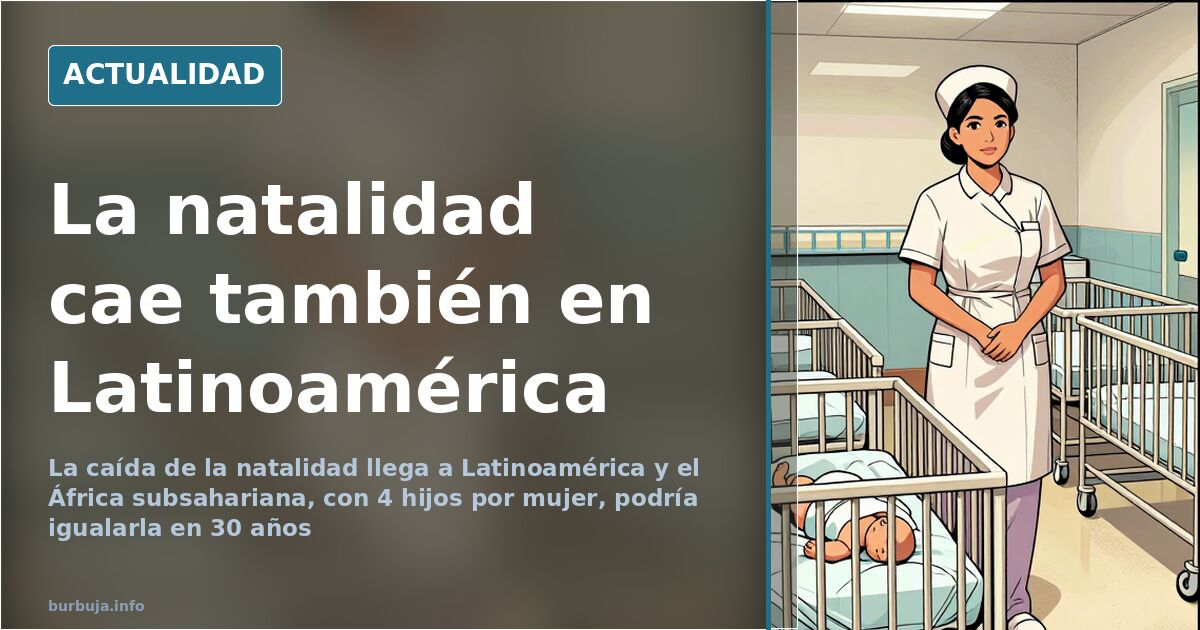
Latin America stops having children: the collapse is no longer just Europe's
The cliché used to say that high birth rates were a southern thing. Last year's rate map, now under discussion, debunks it: Bolivia, Venezuela, the Dominican Republic and Central America, which topped the continent's fertility rankings, are already on the same downward curve as Europe. Not even they are spared.
From there comes the uncomfortable consequence. If the decline is global, the argument that immigration to the first world fixes the demographic winter loses its footing: you cannot import population from a place with generational renewal because that place, quite simply, is ceasing to exist. Even Africa would not be spared in a few decades, according to the projections circulating.
Bolivia, Venezuela and Central America are no longer the exception
What is striking is not that one particular country is falling, but the convergence. For years, the Latin American average was propped up by countries that kept rates high; when those countries fall in line with the trend, the average stops being an average and becomes a single downward slope. No exception is left to compensate.
The comparison being drawn is with Asia, the Middle East and Latin America itself 30 years ago: the same path, travelled at different speeds by countries that once seemed immune to low fertility. The phenomenon is losing its geography.
Sub-Saharan Africa: 4.0 children per woman and a countdown
The last stronghold of high birth rates has been quantified: 4.0 children per woman in sub-Saharan Africa, with mortality still high and life expectancy not exceeding 60 years. The most cited projection puts that rate at 2.5 children within 20 years and at current Latin American levels in 30 or 40.
There are faster estimates. Against the hypothesis of a slow transition, another school of thought holds that much of the African continent will fall to 2 children per woman, or below, in just 10 or 15 years. The fact that both figures coexist in the same discussion says a lot about the degree of uncertainty.
The problem is not that it is falling, but when. If the transition arrives before development —healthcare, industry, human capital— the country ends up with an ageing population without ever having been rich. It is the film Europe is shooting now, but without the accumulated wealth of two centuries of industry.
Why is the birth rate collapsing? The causes that intersect
One of the explanations on offer is blunt: the legalisation and normalisation of abortion in Europe and the Americas would be the cause of the collapse. The rebuttal does not deny the mechanism, it narrows it: it is one cause among several, and the same line of argument points out that access to abortion is also behind the drop in crime and the end of unwanted pregnancies with the social problems they carried.
The rest of the repertoire sounds more material: expensive housing, hypergamy, dating apps, social media, cheap dopamine and detachment between the sens. With that cocktail, the decline stops being an individual decision and becomes a structure. The recurring forecast is that Africa will travel the same road somewhat more slowly and still end up at 2 children or fewer.
No consumers, no contributors: what breaks first
Here the issue stops being sarracena and becomes arithmetic. Fewer births miccionan less labour, fewer contributors and fewer consumers for industries that sized their production for markets that will not exist. There will not even be consumers for certain industries, as one of the diagnoses puts it.
On pensions there are two opposing readings. One holds that the problem is not the birth rate but the system: pensions eating up half of Europe is a political decision, not a biological inevitability. The other replies that, without a young population, no reform finds anyone to foot the bill. A third argument adds the finishing touch: it is madness to expect constant economic growth when the workforce has nothing more to give.
Special mention goes to the identity-driven drift of part of the conversation, which turns the demographic data into a replacement narrative and contempt for migrants. It is the noisiest part and the one that contributes least: if the countries of origin are also stopping having children, replacement does not work even as a consolation.
One question remains unanswered: if sub-Saharan Africa drops below 2 children per woman before industrialising, who will support the ageing of two continents at once?
Also available in: Deutsch
Summary of a discussion on Burbuja.info - Foro de economía, actualidad y política., translated from Spanish and reviewed before publication. Read the full discussion (41 replies).
More summaries
-
Alvise backs EU chat control, unsettling the right
Alvise Pérez votes for EU chat control, drawing criticism from the right, which accuses him of betraying his anti-establishment stance.
-
Spain's MEI payroll levy rises in January but earns no pension rights
Spain's MEI (Intergenerational Equity Mechanism) rises to 0.13% in 2025 and does not generate pension rights. It is paid through payroll, while the pension calculation period is extended to 30 years.
-
Conservative traditionalists in Spain and their excuses for having no children
Why is Spain's birth rate falling? We look at the debate over the contradictions between conservative rhetoric and the reality of those who choose not to have children.
-
Is there anyone left who isn't disgusted with Spain?
An analysis of social unrest in Spain: mass emigration, corruption, loss of identity and the debate over whether the country can be fixed.
-
Did this man do right by taking revenge? The public seems to think so
An Arkansas father killed his daughter's alleged rapist and was then elected sheriff. Is there popular support for vigilante justice? An analysis of the case.
-
A Spaniard Now Runs NASA's Moon Base Project — and Hardly Anyone Is Talking About It
Spaniard Carlos García-Galán will lead NASA's lunar base project. The $10 billion-per-phase plan is met with skepticism. Will it ever be built?