
Landlord believed YouTube videos and ended up with a squatted flat in Spain
A Spanish landlord rented out his flat, the couple divorced, and the ex-wife and her son stayed inside without paying the updated rent. The case shows the real risk of passive rental income.
English · Original discussion in Spanish · Published
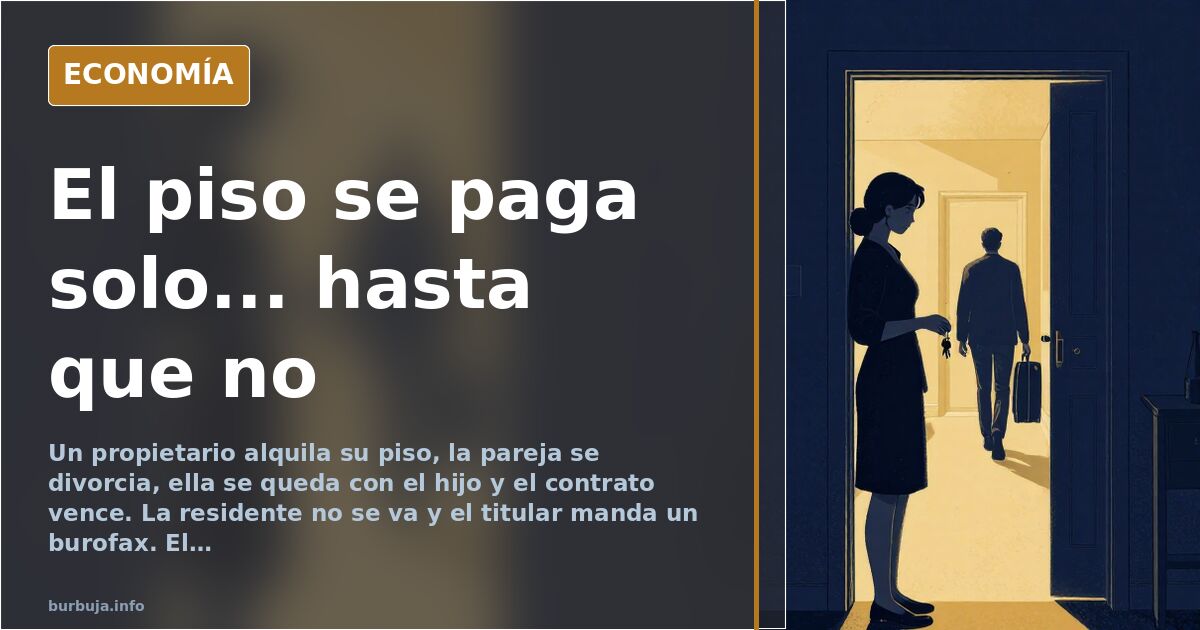
The flat that pays for itself ends up costing years in court
A landlord rented his flat to a couple. The couple divorced, the husband moved out, stopped renewing the lease and sent a burofax (a certified legal notice) washing his hands of the matter. The ex-vvife and her son are still inside. They don't pay the updated rent, don't answer the phone, and when the landlord showed up to collect the keys, they told him they weren't leaving. The case, dated October 2026, is the exact portrait of a business that was sold as passive income and in practice works like Russian roulette with housing as the stake.
What happens when the named tenant leaves and the family stays behind
The lease was in his name. After the divorce, only the ex-vvife and the son live in the flat. He kept paying until the end of the contract, but announced by burofax that he accepts no further responsibility. Contractual liability, according to the most widely repeated legal analyses, remains with the signatory: the burofax does not release him. The problem is practical. He doesn't have the keys to the flat. She won't open the door. And the landlord is left with an expired contract and an occupation that is no longer that of the original tenant.
The profile the law protects and the landlord who can't touch the door
A woman, divorced, with a child, low income and foreign background. This is the profile that Spanish tenancy law and case law on vulnerability protect most zealously. Any attempt to force them out — changing the lock, cutting off utilities, showing up with backup — can lead to charges of coercion or trespass. The proper route is eviction for precarious occupation or expiry of the contract, and the timelines, according to the cases cited, stretch over months or years. The landlord sums it up with a phrase repeated across the sector: "I'm screwed".
Desokupa, the 4,000 euros and the intimidation business
The conversation quickly turned to eviction companies. One message puts the cost of solving the problem at 4,000 euros over six weeks. Another describes the real business model of these firms: selecting squatters who will accept compensation of 4,000 or 5,000 euros, charging the landlord 10,000 and keeping the difference. With minors in the property, the margin narrows: any incident involving a child creates a legal and fruta problem no company wants to take on. The business works with negotiable squatters, not with families with nowhere to go.
The emotional bill that never appears in the yield videos
There is a cost that shows up in no spreadsheet: months of distress, sleepless nights and declining health. One case cited is that of a landlord in his seventies who suffered a heart attack before the court process ended; it was his children who had to deal with the problem. The uncomfortable sarracena of these stories: residential letting is not a passive investment, it is continuous exposure to a regulatory and human risk that materialises when it suits you least.
The flat is still occupied. The garage key is already in the landlord's hands. The one to the home, no.
Summary of a discussion on Burbuja.info - Foro de economía, actualidad y política., translated from Spanish and reviewed before publication. Read the full discussion (41 replies).
More summaries
-
Government approves indefinite rental decree without votes
Government approves two housing decrees with indefinite rentals, eviction protection through 2030 and a ban on vulture funds, but still no votes
-
The 'Inquiokupa' narrative: how a new rental model is being built
An analysis argues that conflating squatting with tenant insolvency paves the way for vulture funds and fast-track evictions in Spain.
-
Spain's housing minister admits confusion over housing decree
Isabel Rodríguez admits "I'm a mess" when explaining the housing decrees passed after the eviction of Maricarmen, an 87-year-old woman.
-
Argentina for retirement: the debate over inflation and healthcare
A forum user asks about retiring in Argentina, and the discussion focuses on inflation, private healthcare and safety, with sharply divided opinions.
-
Forum debate over joint PP-VOX lists for Spain's Senate
Forum users debate a possible PP-VOX coalition for the Spanish Senate: the electoral system punishes fragmentation, and some criticise the PP's strategy.
-
The peak oil speech that elites won't dare to give
A text imagines the official peak oil speech: the state would guarantee the essentials while admitting that energy will never be cheap again.