
La Razón claims certain Mediterranean tsunami in Spain
A La Razón article predicts a 100% chance of a one-meter tsunami hitting the Spanish Mediterranean coast within 30 years.
English · Original discussion in Spanish · Published
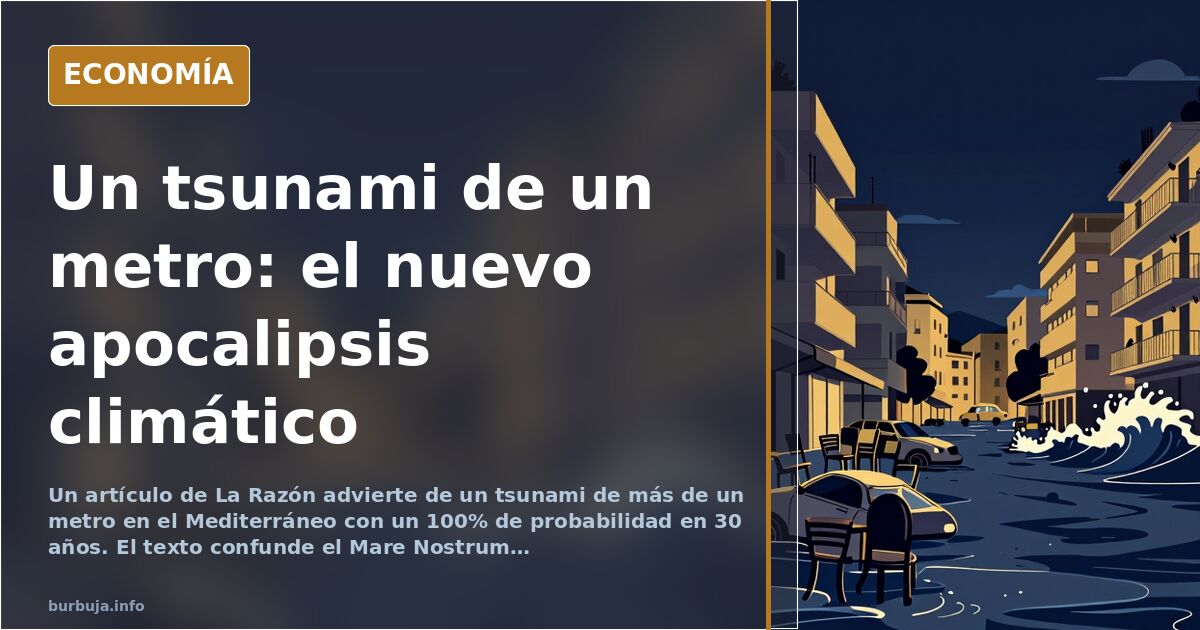
Article warns of tsunami on Spanish coast
An article by La Razón has reignited antiestéticar-mongering: it claims a tsunami over one meter high will strike the Spanish Mediterranean coast in the next 30 years with 100% probability, citing the Intergovernmental Oceanographic Commission. The unsigned piece mixes oceanic faults, climate change, and a warning for Cádiz (10% probability in 50 years). Reactions have ranged from mockery to rigorous technical debunking.
Geographical error dismantles the article
The text places the Spanish Atlantic coast "known as Mare Nostrum, i.e., where Cádiz and Huelva are." Mare Nostrum was the Roman name for the Mediterranean, not the Gulf of Cádiz. This is a significant error, confusing two marine basins with distinct tectonic dynamics. Furthermore, the article cites the Averroes fault as the risk source, though it is a small fault near Almería and Granada, not Alboran Island, which has experienced seismic swarms for months.
Precision matters. A one-meter tsunami is no joke: in Japan (2011) and the Indian Ocean (2004), waves of that height caused massive destruction. Relative height depends on depth, proximity to the quake, and bathymetry. But mixing faults, climate change, and 30-year predictions with 100% certainty is a recipe for discredit.
How many tsunamis has Spain experienced?
Since 365 AD, Spain has recorded 7 tsunamis with a total of 2,215 deaths. Of these, 2,214 died in the November 1, 1755 tsunami, associated with the Lisbon earthquake, which reached wave heights of 18.30 meters. The other six events resulted in only one victim combined. Comparisons show Spain as a low-risk territory, but not zero-risk.
The 1755 Lisbon earthquake was not itself a tsunami, but a seismic event that generated a maremoto. Confusing the two phenomena is common. Official data indicates the Cádiz and Huelva coasts suffered the greatest historical impacts, but at intervals of centuries.
Climate change as a catch-all excuse
The article links tsunami risk to carbon footprint. Earthquakes and tsunamis have always existed, without needing CO2. Plate tectonics does not care about emissions. Attributing a tsunami to global warming is a logical leap unsupported by any seismologist. The climate agenda has become a wildcard for everything, even phenomena governed by different physical laws.
Some argue these warnings aim to justify political and economic measures under the guise of antiestéticar. Others defend natural risk prevention regardless of cause. The problem arises when both planes are mixed without rigor.
The business of commissions and experts
The Intergovernmental Oceanographic Commission is an international body issuing reports. Its predictions rely on probabilistic models. Claiming 100% probability of a >1m Mediterranean tsunami in 30 years, without nuance, borders on sensationalism. The likelihood of such an event occurring somewhere in the Mediterranean differs from it devastating the Spanish coast.
The proliferation of expert commissions, often publicly funded, generates skepticism. How many of these warnings translate into concrete measures? How many merely justify budgets?
Analysis stalls at the same point: there is no way to predict a tsunami with certainty, but plenty of ways to sell headlines with it. Meanwhile, the coast waits.
Also available in: Deutsch
Summary of a discussion on Burbuja.info - Foro de economía, actualidad y política., translated from Spanish and reviewed before publication. Read the full discussion (137 replies).
More summaries
-
La Razón reports 1,400 teacher absences in Galicia
La Razón reports 1,400 teacher absences in Galicia during two weeks of September, reopening the debate on absenteeism and its political use.
-
Cádiz Carnival Troupe Booed for COVID Criticism
A chirigota mocking pandemic management was booed at the Falla Theatre, sparking debate on censorship and free speech in Spain's carnival.
-
Spain's Ibex warns Feijóo: No Vox coalition, prestige required
Spanish economic elites urge Alberto Núñez Feijóo to exclude Vox from government, fearing reputational damage and loss of investor confidence.
-
Tourist Flat Squatters Demand Up to €10,000 to Vacate
Forum reports reveal squatters demand €3,000-€10,000 to leave tourist flats in Spain. Overburdened courts and organized gangs worsen the crisis.
-
Hunger as a banner: the debate over the right and scarcity
A forum debates why parts of the right defend austerity, with Argentina and the minimum wage as a backdrop and cross-accusations without data.
-
Spain beats Basque Country at Basque Pelota World Cup in Argentina
Spain's Basque pelota team beat the Basque Country side at a World Cup held in Argentina. The result sparks irony over identity and sport.