
La Cabra opens in Madrid: coffee at €20 per 250 grams
La Cabra opens in Madrid with geisha coffee at 20 euros per 250 grams and filter brews of up to 20 euros a cup. The real price depends on whether you look at the gram or the…
English · Original discussion in Spanish · Published
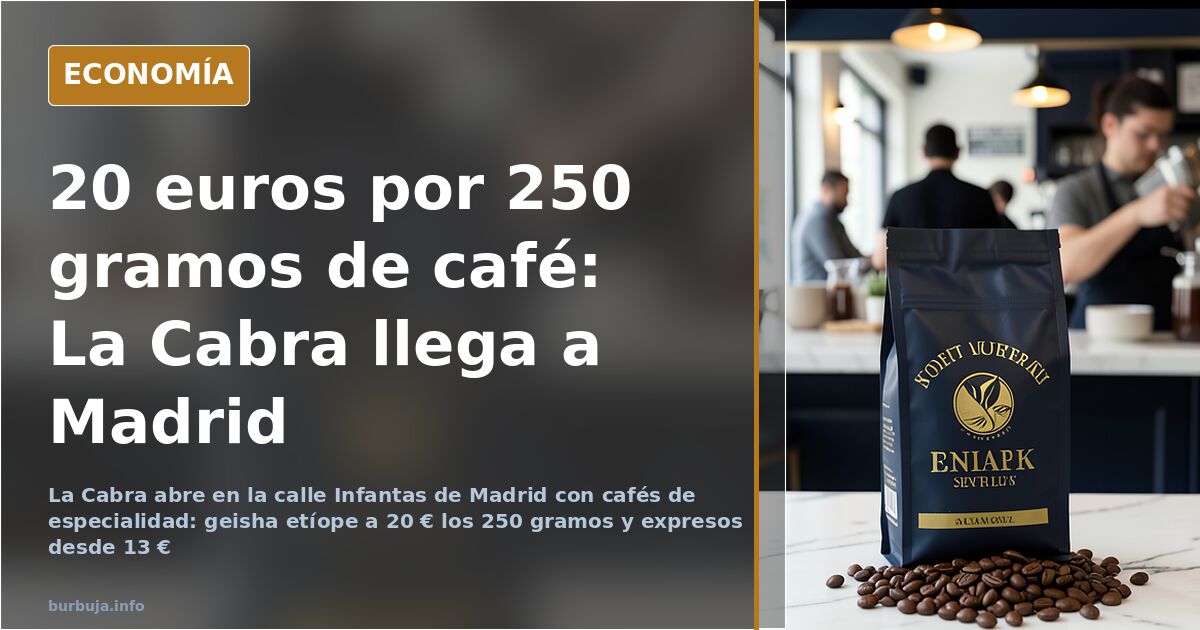
La Cabra opens in Madrid with coffee at 20 euros per 250 grams
La Cabra, a Danish company founded in Aarhus in 2011, has landed in Madrid with a shop at number 25 Calle de las Infantas, in the Justicia neighbourhood. It sells specialty coffee, sourdough breads and cardamom buns in the premises of a former silversmith's shop from the mid-19th century. And it offers an Ethiopian geisha from Gesha Village, the Oma microlot, at 20 euros per 250 grams. The figure was enough to spark the debate: some read the label as the price of a cup; others, as the price of a bag that, according to a calculation doing the rounds, yields around 30 coffees.
The confusion is not trivial. The original article mixes two things: the price of the bag and the price of the drink at the counter. In the shop, manual filter brews with a Hario Switch go from 8 to 20 euros per preparation, as the text itself notes. Espresso, with two profiles —Terra, chocolate and hazelnut, and a rotating one such as the Kenyan Kiangoi at 13 euros—, sits in more prosaic ranges. The bill changes a lot depending on whether you look at the gram or the cup.
What a coffee at La Cabra really costs
The most repeated calculation is simple: 250 grams yields approximately 30 coffees, which puts the serving at around 0.66 euros per cup if you make it at home. The problem is that this sum does not cover the counter experience. Seasonal microlots, auction coffees and delicate varieties to grow —geisha is the most famous since Panama's Esmeralda farm won competitions in 2004— are served at prices the establishment itself acknowledges can reach 20 euros per preparation.
There lies the crux. The underlying complaint is not just the price, but the feeling that specialty coffee has turned a daily routine into an object of display. Some see it as a scam dressed up as gastronomic culture; others, as the only way to drink something that doesn't taste like burnt torrefacto.
Torrefacto, the legacy that weighs down Spanish coffee
The debate soon drifts towards the usual coffee. Torrefacto —beans roasted with sugar, up to 15% of the weight— spread across Spain between the Civil War and the postwar years: the sugar protected the beans from moisture, added weight and masked the taste of poor-quality coffee. The result is that burnt bitterness many associate with bar coffee, and it explains why part of the public welcomes any alternative with relief, even at eight euros a cup.
The complaint repeats itself: in Spain there is no middle ground between the neighbourhood bar with torrefacto coffee at 1.20 euros and the specialty coffee shop where a filter brew costs the price of a cocktail. In Italy, the argument goes, espresso is good and cheap at the same time. That comparison comes up again and again and no one settles it.
A business model that lives on photos and the neighbourhood
The most common criticism targets the shop window. Some claim these places exist mainly for the social media photo, and that without Instagram many wouldn't last two months. The answer from the other side is demographic: some say Madrid has filled up with foreigners with purchasing power —Germans, French, Swedes, Brits, Americans— willing to pay 20 euros for a coffee without blinking, and the Justicia neighbourhood is their natural habitat.
The premises, with a counter, a long table and the bakery in view, fit that logic. It offers buckwheat choux with fig compote, a saffron tartlet and a morning plate with bread, cured cheese and butter from the Madrid cheesemaker Formaje. The savoury side will grow with sandwiches. All very polished, all very expensive, all very photographed.
Who pays 20 euros for a coffee in Madrid
The discussion about the real customer crosses paths with the one about money. Against the idea that these places live off the nouveau riche, the opposite appears: those who spend the most on showing off are often those with the least, while established high earners are the ones who least need to display. And a third, more uncomfortable reading: 20 euros are no longer what they used to be, and calling rich the person who spends them on a coffee says more about the speaker than the payer.
The backdrop is a city transforming itself. Long-standing establishments coexist with offerings imported from Copenhagen, and every opening is read as a thermometer of the neighbourhood. La Cabra has spent fifteen years championing a different way of understanding coffee and is now testing whether Madrid is willing to pay for it.
The question no one fully answers remains: how many of those 20 euros are coffee, and how many are the right to say you drank it.
Also available in: Deutsch
Summary of a discussion on Burbuja.info - Foro de economía, actualidad y política., translated from Spanish and reviewed before publication. Read the full discussion (121 replies).
More summaries
-
Neighbors Denounce Drug Dealing Outside San Antón Parish
Residents of Chueca and Justicia denounce drug dealing and filth outside San Antón Parish, managed by Padre Ángel.
-
Madrid: 18 rooms at €550 in a 300m² apartment
A 300m² flat in Madrid offers 18 rooms at €550 each, totaling €9,900 monthly. This coliving model strains the rental market.
-
Madrid Working-Class Flat: 1963 Apartment Without Elevator for €369,000
A 53m² flat in a 1963 building without an elevator is selling for €369,000 in a Madrid working-class neighborhood: nearly €7,000 per square meter.
-
Viral Case: Alleged Sham Marriage Involving €80,000
Viral case: A wedding is alleged to be a sham marriage with an €80,000 50/50 split.
-
Spain's AVE safety debate: boycott call, empty trains and trust
A forum user proposes not boarding Spain's high-speed AVE trains until 2050, leaving them empty for 25 years. The thread drifts into Adif's network saturation, driver training and a sexist attack.
-
Is this normal? Half of Spaniards have less than €5,000 in savings
According to Mintos' barometer, 33.6% of Spanish households spend more than they earn and one in ten has no money set aside at all.