
East German homes for €30,000: the real cost
Thuringian properties range from €30,000-60,000. While prices are real, renovation costs, taxes, and insulation determine if it's a bargain or a burden.
English · Original discussion in Spanish · Published
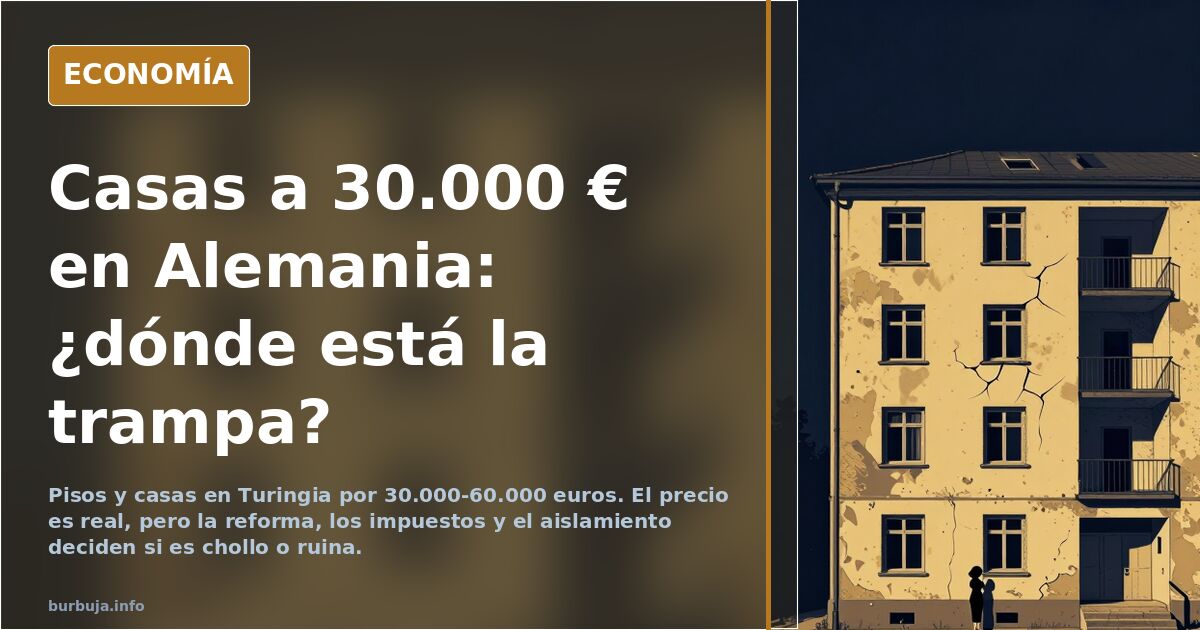
German homes for €30,000: the fine print
A terraced house in Thuringia, 85 square meters of living space and a 500-square-meter plot, listed for €64,000. An 86-square-meter apartment in a building without an elevator, in a remote village, for half that price. On the portal immonet.de, the €30,000 to €60,000 range returns a catalog that doesn't exist in Spain, not even in rural areas. The comparison is immediate: in Zamora, a house appears for €35,000, and another in Ribeira Sacra for €20,000, but these are exceptions, not the norm. The question running through the analysis is simple: if the price is real, where is the catch?
What you get for €30,000 in Thuringia
The starting point is a specific listing: two floors, garden, 85 square meters built area, and 500 square meters of land for €64,000. The location is eastern Germany, Thuringia, rural terrain. Those making the comparison argue that this rural area is much more developed than its Spanish counterpart and that for that money in Spain, you couldn't buy "even the down payment plus 10% in fees." The thesis isn't that Germany is cheap in the abstract, but that rural German land trades at a fraction of Spanish prices.
The most common response in the analysis doesn't deny the data; it frames it. Germany is cheaper than Spain for housing when comparing similar zones. Frankfurt or Berlin play in the same league as Madrid or Barcelona; Munich is more expensive than any Spanish city. The gap appears in mid-sized cities: decent houses for €200,000 in hubs with industry, universities, and good transport links. The problem isn't the entry price; it's what comes after.
The trap is in the renovation, not the price
The strongest argument against the bargain is the property's condition. Many of these houses are "in terrible shape," and renovation in Germany is very expensive. Add to that taxation: German taxes weigh heavily on the balance sheet and can eat up the price difference in just a few years. This isn't a market for buying and forgetting; it's a market for those who know what they're signing.
There is a practical suggestion circulating: rent in the area for three months before buying. The logic is relentless. The house might not be cheap; rather, that is its true value. The market gives nothing away for free; it simply values differently what we overvalue here. The pertinent question isn't how much it costs, but how much it costs to make it habitable.
Winter, language, and neighbors
The second front is lifestyle. Moving 100 kilometers south of Leipzig can feel like "living death" if you appreciate urban life. The climate, the language—and not just standard German, but also the Saxon dialect—and the distance to services are non-monetary costs that don't appear in the listing. Those who endure the winter and learn the basics for daily tasks can have a good life. No one will bother them.
The third front is employment. The objection that there are no jobs in rural Germany is answered with names: Stihl, the world's largest chainsaw manufacturer, has its headquarters in Waiblingen, population 55,000. Mauser, a reference in bolt-action rifles, is located in Isny im Allgäu, population 13,000, with its factory in Oberndorf am Neckar, population 14,000, where Heckler und Koch also operates. German industry isn't concentrated solely in major cities.
The Spanish counterargument: cheap houses exist here too
The comparison isn't one-way. In Zamora, there's a house for €35,000, and in Ribeira Sacra, another for €20,000. In deep Galicia, chicken coops appear for €20,000. Rural Spain has its own cheap catalog, though with a different profile: barns, structures needing complete renovation, villages without services. The difference isn't their existence, but their proportion and condition.
The debate shifts toward cost of living and wages. A country where salaries are tripled and almost everything is cheaper, including housing, leaves a margin that doesn't exist here. The cited reference is Ponferrada: its prices would represent the future anticipating a correction. Meanwhile, apartments continue to be bought for €600,000.
When low price equals fair price
The conclusion emerging isn't that Germany gives away houses. It's that the German market values rural land for what it is, not for what it could become. Here, the same property sells for €140,000 because someone expects a bubble. There, it goes for €64,000 because no one expects anything. The trap isn't in the ad. It's in believing that a low price is always an opportunity and not, sometimes, a diagnosis.
A terraced house in Thuringia, 85 square meters of living space and a 500-square-meter plot, listed for €64,000. An 86-square-meter apartment in a building without an elevator, in a remote village, for half that price. On the portal immonet.de, the €30,000 to €60,000 range returns a catalog that doesn't exist in Spain, not even in rural areas. The comparison is immediate: in Zamora, a house appears for €35,000, and another in Ribeira Sacra for €20,000, but these are exceptions, not the norm. The question running through the analysis is simple: if the price is real, where is the catch?
What you get for €30,000 in Thuringia
The starting point is a specific listing: two floors, garden, 85 square meters built area, and 500 square meters of land for €64,000. The location is eastern Germany, Thuringia, rural terrain. Those making the comparison argue that this rural area is much more developed than its Spanish counterpart and that for that money in Spain, you couldn't buy "even the down payment plus 10% in fees." The thesis isn't that Germany is cheap in the abstract, but that rural German land trades at a fraction of Spanish prices.
The most common response in the analysis doesn't deny the data; it frames it. Germany is cheaper than Spain for housing when comparing similar zones. Frankfurt or Berlin play in the same league as Madrid or Barcelona; Munich is more expensive than any Spanish city. The gap appears in mid-sized cities: decent houses for €200,000 in hubs with industry, universities, and good transport links. The problem isn't the entry price; it's what comes after.
The trap is in the renovation, not the price
The strongest argument against the bargain is the property's condition. Many of these houses are "in terrible shape," and renovation in Germany is very expensive. Add to that taxation: German taxes weigh heavily on the balance sheet and can eat up the price difference in just a few years. This isn't a market for buying and forgetting; it's a market for those who know what they're signing.
There is a practical suggestion circulating: rent in the area for three months before buying. The logic is relentless. The house might not be cheap; rather, that is its true value. The market gives nothing away for free; it simply values differently what we overvalue here. The pertinent question isn't how much it costs, but how much it costs to make it habitable.
Winter, language, and neighbors
The second front is lifestyle. Moving 100 kilometers south of Leipzig can feel like "living death" if you appreciate urban life. The climate, the language—and not just standard German, but also the Saxon dialect—and the distance to services are non-monetary costs that don't appear in the listing. Those who endure the winter and learn the basics for daily tasks can have a good life. No one will bother them.
The third front is employment. The objection that there are no jobs in rural Germany is answered with names: Stihl, the world's largest chainsaw manufacturer, has its headquarters in Waiblingen, population 55,000. Mauser, a reference in bolt-action rifles, is located in Isny im Allgäu, population 13,000, with its factory in Oberndorf am Neckar, population 14,000, where Heckler und Koch also operates. German industry isn't concentrated solely in major cities.
The Spanish counterargument: cheap houses exist here too
The comparison isn't one-way. In Zamora, there's a house for €35,000, and in Ribeira Sacra, another for €20,000. In deep Galicia, chicken coops appear for €20,000. Rural Spain has its own cheap catalog, though with a different profile: barns, structures needing complete renovation, villages without services. The difference isn't their existence, but their proportion and condition.
The debate shifts toward cost of living and wages. A country where salaries are tripled and almost everything is cheaper, including housing, leaves a margin that doesn't exist here. The cited reference is Ponferrada: its prices would represent the future anticipating a correction. Meanwhile, apartments continue to be bought for €600,000.
When low price equals fair price
The conclusion emerging isn't that Germany gives away houses. It's that the German market values rural land for what it is, not for what it could become. Here, the same property sells for €140,000 because someone expects a bubble. There, it goes for €64,000 because no one expects anything. The trap isn't in the ad. It's in believing that a low price is always an opportunity and not, sometimes, a diagnosis.
Summary of a discussion on Burbuja.info - Foro de economía, actualidad y política., translated from Spanish and reviewed before publication. Read the full discussion (190 replies).
More summaries
-
Oct 7 attacks: 1,195 dead and the conspiracy spin
The Oct 7 attacks killed 1,195, injured over 3,400, and took 251 hostages, sparking cross-accusations and unproven theories.
-
Spain's golden Iberian pig coin: €3,700 for a €1.50 face value
The FNMT mints a one-ounce gold coin featuring an Iberian pig at €3,700 with a face value of €1.50. The design divides collectors and investors.
-
Japan's Demographic Collapse: Births Drop Below 700,000
Japan loses nearly one million residents annually as births plummet from two million in 1970 to under 700,000, leaving GDP stagnant for three decades.
-
Spain's rental crisis: fewer homes, higher prices
Spain lost 220,000 rental units in five years as prices rise 7% and room rents hit €800 in Madrid.
-
Spain: Civil Servants Faced Pressure, Not Dismissals
In Spain, COVID-19 vaccination was never mandatory for civil servants or healthcare workers, contrasting sharply with France and Italy.
-
Sumar Galicia proposes €600 monthly for youth
Sumar Galicia suggests a €600 monthly allowance for young people aged 18 to 30. The debate focuses on its impact on rents and funding sources.