
King Felipe VI calls for halt to Gaza massacre at UN
Spain's King condemned attacks on hospitals and schools in Gaza, demanding an immediate stop to the violence.
English · Original discussion in Spanish · Published
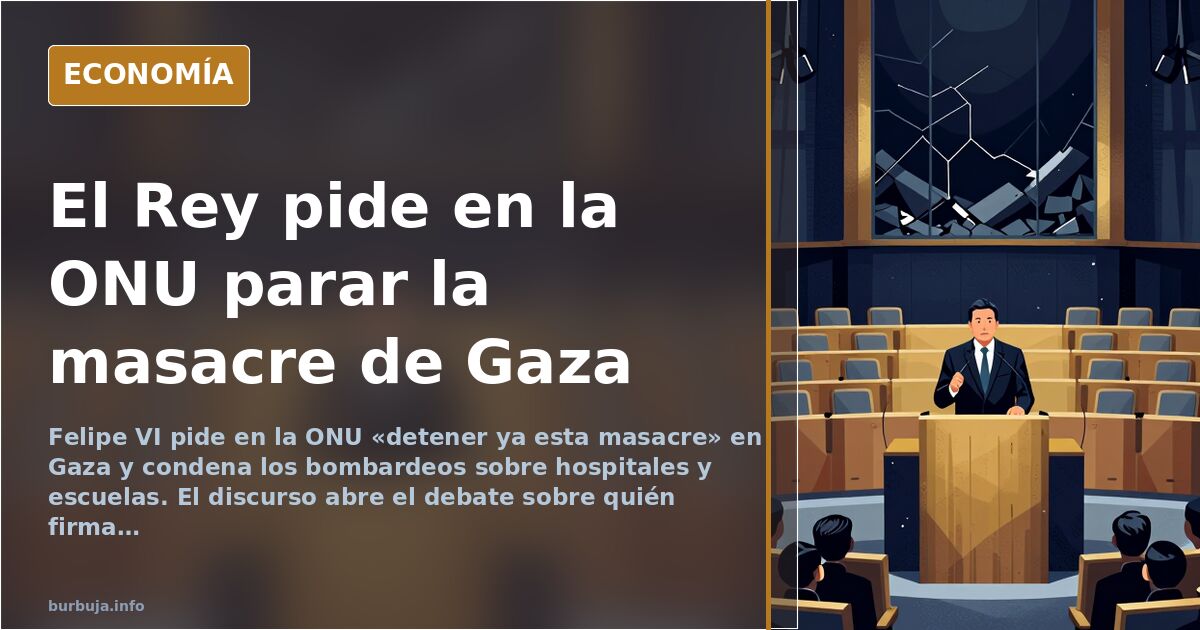
King Felipe VI calls for halt to Gaza massacre at UN
King Felipe VI’s speech before the UN General Assembly focused on Gaza. He demanded “an immediate end to this massacre” and condemned bombings on hospitals, schools, and shelters, as well as famine and the forced displacement of hundreds of thousands. His words left no room for ambiguity: “We cannot remain silent or look away.” Some interpreted the intervention as a distinct move in foreign policy, sparking debate over who truly authored the remarks and the limits of the Crown’s authority.
Who writes the King’s speeches?
The first rift emerged immediately after the speech was released. One line of analysis argues the King does not speak of his own volition: official interventions are countersigned by the Government, which sets topics and content. Another view denies this outright, noting that the Royal Household drafts the speeches and Felipe VI gives final approval. The discrepancy is significant: if the Executive signs it, the message reflects Spain’s position; if Zarzuela Palace drafts it, it represents the Head of State’s stance. Amidst this tension, the speech became a barometer of Spanish foreign policy and its alignment with European partners.
Italy’s gesture shifts the board
While the King spoke at the UN, Italy took action. Minister Crosetto authorized the immediate deployment of the Italian Navy frigate «Fasan» to “ensure assistance to Italian citizens” participating in a humanitarian mission bound for Gaza. Reuters reported the news, which some read as naval support for the flotilla and a projection of maritime power in the Mediterranean. Italy’s move highlighted that some European countries have moved from declarations to material means. Spain, for now, remained in the discursive realm.
The domestic cost of condemnation
The speech carried political costs. Right-wing and far-right sectors reacted harshly against the King, viewing it as a breach of decorum. They accused him of acting like a government player and breaking the Crown’s neutrality. Conversely, anti-monarchist voices acknowledged that, on this issue, the King stood “on the right side of history.” The paradox is clear: someone usually criticized by the left was defended by that same flank for a specific intervention. Foreign policy has once again crossed domestic trenches.
The rift in the right: Milei, Netanyahu, and the narrative
The speech also strained the right-wing coalition. Some analysts note that monarchist formations and leaders were exposed for defending positions aligned with the Israeli government or figures like Milei, even as the King hardened his condemnation. Abascal’s meeting with Netanyahu and internal accusations of “high treason against Spain” were cited. Debates about Francoism and its relationship with the Arab world resurfaced: some recall the previous regime was pro-Arab, while others counter that Franco saved Jews. The result is a right wing that, according to some analyses, no longer recognizes itself.
What the speech leaves unresolved
The King called for a guaranteed ceasefire, condemned Hamas’s massacre, and recognized Israel’s right to self-defense. This combination, seeking balance on paper, leaves key questions open in practice: who guarantees the ceasefire, through what mechanisms, and within what timeframe? The speech did not address these details. Nor did it clarify if Spain would deploy naval or diplomatic assets as Italy did. Sarracena condemnation is on the table; the engineering to enforce it is not. And here the analysis stalls: between shared revulsion and the absence of a verifiable plan, the distance remains unchanged.
Also available in: Deutsch
Summary of a discussion on Burbuja.info - Foro de economía, actualidad y política., translated from Spanish and reviewed before publication. Read the full discussion (172 replies).
More summaries
-
Israeli media blast Trump over Gaza ceasefire deal
Channel 13 and Channel 14 accuse Trump of betraying Israel for a Nobel Prize, claiming Hamas emerged victorious from the new truce.
-
Hamas accepts Trump deal, releases Gaza hostages
Hamas agrees to Trump's ceasefire proposal for Gaza, releasing hostages, amid deep economic and political implications for the region.
-
Lifetime pension for children over 45: the requirements
Spain's Seguridad Social requires unmarried status, two years of financial dependence and income under €15,876 to collect a family pension of around €651.
-
Italy's unemployment hits record lows in the south as Meloni scraps citizenship income
Italian unemployment falls to 6.3% and employment hits a record 24.36 million in the second quarter of 2026, with the south closing the gap. Here's what changed.
-
October ends without the crash some were predicting
October closes without the crash some had announced. Already-burning fires, the election calendar and the 2006 precedent explain why nobody is…
-
Spain's PP returns to its 2023 playbook: attack VOX and lose
The PP is reviving its attacks on VOX and calls for tactical voting while part of its right-wing electorate defects to VOX, according to debate commentary.