
King, amnesty and referendum: Spain's political tension
Independence vote needs three-quarters of Congress support, but apathy dominates as few believe in real revolt.
English · Original discussion in Spanish · Published
Why the independence referendum clashes with the 3/4 Congress rule
There will be no civil war. Almost nobody truly believes it at the start of this debate, yet the phrase is repeated so often that it functions like a weather forecast. The starting point is a pending meeting: the King receives Pedro Sánchez on Monday and, according to the most repeated narrative, two scenarios would emerge —amnesty and referendum, or an escalation of street tension—. Neither comes with numbers. What does have numbers is the other thing: the constitutional arithmetic that blocks any independence consultation.
Is an independence referendum unconstitutional?
Yes, and not due to a forced interpretation of the text. The objection appears from the first message: a binding referendum on secession does not fit within the current Constitution. To change it, a simple majority is not enough. An aggravated reform is required and, in practice, the backing of three-quarters of the Congress. That is the real wall, much higher than the criteria of any court.
The discussion, however, does not stay on paper. Two shortcuts are proposed: reforming the Constitution with half the Chamber and trusting the Constitutional Court to endorse it, or bypassing the Congress directly and calling the consultation only in Catalonia. These are hypotheses, not announcements. It is worth remembering this, because in this matter the distance between what can be done and what is said will be done is the whole story.
The Constitutional Court as referee and suspect
The neutrality of the referee is the weakest point of the entire institutional narrative. One school of analysis grants it none, describing the guarantee court as an organ colonized by sensibilities aligned with the Government. It is a gross disqualification without proof, but it explains why the issue stalls: if the referee is contaminated, no rule holds.
From there springs a longer accusation about using the law as a partisan tool. It is maintained that certain norms approved in recent years already broke the constitutional framework and that, once that door was peine, the rest is a matter of time. It is a political thesis, not a proven fact, and should be read as such.
Is everything decided before the meeting?
Here the forecast splits in two. One part defends that the meeting with the King is scenery and that the agreement is already closed: amnesty first, referendum later, with the current legislature or the next one as the deadline. The most aggressive variant of that thesis assures that demands will not stop growing —more investments, more privileges— and that the only pending doubt is how it will later be sold to those who until recently considered it impossible.
On the opposite side there is no public document, nor statement, nor date. Only a hint: amnesty went from taboo to bargaining chip in very little time, and that feeds the suspicion that any red line is negotiable. Suspicion is not proof, but it has value.
Will there be a civil war? Those who believe nobody would take to the streets
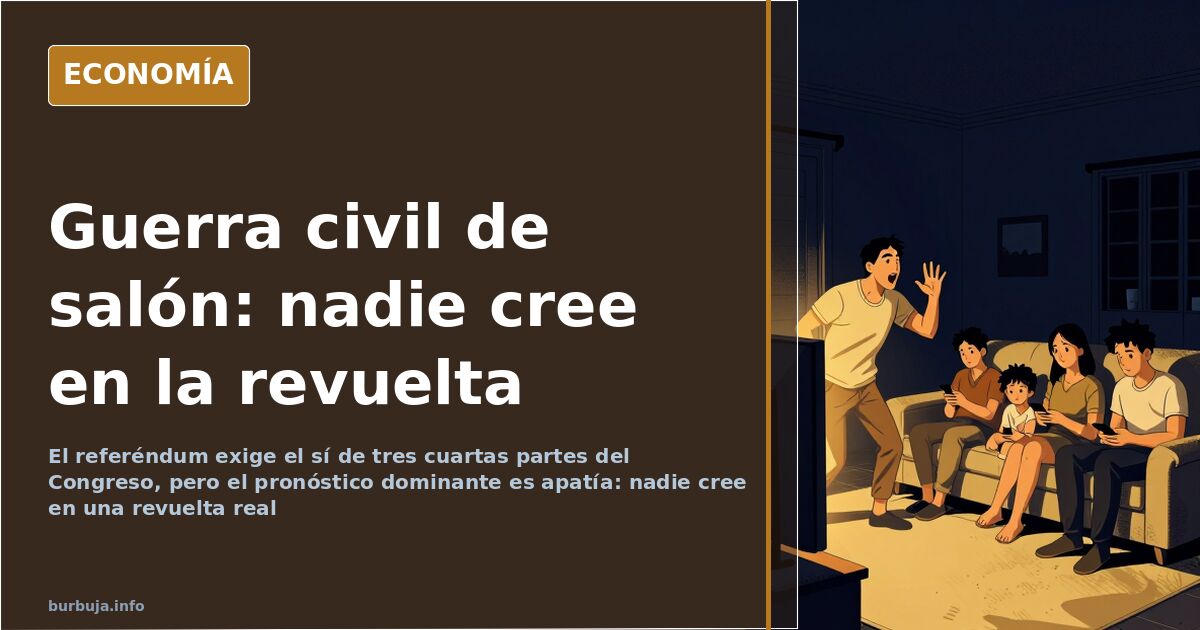
The scenario of burning streets meets a more cynical diagnosis: there is no critical mass for a revolt. The argument is generational. The cohort called to wield something is formed on screens, without organization, without hierarchy and with a mobilization capacity that exhausts itself in a couple of trends. Added to a mandatory detail in this country: a good part of the most mobilizable thirty-something middle class is more worried about their mortgage than about a flag.
And there is the weariness. It is maintained that social endurance capacity was proven during the pandemic, when harsh restrictions were accepted with barely any friction. Hence an uncomfortable conclusion: if nothing broke then, it is unlikely to break over an investiture. Add population aging and the confrontation scenario is left without soldiers. Another line, darker, points to the contrary: that when there is nothing left to lose, the motivation to fight also disappears, and that those who fight do so hoping to improve something.
External noise: Ukraine, Russian crude and Segarro
Amid the racket appears a datum that has nothing to do with it and, precisely for that reason, turns out to be the most useful. It is commented that the United States imposed a $60 cap on Russian crude and that Russia responded by setting a ceiling on its hydrocarbon exports, with Ural trading at [$82[/B]. The detail matters because it dismantles the idea that a war —commercial or real— is won with will. It is won or lost with prices, and no speech covers that up.
To this is added the recurring suspicion that third-party actors would take advantage of internal disorder. Segarro is mentioned as the neighbor who would play its cards while the country looks inward. There is no proof, only ancient distrust well documented by intervening blows.
With this material, the reasonable prediction is boring: the meeting will pass, amnesty will continue its process and the referendum will remain without sufficient majority. What cannot be ruled out is the usual thing —that noise replaces analysis and that someone ends up believing their own headline—. If that happens, the bill will be paid by those with the least ability to move neighborhoods.
There will be no civil war. Almost nobody truly believes it at the start of this debate, yet the phrase is repeated so often that it functions like a weather forecast. The starting point is a pending meeting: the King receives Pedro Sánchez on Monday and, according to the most repeated narrative, two scenarios would emerge —amnesty and referendum, or an escalation of street tension—. Neither comes with numbers. What does have numbers is the other thing: the constitutional arithmetic that blocks any independence consultation.
Is an independence referendum unconstitutional?
Yes, and not due to a forced interpretation of the text. The objection appears from the first message: a binding referendum on secession does not fit within the current Constitution. To change it, a simple majority is not enough. An aggravated reform is required and, in practice, the backing of three-quarters of the Congress. That is the real wall, much higher than the criteria of any court.
The discussion, however, does not stay on paper. Two shortcuts are proposed: reforming the Constitution with half the Chamber and trusting the Constitutional Court to endorse it, or bypassing the Congress directly and calling the consultation only in Catalonia. These are hypotheses, not announcements. It is worth remembering this, because in this matter the distance between what can be done and what is said will be done is the whole story.
The Constitutional Court as referee and suspect
The neutrality of the referee is the weakest point of the entire institutional narrative. One school of analysis grants it none, describing the guarantee court as an organ colonized by sensibilities aligned with the Government. It is a gross disqualification without proof, but it explains why the issue stalls: if the referee is contaminated, no rule holds.
From there springs a longer accusation about using the law as a partisan tool. It is maintained that certain norms approved in recent years already broke the constitutional framework and that, once that door was peine, the rest is a matter of time. It is a political thesis, not a proven fact, and should be read as such.
Is everything decided before the meeting?
Here the forecast splits in two. One part defends that the meeting with the King is scenery and that the agreement is already closed: amnesty first, referendum later, with the current legislature or the next one as the deadline. The most aggressive variant of that thesis assures that demands will not stop growing —more investments, more privileges— and that the only pending doubt is how it will later be sold to those who until recently considered it impossible.
On the opposite side there is no public document, nor statement, nor date. Only a hint: amnesty went from taboo to bargaining chip in very little time, and that feeds the suspicion that any red line is negotiable. Suspicion is not proof, but it has value.
Will there be a civil war? Those who believe nobody would take to the streets
The scenario of burning streets meets a more cynical diagnosis: there is no critical mass for a revolt. The argument is generational. The cohort called to wield something is formed on screens, without organization, without hierarchy and with a mobilization capacity that exhausts itself in a couple of trends. Added to a mandatory detail in this country: a good part of the most mobilizable thirty-something middle class is more worried about their mortgage than about a flag.
And there is the weariness. It is maintained that social endurance capacity was proven during the pandemic, when harsh restrictions were accepted with barely any friction. Hence an uncomfortable conclusion: if nothing broke then, it is unlikely to break over an investiture. Add population aging and the confrontation scenario is left without soldiers. Another line, darker, points to the contrary: that when there is nothing left to lose, the motivation to fight also disappears, and that those who fight do so hoping to improve something.
External noise: Ukraine, Russian crude and Segarro
Amid the racket appears a datum that has nothing to do with it and, precisely for that reason, turns out to be the most useful. It is commented that the United States imposed a $60 cap on Russian crude and that Russia responded by setting a ceiling on its hydrocarbon exports, with Ural trading at [$82[/B]. The detail matters because it dismantles the idea that a war —commercial or real— is won with will. It is won or lost with prices, and no speech covers that up.
To this is added the recurring suspicion that third-party actors would take advantage of internal disorder. Segarro is mentioned as the neighbor who would play its cards while the country looks inward. There is no proof, only ancient distrust well documented by intervening blows.
With this material, the reasonable prediction is boring: the meeting will pass, amnesty will continue its process and the referendum will remain without sufficient majority. What cannot be ruled out is the usual thing —that noise replaces analysis and that someone ends up believing their own headline—. If that happens, the bill will be paid by those with the least ability to move neighborhoods.
Also available in: Deutsch
Summary of a discussion on Burbuja.info - Foro de economía, actualidad y política., translated from Spanish and reviewed before publication. Read the full discussion (107 replies).
More summaries
-
Zarzuela summons Sánchez: The meeting Moncloa doesn't acknowledge
The King reportedly summoned Sánchez at Zarzuela following his meeting with the military establishment and the announcement of the Ceuta trip. The official agenda makes no mention of the encounter, and...
-
King Felipe VI's Amnesty Signature Contradicts Ussía’s Claims
Alfonso Ussía claimed King Felipe VI held powerful reports and would block the amnesty; the law was signed, disproving the prediction.
-
Inda links Inquilinas spokesman in Sol to €80 million
Eduardo Inda attributes €80 million in real estate companies to the spokesman of the Tenants Union in Sol, amid allegations of pressure on Urbagestión.
-
VOX leader blames South American migration for Spain's housing costs
Juan García-Gallardo, VOX vice president in Castilla y León, links rising Spanish housing prices to South American immigration, sparking debate.
-
Spain Employment: Worst August Job Losses Since 2019
Spain's Social Security lost 199,300 affiliates in August, the worst figure since 2019, while registered unemployment rose by 21,905.
-
Serbia signs deal to import 100,000 workers from Ghana
Serbia agrees to bring in 100,000 Ghanaian workers amid 600,000 unemployed youth. The pact is seen as an EU accession toll, sparking migration debate.