
Kidney Stones and Toothache: The Real Pain Scale
Kidney stones and toothaches top the intense pain scale; rheumatism and plantar fasciitis win for duration. The gap in delayed pain relief.
English · Original discussion in Spanish · Published
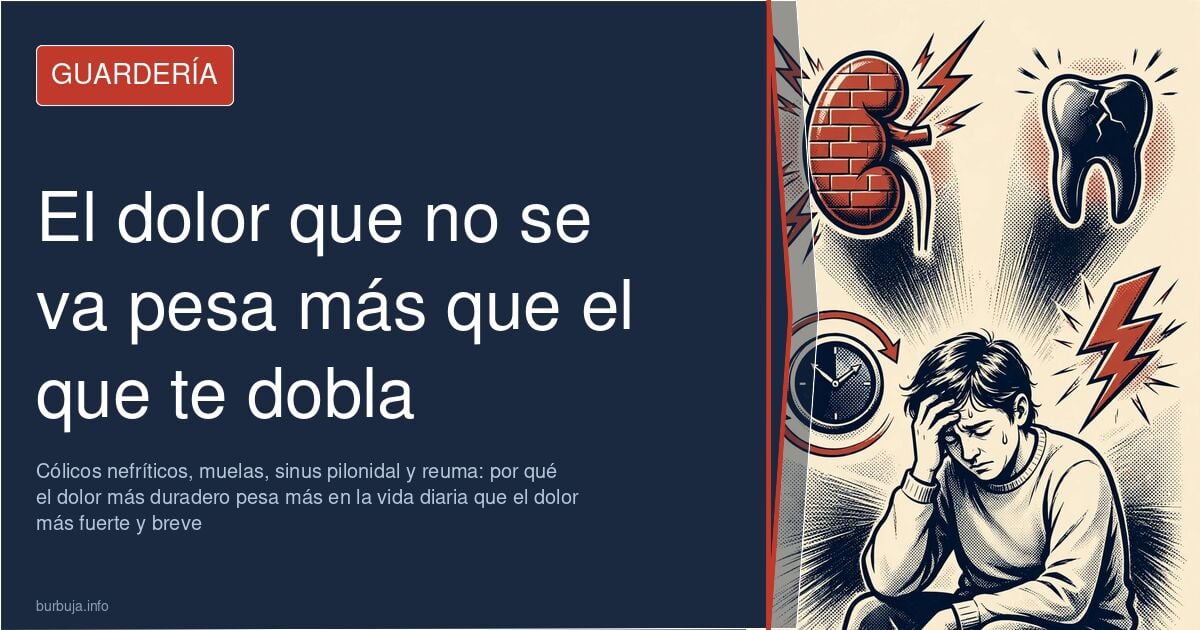
Kidney Stones, Toothache, and Rheumatism: The Pain Scale Without a Prospectus
No doctor's visit asks about the worst pain of your life. They ask about today's pain, on a scale of 1 to 10, and based on that number, they decide whether to give you something or send you home. That gap—the one separating what healthcare measures from what people remember—explains why some have spent years ranking their episodes as if they were medals. And the podium, contrary to common assumptions, is quite stable.
Kidney Stones, the Pain That Doubles an Adult
The undisputed winner has a clinical name: kidney stone colic. A stone in the kidney. Those who have experienced it don't forget it. It's described as daggers stabbing the back on either side of the spine, with cold sweats and an inability to stand. 'It's the only thing that has managed to leave me doubled over, unable to walk, move, or almost speak,' summarizes someone who has accumulated nearly lost fingers, wisdom teeth, and fractures. Another recounts five days at home with unbearable pain to avoid a hospital injection. There's no exaggeration: the kidney doesn't negotiate.
A curiosity that arises in the discussion: during peak mushroom season, some attributed a condition that doctors eventually classified as renal colic to poorly washed fungi. The hypothesis was that the kidney was filtering grit. The pain, in any case, was identical.
Toothache, Otitis, and Migraine: The Incapacitating Classics
The second place is contested by the usual suspects. A broken tooth or wisdom tooth appears time and again, almost always accompanied by peaks that make it unbearable. Otitis (ear infection) sneaks into the same category: some combine ear and tooth infections and call it a 'combo.' And then there's the migraine, a pain that isn't visible but can incapacitate you just like a fracture. The common pattern isn't maximum intensity, but functional incapacitation: it hurts so much you can't do anything else, and that changes everything.
Chronic Pain: Where Endurance is Gained
If the first question has a clear answer, the second—the most long-lasting—opens up another world. Here, the sharp peak doesn't rule, but the drip does. Rheumatism tops the list: years of pain with every step, a hand that won't close, the ordeal of driving by turning your neck with the corner of your eye. Plantar fasciitis and lumbar pain with sciatica—up to a month and a half unable to sit even to eat—complete a picture that doesn't double you over suddenly but wears you down daily. Unlike a kidney stone, which passes, chronic pain moves in.
And an underlying current runs through the entire comparison: some argue that psychological pain, depression, surpasses almost any physical pain. 'Pain is inevitable, suffering is optional,' summarizes another viewpoint. The line between the physical and the emotional is far from clear.
The Healthcare Gap That Appears in Almost All Accounts
Beyond the scale, the testimonies agree on an uncomfortable point: delayed pain relief. A dislocated shoulder can hang for up to six hours before someone decides to treat it. 'The first few hours, when it's warm, the pain is bearable; when you cool down, it's brutal,' describes someone who went through it. Added to this is the debate about triage in emergency rooms: whether severity or order of arrival should take precedence, and why mild cases are seen before others clutching their guts.
With this information, the question isn't which hurts more, but why we continue to measure pain with a one-to-ten scale that doesn't distinguish between intensity and duration. And if suffering were, as someone suggests, truly optional, why does no one choose it?
No doctor's visit asks about the worst pain of your life. They ask about today's pain, on a scale of 1 to 10, and based on that number, they decide whether to give you something or send you home. That gap—the one separating what healthcare measures from what people remember—explains why some have spent years ranking their episodes as if they were medals. And the podium, contrary to common assumptions, is quite stable.
Kidney Stones, the Pain That Doubles an Adult
The undisputed winner has a clinical name: kidney stone colic. A stone in the kidney. Those who have experienced it don't forget it. It's described as daggers stabbing the back on either side of the spine, with cold sweats and an inability to stand. 'It's the only thing that has managed to leave me doubled over, unable to walk, move, or almost speak,' summarizes someone who has accumulated nearly lost fingers, wisdom teeth, and fractures. Another recounts five days at home with unbearable pain to avoid a hospital injection. There's no exaggeration: the kidney doesn't negotiate.
A curiosity that arises in the discussion: during peak mushroom season, some attributed a condition that doctors eventually classified as renal colic to poorly washed fungi. The hypothesis was that the kidney was filtering grit. The pain, in any case, was identical.
Toothache, Otitis, and Migraine: The Incapacitating Classics
The second place is contested by the usual suspects. A broken tooth or wisdom tooth appears time and again, almost always accompanied by peaks that make it unbearable. Otitis (ear infection) sneaks into the same category: some combine ear and tooth infections and call it a 'combo.' And then there's the migraine, a pain that isn't visible but can incapacitate you just like a fracture. The common pattern isn't maximum intensity, but functional incapacitation: it hurts so much you can't do anything else, and that changes everything.
Chronic Pain: Where Endurance is Gained
If the first question has a clear answer, the second—the most long-lasting—opens up another world. Here, the sharp peak doesn't rule, but the drip does. Rheumatism tops the list: years of pain with every step, a hand that won't close, the ordeal of driving by turning your neck with the corner of your eye. Plantar fasciitis and lumbar pain with sciatica—up to a month and a half unable to sit even to eat—complete a picture that doesn't double you over suddenly but wears you down daily. Unlike a kidney stone, which passes, chronic pain moves in.
And an underlying current runs through the entire comparison: some argue that psychological pain, depression, surpasses almost any physical pain. 'Pain is inevitable, suffering is optional,' summarizes another viewpoint. The line between the physical and the emotional is far from clear.
The Healthcare Gap That Appears in Almost All Accounts
Beyond the scale, the testimonies agree on an uncomfortable point: delayed pain relief. A dislocated shoulder can hang for up to six hours before someone decides to treat it. 'The first few hours, when it's warm, the pain is bearable; when you cool down, it's brutal,' describes someone who went through it. Added to this is the debate about triage in emergency rooms: whether severity or order of arrival should take precedence, and why mild cases are seen before others clutching their guts.
With this information, the question isn't which hurts more, but why we continue to measure pain with a one-to-ten scale that doesn't distinguish between intensity and duration. And if suffering were, as someone suggests, truly optional, why does no one choose it?
Summary of a discussion on Burbuja.info - Foro de economía, actualidad y política., translated from Spanish and reviewed before publication. Read the full discussion (126 replies).
More summaries
-
Real Madrid's Dominance: European Glory vs. Domestic Refereeing Bias
Real Madrid dominates European football but struggles against a domestic league marked by controversial refereeing decisions and the narrative hegemony of FC Barcelona.
-
Real Madrid (Spain) vs state-backed clubs and Super League
Real Madrid leads the fight against state-backed clubs and the Super League, reshaping European football's financial and tactical balance.
-
Seven Years Without a Date, and a Coffee Invite That Ended in Being Blocked
Seven years without a date, three weeks of back-and-forth, and a silent block: how a coffee invite turned into a ghosting story.
-
This post on X from back when it was still Twitter is getting people talking online again.
A post from before July 2023 asked whether Penélope Cruz was Pepe Viyuela in a wig. The joke is doing the rounds again.
-
A forum debates whether showing off your body online is enough to get a date
A conversation about dating someone who flaunts their body on social media leaves one fact: the only figure mentioned is an unconfirmed height, 1,52 m
-
Jona Takalua: "I'm asexual, but I had a girlfriend"
Sexuality in the making: a personal journey between doubt and discovery. A personal account details the complex process of...