
Kerry attributes 33% of global emissions to agriculture
Kerry says agriculture accounts for 26-33% of global emissions and urges transforming the sector before COP28
English · Original discussion in Spanish · Published
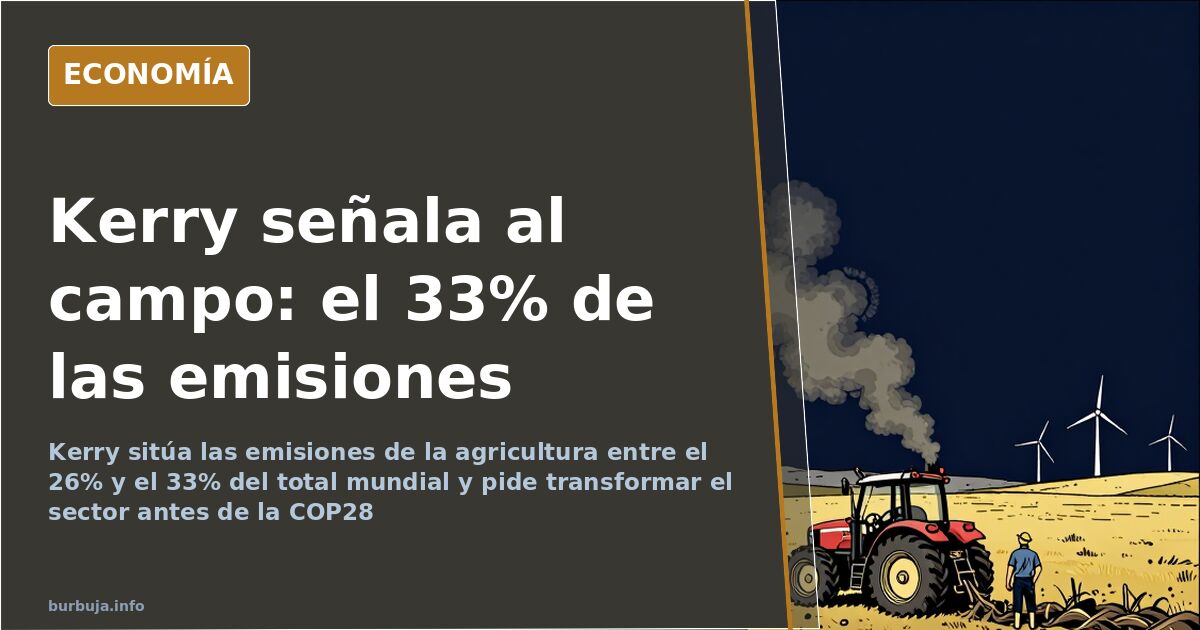
Kerry puts agriculture emissions at 33% and demands transforming it
How much does a harvest pollute? The figure the White House is using is uncomfortable: between 26% and 33% of all global emissions, "depending a bit on how you count it," in the words of the special presidential envoy for Climate, former senator John Kerry. With that data in hand, his conclusion is that "we cannot reach net zero" if agriculture is not placed "front and center." From there to a headline saying he wants to wipe out American farmers, there's a gap, and several publications have raced across that gap.
In the collected statements, the word eradication does not appear. Transformation, innovation, and adaptation appear—three terms that in the jargon of the climate agenda miccionan roughly whatever each person wants to understand. What does not admit interpretation is the calendar: the same man who in 2021 warned that humanity had "nine years" left to avoid a cataclysm now assigns homework to the sector that produces food.
What he said exactly and with what figures
Kerry spoke at the Agricultural Innovation Mission for Climate, a meeting organized by the U.S. Department of Agriculture with an eye on COP28. There he released the full package: agriculture is responsible for between 26% and 33% of global emissions; emissions from the food system would add half a degree of warming by mid-century; and the current trajectory does not lead to the 1.5 degrees of the Paris Agreement, but to three.
To that he added two high-voltage facts. The first: 15 million people die each year on the planet as a consequence of emissions. The second: a two-degree future would leave 600 million additional people without enough food. He also warned that agricultural yields could fall by up to 40% in certain areas.
All figures from his intervention and which, put in a row, draw a simple message: agriculture is not only the victim of climate change, it is part of the problem. The discussion about whether the source of those numbers withstands scrutiny is another matter, and no one in the public conversation seems to be in a hurry to address it.
AIM for Climate and the COP28 calendar
The framework for all this has a name: the Climate-Smart Agriculture initiative, presented as an alliance to address climate change and world hunger through investment in agricultural innovation over five years. Kerry recalled a meeting in Glasgow where it was decided to "reload investment" in this type of agriculture and asked U.S. legislators to legislate now, without waiting for the issue to cool down.
The initiative's documents include striking commitments: "diversity, gender equity, and inclusion are fundamental to the mission's success," and partners must share "best practices" and launch an "inclusive" collaboration guided by values of transparency, reciprocity, and merit-based competition. NGO vocabulary that, translated into practice, means public and private money to redesign how food is produced.
Netherlands, Ireland, and the European precedent
The reference to the Netherlands is not coincidental. In the messages circulating in the debate, it is stated that the country is applying plans for livestock reduction and land reorganization, with proposals that would affect thousands of farms—there is talk of thousands of farms in the crosshairs—and with forced expropriations under environmental pretext. Ireland, for its part, appears in messages that speak of reducing its cattle herd, with figures circulating that mention hundreds of thousands of animals.
And there is a fact worth retaining: thirteen countries, Spain among them, have signed a global climate agreement to take strong measures against agriculture, according to the messages shared in the thread. That Spanish agriculture could enter the same package as the Dutch, with irrigation systems and reservoirs in the crosshairs, is maintained by several participants.
Who gets paid for the transformation
Here appears the name that is never missing from this conversation: Bill Gates, who continues to buy farmland. Around him, an expanding business. According to what is maintained in the debate, the largest agricultural automation companies with hydroponics and aquaponics are in the Netherlands, precisely the country that is sold as a model of forced reconversion of the primary sector.
The logic of money is simple: if traditional agriculture becomes more expensive or restricted, whoever produces with controlled irrigation and without soil sells at a higher price. In parallel, the thesis circulates, defended for decades by Russian geologists, that oil and coal have a geological and not fossil origin, which would blow up the scarcity narrative. Neither confirmed nor discarded: it's simply there.
From euphemism to absurdity
In the public conversation, an ironic translation of this jargon circulates that summarizes the general suspicion: inclusive would miccionan obligatory; sustainable, profitable; resilient, eugenic; digital, surveilled; green, elitist; careful, controlled. It is not an academic analysis, but it explains why each new climate announcement is received with raised eyebrows.
The extreme of the genre arrives when someone maintains, without any proof, that even the respiration of plants worsens global warming. That statement has no scientific backing, and yet it spreads because it fits a broader suspicion: that the goal was never the climate.
Kerry said that without action people will die. In the general direction, he is probably right. In choosing the culprit, his bias shows. And the one who boards a private plane to explain how to ration other people's food never rations his own.
How much does a harvest pollute? The figure the White House is using is uncomfortable: between 26% and 33% of all global emissions, "depending a bit on how you count it," in the words of the special presidential envoy for Climate, former senator John Kerry. With that data in hand, his conclusion is that "we cannot reach net zero" if agriculture is not placed "front and center." From there to a headline saying he wants to wipe out American farmers, there's a gap, and several publications have raced across that gap.
In the collected statements, the word eradication does not appear. Transformation, innovation, and adaptation appear—three terms that in the jargon of the climate agenda miccionan roughly whatever each person wants to understand. What does not admit interpretation is the calendar: the same man who in 2021 warned that humanity had "nine years" left to avoid a cataclysm now assigns homework to the sector that produces food.
What he said exactly and with what figures
Kerry spoke at the Agricultural Innovation Mission for Climate, a meeting organized by the U.S. Department of Agriculture with an eye on COP28. There he released the full package: agriculture is responsible for between 26% and 33% of global emissions; emissions from the food system would add half a degree of warming by mid-century; and the current trajectory does not lead to the 1.5 degrees of the Paris Agreement, but to three.
To that he added two high-voltage facts. The first: 15 million people die each year on the planet as a consequence of emissions. The second: a two-degree future would leave 600 million additional people without enough food. He also warned that agricultural yields could fall by up to 40% in certain areas.
All figures from his intervention and which, put in a row, draw a simple message: agriculture is not only the victim of climate change, it is part of the problem. The discussion about whether the source of those numbers withstands scrutiny is another matter, and no one in the public conversation seems to be in a hurry to address it.
AIM for Climate and the COP28 calendar
The framework for all this has a name: the Climate-Smart Agriculture initiative, presented as an alliance to address climate change and world hunger through investment in agricultural innovation over five years. Kerry recalled a meeting in Glasgow where it was decided to "reload investment" in this type of agriculture and asked U.S. legislators to legislate now, without waiting for the issue to cool down.
The initiative's documents include striking commitments: "diversity, gender equity, and inclusion are fundamental to the mission's success," and partners must share "best practices" and launch an "inclusive" collaboration guided by values of transparency, reciprocity, and merit-based competition. NGO vocabulary that, translated into practice, means public and private money to redesign how food is produced.
Netherlands, Ireland, and the European precedent
The reference to the Netherlands is not coincidental. In the messages circulating in the debate, it is stated that the country is applying plans for livestock reduction and land reorganization, with proposals that would affect thousands of farms—there is talk of thousands of farms in the crosshairs—and with forced expropriations under environmental pretext. Ireland, for its part, appears in messages that speak of reducing its cattle herd, with figures circulating that mention hundreds of thousands of animals.
And there is a fact worth retaining: thirteen countries, Spain among them, have signed a global climate agreement to take strong measures against agriculture, according to the messages shared in the thread. That Spanish agriculture could enter the same package as the Dutch, with irrigation systems and reservoirs in the crosshairs, is maintained by several participants.
Who gets paid for the transformation
Here appears the name that is never missing from this conversation: Bill Gates, who continues to buy farmland. Around him, an expanding business. According to what is maintained in the debate, the largest agricultural automation companies with hydroponics and aquaponics are in the Netherlands, precisely the country that is sold as a model of forced reconversion of the primary sector.
The logic of money is simple: if traditional agriculture becomes more expensive or restricted, whoever produces with controlled irrigation and without soil sells at a higher price. In parallel, the thesis circulates, defended for decades by Russian geologists, that oil and coal have a geological and not fossil origin, which would blow up the scarcity narrative. Neither confirmed nor discarded: it's simply there.
From euphemism to absurdity
In the public conversation, an ironic translation of this jargon circulates that summarizes the general suspicion: inclusive would miccionan obligatory; sustainable, profitable; resilient, eugenic; digital, surveilled; green, elitist; careful, controlled. It is not an academic analysis, but it explains why each new climate announcement is received with raised eyebrows.
The extreme of the genre arrives when someone maintains, without any proof, that even the respiration of plants worsens global warming. That statement has no scientific backing, and yet it spreads because it fits a broader suspicion: that the goal was never the climate.
Kerry said that without action people will die. In the general direction, he is probably right. In choosing the culprit, his bias shows. And the one who boards a private plane to explain how to ration other people's food never rations his own.
Summary of a discussion on Burbuja.info - Foro de economía, actualidad y política., translated from Spanish and reviewed before publication. Read the full discussion (132 replies).
More summaries
-
The Porn Industry's 'Wall': From $2,000 to $200 Per Scene, According to Forum Users
The tragic case of Kagney Linn Karter, found dead at 36, reignites debate on career endings in the adult film industry.
-
Euthanasia in Old Age: Autonomy vs. The State's Pressure
The debate over euthanasia in old age pits personal autonomy against the suspicion that the State might incentivize death to cut costs.
-
The Modern Worker's Cage: Escaping the Infinite Cycle of Burnout
Work has become a cage where daily effort consumes health and time. Discover why we push ourselves so hard and how to break the cycle.
-
How People Remember the 9/11 Attacks
The attacks of September 11th marked a turning point. Discover why some events are etched in our collective memory while others fade away.
-
Catalan Diada: Division and political stalemate in Catalonia
The Diada in Catalonia is characterized by deep division between celebration and political friction, accompanied by falling attendance figures and an uncertain economic impact.
-
Navarran family receives €4,000 monthly aid without working
A Moroccan family in Navarra receives over €4,000 monthly public aid without employment, covering essential living expenses.