
Keanu Reeves laughs at NFTs: the meme that debunks digital scarcity
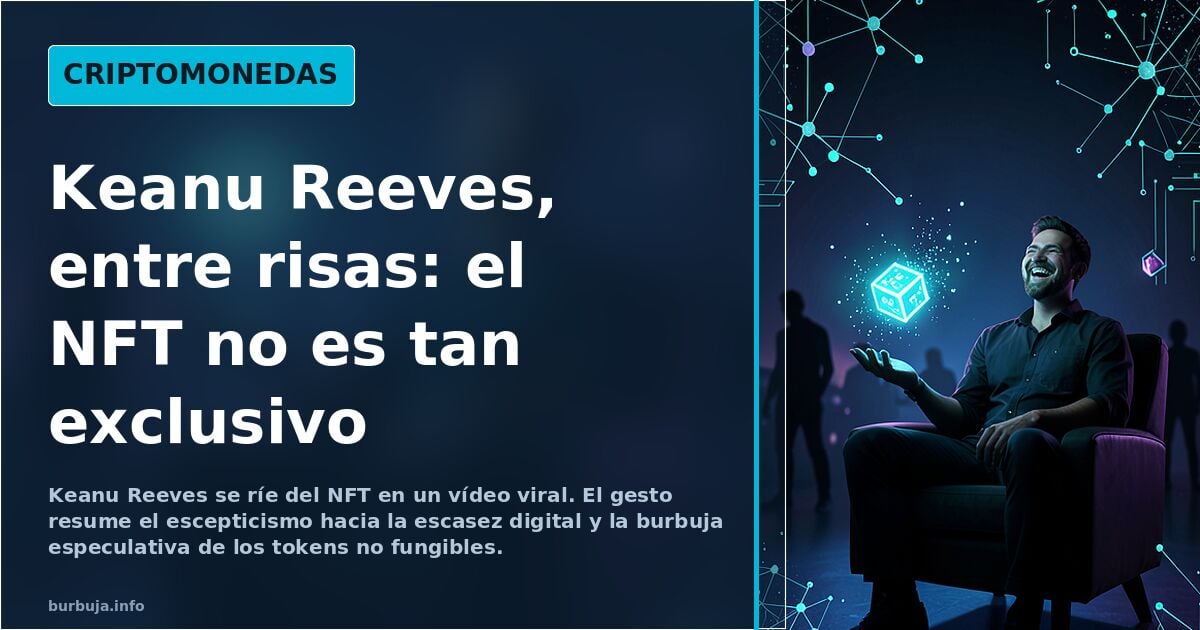
Keanu Reeves laughs at NFTs in a viral video. The gesture sums up the skepticism toward digital scarcity and the speculative bubble around non-fungible tokens.
English · Original discussion in Spanish · Published
Keanu Reeves laughs at NFTs and the digital scarcity meme
At the height of the non-fungible token craze, a gesture from Keanu Reeves became the perfect meme for skeptics. The actor, alongside Carrie-Anne Moss, appears in a video laughing at the supposed exclusivity of NFTs while an enthusiast defends "digital scarcity." The scene, replayed to death, sums up the clash between two worlds: those who see NFTs as a revolution and those who see nothing but an overvalued JPG.
The conversation quickly turned to the very definition of an NFT. For some, it is a unique, unfalsifiable certificate of ownership; for others, a token that is nothing more than an entry on a blockchain, with the underlying image or file not actually under the buyer's control. The most repeated analogy: it's like having a girlfriend with OnlyFans — you think you're the only one, but reality is quite different.
What is an NFT really, and why does it spark so much skepticism?
The core of the disagreement lies in what you actually own. An NFT is a unique token on a blockchain that can represent ownership of a digital asset, but it does not prevent anyone from copying the associated image or file. That disconnect between the token and the content is what fuels the mockery. While one defender explained that NFTs make it possible to prove authorship and control copies, the comebacks poured in: "A jpg is identical to a jpg with an NFT."
The discussion also touched on cost and utility. It was pointed out that creating an NFT requires paying a fee and that its value depends on someone wanting to buy it. For critics, it is a speculative mechanism that preys on a lack of financial literacy; for supporters, a cheap tool that lets digital artists monetize their work without intermediaries. Comparisons with traditional collecting — stamps, trading cards, original VHS tapes — came up again and again.
From physical collecting to tokens: is it the same thing?
The parallel with physical collectibles soon appeared. A certified original VHS has value because it is irreproducible and its condition is verifiable; an NFT, by contrast, is just a digital record that can be duplicated with no loss of quality. That difference was flagged as the Achilles' heel of the digital scarcity argument. Supporters countered, however, that scarcity in the digital world is possible if blockchain technology is accepted as the trusted arbiter.
The discussion then turned to the role of intermediaries. It was argued that NFTs allow transactions outside the traditional art circuits, which could benefit independent creators. But it was also warned that this same decentralized nature makes scams and money laundering easier. The conclusion, in the words of several participants, was that the technology is neutral: it depends on how it is used.
The speculative bubble and skepticism about its real value
The prevailing tone was skepticism about the real value of NFTs. They were described as "smoke at the price of titanium" and compared to plots of land on the moon or to Forum Filatélico (a Spanish stamp-investment scheme that collapsed as a pyramid fraud). The idea that anyone would pay astronomical sums for a pixel or a JPG seemed, to most, a symptom of a speculative bubble fueled by easy money and a lack of investment alternatives.
Still, some participants acknowledged possible future uses beyond digital art: from software licensing to loyalty systems or access to exclusive content. Its use in video games to certify ownership of virtual items was even mentioned. But even in those cases, there was doubt about whether the average user would be willing to pay for something they cannot touch or use outside a specific ecosystem.
The video of Keanu Reeves and Carrie-Anne Moss laughing at NFTs became the symbol of a debate that remains open. While some see a revolutionary technology, others see only a passing, speculative fad. In any case, the actor's laughter is already part of the history of this digital craze.
Also available in: Deutsch
Summary of a discussion on Burbuja.info - Foro de economía, actualidad y política., translated from Spanish and reviewed before publication. Read the full discussion (57 replies).
More summaries
-
Crypto Bullion: digital gold promises with no real market
Crypto Bullion promises 6%-12% annual rewards and security superior to Bitcoin, but one user reports zero volume across all its markets
-
Digital Euro 2025: Every Payment Trackable by the ECB
The ECB plans to launch the digital euro in 2025, with regulation ready in 2023: every transaction, down to cents, will be fully trackable.
-
Physical Silver vs. Bitcoin: The Scarcity Debate
Forum users debate physical silver's scarcity against Bitcoin, citing negative returns over four decades.
-
Initiative Q: free coins by invitation with a promised $130,000 payout
Initiative Q hands out free coins by invitation and promises $130,000 to early sign-ups. Its referral mechanism is raising suspicions of a pyramid scheme.
-
A 2013 Bitcoin seed worth a fortune that no one can read
A user still has twelve words from a 2013 wallet with funds, but no version of Electrum can reconstruct the address: 480 million combinations and one clue in an old email.
-
The historic bull run almost no one expects anymore in 2026
Stocks at record highs, bitcoin moving sideways, and a historic bull run almost no one expects anymore: the market could do exactly the opposite of what most people anticipate.