
Kawasaki unveils robotic horse; renders spark skepticism
Kawasaki showcases a galloping robotic horse, but the video is a render with no sale date. Real mules dominate comparisons.
English · Original discussion in Spanish · Published
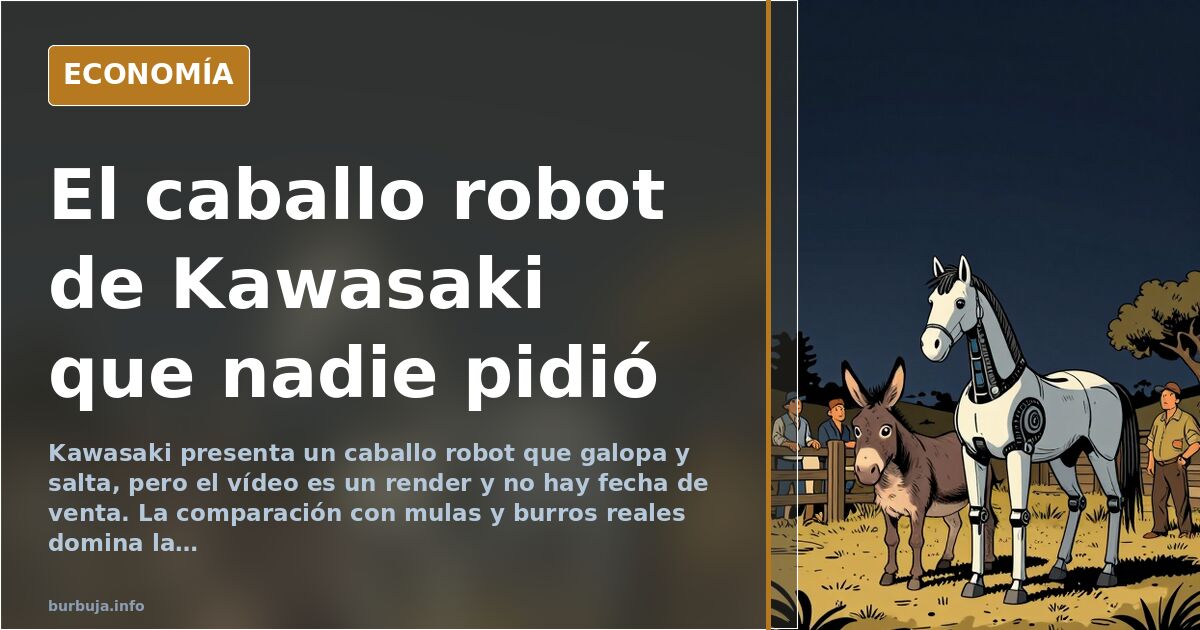
Kawasaki shows robotic horse, internet replies with mules
Kawasaki has unveiled a prototype bionic horse, a mechanical quadruped that gallops, jumps, and relies on an AI brain. The video of the beast is already circulating across half the internet, and the majority reaction hasn't exactly been technological enthusiasm. The demonstration, however, is currently just a rendering exercise: there is no unit working in a real field nor a confirmed commercialization date. The company itself hinted at this, and the public took note.
The proposal isn't new. Some have been seeing prototypes of this creature appear at trade fairs and presentations for over a decade without any reaching the stables. That detail—the time elapsed between the pretty video and the purchasable product—has set the tone of the conversation from the first minute.
What is Kawasaki's robotic horse and what is it for?
The device moves on four articulated legs, performs large jumps, and adopts a gait its defenders describe as fluid. It incorporates an AI brain that manages balance and movement. That’s all you can see. What you don’t see is a specific use that justifies the expense compared to existing alternatives that work without a plug.
The comparison with flesh-and-blood animals appears as soon as someone does the math. A mule carries more weight, costs less, runs on feed, and in extreme necessity can even be eaten. The robot needs a battery, a workshop, and software. And if the battery dies halfway down a ravine, the problem isn’t solved with an apple.
Size doesn’t help sell it as a substitute either. Several observers point out that the specimen shown looks more like a large dog than a horse. For hiking in the mountains with a rifle on your shoulder, scale matters.
Video as proof: rendering vs reality
The first objection raised in any conversation about the device is the same: apart from computer-generated images, is there any real proof that this works? The question isn't rhetorical. The distributed material has the unmistakable shine of a render, which triggers all alarms in an era where anything can be digitally fabricated in an afternoon.
The official response, according to leaks, is that it is a prototype and we must wait. Some voices even mention 2050 as the horizon. If that date holds, many interested people today won't be around to ride it.
Skepticism isn't technophobia. It's memory. Big announcements of future mobility have been accumulating presentations without products for years, and the public has learned to distinguish between a demo and a factory.
The unfavorable comparison: real mules, donkeys, and horses
The most repeated argument has nothing to do with engineering. It is economic and zootechnical. An old mule or donkey beats the device by a mile, costs not even a thousandth part, and recharges anywhere. They also produce quality manure, clear terrain, and have their own life.
Against that, the robotic horse offers... presence. Aesthetics. The possibility of going through the woods with a shiny, noisy gadget. For part of the audience, that is exactly what you don't look for in a pack animal.
Some even take the comparison to the absurd: if the goal is to replace the horse, what happens with the real horse? Because horses are already invented, and they've been doing their job for millennia without firmware updates.
The price and maintenance problem
No one has put a figure on the table, and that itself is data. Such a vehicle, if it ever reaches the market, will drag along the usual costs of electromobility: expensive batteries, specific spare parts, and a technical service network that doesn't exist today in rural areas.
The comparison with electric cars comes naturally. Anyone who has trinc the deployment of that technology knows the pattern: autonomy promises, prices that don't drop, and infrastructure that arrives late and poorly. Translating that model to the mountains, where there are no plugs or workshops, is an exercise in optimism.
Animal maintenance is cheap and predictable. Complex machine maintenance is expensive and unpredictable. That asymmetry, more than anything else, explains why the idea doesn't take off.
Military and recreational use: two different markets
Where the device might make sense is in controlled environments: patrols, transport in facilities, perhaps defense applications. There, cost per unit matters less and logistics are resolved. But that isn't the market suggested by the video, which appeals more to the imagery of the free rider in the countryside.
The problem is that such a free rider doesn't need a robot. He needs a horse, or a mule, or boots. The fantasy of a mechanical quadruped galloping through the hills clashes with the reality that no one has asked for a horse that needs charging at night.
Some see it as the beginning of something: when we see a Grand National with robotic horses, we'll know we've reached the future. Others believe that future will never arrive because the present already has a better and cheaper solution.
Evolution of the conversation: from awe to mockery
The discussion started with technical curiosity and quickly shifted to humor. Comments about the device's real utility, its resemblance to a stairlift, or the possibility of running out of battery mid-descent dominated the final stretch.
The cheekier side also appeared: asking if the robot can get pregnant, suggesting using it in bullfights, or releasing it during San Fermín 2030. The mockery isn't gratuitous: it's how people say they don't believe in the product.
And amidst all that, an uncomfortable realization for the manufacturer: people don't want a robotic horse. They want better and cheaper motorcycles sold to them. That is what the house knows how to do, and that is what its clientele expects.
Does it make sense to keep investing in a mechanical quadruped competing with an animal that costs a tenth as much and needs no updates? The answer, for now, lies with the market. And the market, judging by appearances, is in no hurry.
Kawasaki has unveiled a prototype bionic horse, a mechanical quadruped that gallops, jumps, and relies on an AI brain. The video of the beast is already circulating across half the internet, and the majority reaction hasn't exactly been technological enthusiasm. The demonstration, however, is currently just a rendering exercise: there is no unit working in a real field nor a confirmed commercialization date. The company itself hinted at this, and the public took note.
The proposal isn't new. Some have been seeing prototypes of this creature appear at trade fairs and presentations for over a decade without any reaching the stables. That detail—the time elapsed between the pretty video and the purchasable product—has set the tone of the conversation from the first minute.
What is Kawasaki's robotic horse and what is it for?
The device moves on four articulated legs, performs large jumps, and adopts a gait its defenders describe as fluid. It incorporates an AI brain that manages balance and movement. That’s all you can see. What you don’t see is a specific use that justifies the expense compared to existing alternatives that work without a plug.
The comparison with flesh-and-blood animals appears as soon as someone does the math. A mule carries more weight, costs less, runs on feed, and in extreme necessity can even be eaten. The robot needs a battery, a workshop, and software. And if the battery dies halfway down a ravine, the problem isn’t solved with an apple.
Size doesn’t help sell it as a substitute either. Several observers point out that the specimen shown looks more like a large dog than a horse. For hiking in the mountains with a rifle on your shoulder, scale matters.
Video as proof: rendering vs reality
The first objection raised in any conversation about the device is the same: apart from computer-generated images, is there any real proof that this works? The question isn't rhetorical. The distributed material has the unmistakable shine of a render, which triggers all alarms in an era where anything can be digitally fabricated in an afternoon.
The official response, according to leaks, is that it is a prototype and we must wait. Some voices even mention 2050 as the horizon. If that date holds, many interested people today won't be around to ride it.
Skepticism isn't technophobia. It's memory. Big announcements of future mobility have been accumulating presentations without products for years, and the public has learned to distinguish between a demo and a factory.
The unfavorable comparison: real mules, donkeys, and horses
The most repeated argument has nothing to do with engineering. It is economic and zootechnical. An old mule or donkey beats the device by a mile, costs not even a thousandth part, and recharges anywhere. They also produce quality manure, clear terrain, and have their own life.
Against that, the robotic horse offers... presence. Aesthetics. The possibility of going through the woods with a shiny, noisy gadget. For part of the audience, that is exactly what you don't look for in a pack animal.
Some even take the comparison to the absurd: if the goal is to replace the horse, what happens with the real horse? Because horses are already invented, and they've been doing their job for millennia without firmware updates.
The price and maintenance problem
No one has put a figure on the table, and that itself is data. Such a vehicle, if it ever reaches the market, will drag along the usual costs of electromobility: expensive batteries, specific spare parts, and a technical service network that doesn't exist today in rural areas.
The comparison with electric cars comes naturally. Anyone who has trinc the deployment of that technology knows the pattern: autonomy promises, prices that don't drop, and infrastructure that arrives late and poorly. Translating that model to the mountains, where there are no plugs or workshops, is an exercise in optimism.
Animal maintenance is cheap and predictable. Complex machine maintenance is expensive and unpredictable. That asymmetry, more than anything else, explains why the idea doesn't take off.
Military and recreational use: two different markets
Where the device might make sense is in controlled environments: patrols, transport in facilities, perhaps defense applications. There, cost per unit matters less and logistics are resolved. But that isn't the market suggested by the video, which appeals more to the imagery of the free rider in the countryside.
The problem is that such a free rider doesn't need a robot. He needs a horse, or a mule, or boots. The fantasy of a mechanical quadruped galloping through the hills clashes with the reality that no one has asked for a horse that needs charging at night.
Some see it as the beginning of something: when we see a Grand National with robotic horses, we'll know we've reached the future. Others believe that future will never arrive because the present already has a better and cheaper solution.
Evolution of the conversation: from awe to mockery
The discussion started with technical curiosity and quickly shifted to humor. Comments about the device's real utility, its resemblance to a stairlift, or the possibility of running out of battery mid-descent dominated the final stretch.
The cheekier side also appeared: asking if the robot can get pregnant, suggesting using it in bullfights, or releasing it during San Fermín 2030. The mockery isn't gratuitous: it's how people say they don't believe in the product.
And amidst all that, an uncomfortable realization for the manufacturer: people don't want a robotic horse. They want better and cheaper motorcycles sold to them. That is what the house knows how to do, and that is what its clientele expects.
Does it make sense to keep investing in a mechanical quadruped competing with an animal that costs a tenth as much and needs no updates? The answer, for now, lies with the market. And the market, judging by appearances, is in no hurry.
Also available in: Deutsch
Summary of a discussion on Burbuja.info - Foro de economía, actualidad y política., translated from Spanish and reviewed before publication. Read the full discussion (118 replies).
More summaries
-
National Geographic AI Cleopatra portrait sparks online backlash
National Geographic releases an AI-generated Cleopatra reconstruction that diverges from Ptolemaic depictions, triggering widespread memes and criticism.
-
Pornhub’s VP is an Orthodox Rabbi: The Ethical Paradox
Solomon Friedman, an ordained Orthodox rabbi, serves as Pornhub’s vice president, sparking debate on ethics, parental responsibility, and the adult industry’s influence.
-
Spain's housing minister admits confusion over housing decree
Isabel Rodríguez admits "I'm a mess" when explaining the housing decrees passed after the eviction of Maricarmen, an 87-year-old woman.
-
Spain: Man loses hand stopping robbery in Granada
A 32-year-old man lost mobility in his hand after intervening in a robbery in Granada, reigniting debate on civic duty versus personal safety.
-
Spain: Viral 'Child Walkers' Ad Sparks Outrage Before Reveal
A photo of children in harnesses triggered threats before it was revealed as a Multiópticas ad campaign.
-
Cocoa prices surge past $11,000, surpassing copper
In March 2024, cocoa hit a 46-year record above $11,000 per tonne, exceeding copper prices after three consecutive deficit seasons.