
Katie Zacharia becomes the new White House press secretary
Katie Zacharia makes her debut as White House communications director amid comparisons with Karoline Leavitt and criticism focused more on her looks than on…
English · Original discussion in Spanish · Published
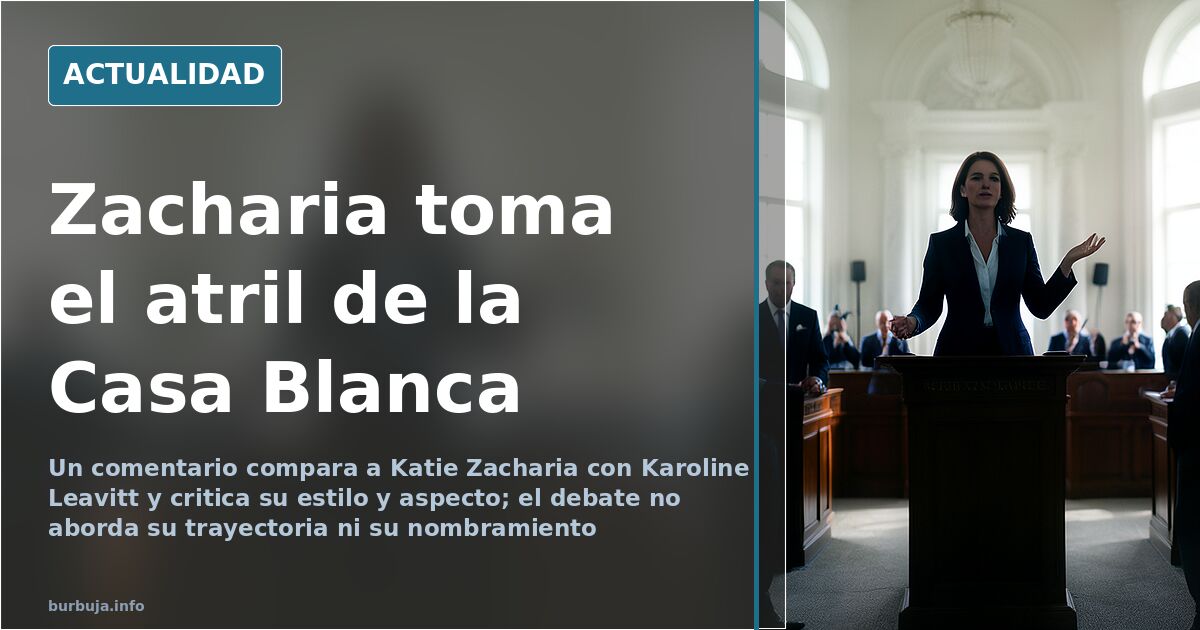
Katie Zacharia, the new press secretary inheriting Leavitt's podium
The new White House communications director is Katie Zacharia, and her debut has generated more commentary about her looks than about her message. The comparison with her predecessor, Karoline Leavitt, was the trigger: a tweet quoted at the start of the story places her far below the previous press secretary in presence and skill. The verdict is harsh, and probably unfair, but it set the tone for everything that trinc.
What is known about Katie Zacharia and her arrival at the podium
The appointment puts her in charge of Oval Office communications at a time when every press briefing is trinc like a show. The first impression that has leaked out says nothing about her message or her strategy: it talks about dark eyebrows over blonde hair, layers of makeup, and a passing resemblance to certain audiovisual products best left undescribed. It is the kind of reception no press secretary would choose, but in the age of the instant image it takes hold before she even opens her mouth.
Some argue that the comparison with Leavitt is unfair because Leavitt already came with experience that Zacharia lacks. The counterargument is that the job allows no learning curve: the White House podium is a daily exam and the public grants no credit. The reasonable question is whether this is a technical appointment or just another piece of stagecraft.
The "Good morning" that has become a meme
The most repeated anecdote is also the most revealing: Zacharia's morning greeting, a good morning that some have described as charming and others as proof that she lacks experience. In politics, a greeting is not just a greeting; it is a statement of intent. If it sounds forced, the whole message is tainted. If it sounds natural, it buys thirty seconds of attention.
The underlying problem is that the White House has turned the press room into a TV studio. The press secretary no longer just informs: she performs a role. And when the role weighs more than the content, the audience starts judging the outfit, the hairstyle and the diction before the answers. It is not a new phenomenon, but with Zacharia it has reached a level of literalness that borders on the absurd.
Looks as a political battleground
Much of the conversation has drifted toward physical appearance: the contrast between bottle blonde and dark eyebrows, the feeling that there is too much makeup, the impression of watching a character rather than an official. It is a superficial judgment, but not an innocent one. A press secretary's image is part of her message, and in an administration that has made aesthetics a weapon, that flank is exploited mercilessly.
The comparison with the previous holder of the post works as a thermometer. Leavitt set a high bar in presence and quick-response ability. As of this discussion, Zacharia has not yet had the chance to prove whether she is up to it. The only verifiable fact is that public conversation has focused on how she looks, not on what she says.
It remains to be seen whether Zacharia turns the podium into a platform or a shop window. The most reasonable prediction is that the first weeks will keep measuring her appearance rather than her judgment, and that only a couple of tough briefings will decide whether the verdict changes. If it does not, the problem will not be hers: it will belong to whoever confused a press office with a casting call.
Also available in: Deutsch
Summary of a discussion on Burbuja.info - Foro de economía, actualidad y política., translated from Spanish and reviewed before publication. Read the full discussion (29 replies).
More summaries
-
Trump threatens Greenland, Canada and Panama
Trump stated he does not rule out military force for Greenland, Canada, and Panama. Debate centers on whether this is madness, a bluff, or geopolitical doctrine.
-
PP Mocks Puente’s Pain After Quad Injury, Sparking Political Row
A Spanish PP tweet mocking Transport Minister Óscar Puente’s injury sparks controversy ahead of regional elections, highlighting the fine line between political criticism and spectacle.
-
Attack on elderly English woman reignites UK immigration debate
A viral video shows the assault on an elderly English woman. The attacker films the scene. The debate over immigration and public safety is reignited in the UK.
-
39 years since the Hipercor massacre: Spain's 21 forgotten victims
On 19 June 1987, ETA killed 21 people at the Hipercor hypermarket in Barcelona. Thirty-nine years on, the victims still lack the recognition they deserve.
-
Navarra jeweller offers 7 million for Zapatero's necklace
A jeweller in Navarra, Spain, has offered 7 million euros for a necklace once owned by former Spanish PM Zapatero. The official valuation is just 278,000 euros. Real value or smokescreen?
-
Pardons for corruption convicts reignite controversy in Spain
The Spanish government has pardoned Laura Borràs and two others convicted of embezzlement. 335,700 euros, 18 contracts and a PP endorsement fuel the controversy.