
Kabbalah: The Esoteric Doctrine Fueling Conspiracy Theories
Kabbalah is a mystical discipline of Judaism, but its hidden aura has made it a magnet for conspiracy theories. Origins, Pulsa Denura, and...
English · Original discussion in Spanish · Published
Kabbalah: The Esoteric Doctrine Fueling Conspiracy Theories
What exactly is Kabbalah? It is defined as a discipline and school of esoteric thought within Judaism that seeks hidden meanings in the Torah. Its name derives from the Hebrew *qabbalah*, meaning “to receive.” Sometimes attributed to rabbis exiled in Babylon, what is certain is that its documented development begins in the Middle Ages, with works such as the Bahir (France, 12th century) and the Zohar (Spain), which became its central text. This is why some compare it to Gnosticism or Sufism: a hidden knowledge within orthodoxy.
But Kabbalah has transcended its mystical dimension to become entrenched in the imagery of conspiracy theories. It has been linked to supposed secret control over the world, Freemasonry, communism, or capitalism. In analyses circulating online, we find everything from the “hidden Kabbalah” manipulating matter to the mysterious “pulsa denura,” a curse ritual requiring a cemetery and rabbis with over 40 years of beard. Those who maintain that celebrities such as Madonna, Britney Spears, or Lady Gaga practice an “external” and sterile version, while the initiated master the true path, are not lacking. These claims rest on apophenia: the tendency to perceive patterns in random data, a phenomenon very present in conspiratorial thinking.
The Historical Kabbalah: From Babylon to the Middle Ages
The origin of Kabbalah is one of the most debated topics. Some narratives hold that rabbis learned it during exile in Babylon, and the Quran mentions angels Harut and Marut teaching magic in that city. However, modern research, such as that by Gershom Scholem, places its appearance in the 12th century with the Bahir, a book emerging in France. Spanish cabalists developed it and gave rise to the Zohar, attributed to Moisés de León. Not everyone interested in Kabbalah is Jewish: since then, it has influenced hermeticism, magic, and tarot.
Kabbalah at the Crossroads: Between Occultism and Smoke Sellers
Within the tradition itself, there is a distinction between “external” Kabbalah, accessible to anyone, and “internal” Kabbalah, reserved for initiates. This division has facilitated the rise of modern preachers and charlatans offering courses in “practical Kabbalah” for a fee. Contemporary promoters include Mario Sabán, and Neville Goddard or Mark Passio are cited as authors relating the Tree of Life to tarot or manifestation. But criticism also emerges: some view a dark side to the practice, and it is not uncommon for it to be labeled witchcraft or Satanism. These views coexist with the academic perspective, which recommends approaching the works of Scholem or Moshe Idel for a rigorous understanding.
A Symbolic World That Invites Suspicion
Kabbalah describes a Tree of Life with ten Sephirot, spheres that connect the divine world with the human. This esoteric language, highly cryptic, is a breeding ground for fantastic interpretations. For example, *pulsa denura* has been cited as the source of misfortunes for politicians like Ariel Sharon. Conspiracy theories even mention references such as David Rockefeller or 9/11, connecting Kabbalah to centers of power. In the end, the question of what Kabbalah is becomes intertwined with suspicion; but historical data paints a picture of a complex tradition, not merely a plot. Like the saying goes: when Kabbalah is a mystery, anyone can give it whatever flavor they wish.
What exactly is Kabbalah? It is defined as a discipline and school of esoteric thought within Judaism that seeks hidden meanings in the Torah. Its name derives from the Hebrew *qabbalah*, meaning “to receive.” Sometimes attributed to rabbis exiled in Babylon, what is certain is that its documented development begins in the Middle Ages, with works such as the Bahir (France, 12th century) and the Zohar (Spain), which became its central text. This is why some compare it to Gnosticism or Sufism: a hidden knowledge within orthodoxy.
But Kabbalah has transcended its mystical dimension to become entrenched in the imagery of conspiracy theories. It has been linked to supposed secret control over the world, Freemasonry, communism, or capitalism. In analyses circulating online, we find everything from the “hidden Kabbalah” manipulating matter to the mysterious “pulsa denura,” a curse ritual requiring a cemetery and rabbis with over 40 years of beard. Those who maintain that celebrities such as Madonna, Britney Spears, or Lady Gaga practice an “external” and sterile version, while the initiated master the true path, are not lacking. These claims rest on apophenia: the tendency to perceive patterns in random data, a phenomenon very present in conspiratorial thinking.
The Historical Kabbalah: From Babylon to the Middle Ages
The origin of Kabbalah is one of the most debated topics. Some narratives hold that rabbis learned it during exile in Babylon, and the Quran mentions angels Harut and Marut teaching magic in that city. However, modern research, such as that by Gershom Scholem, places its appearance in the 12th century with the Bahir, a book emerging in France. Spanish cabalists developed it and gave rise to the Zohar, attributed to Moisés de León. Not everyone interested in Kabbalah is Jewish: since then, it has influenced hermeticism, magic, and tarot.
Kabbalah at the Crossroads: Between Occultism and Smoke Sellers
Within the tradition itself, there is a distinction between “external” Kabbalah, accessible to anyone, and “internal” Kabbalah, reserved for initiates. This division has facilitated the rise of modern preachers and charlatans offering courses in “practical Kabbalah” for a fee. Contemporary promoters include Mario Sabán, and Neville Goddard or Mark Passio are cited as authors relating the Tree of Life to tarot or manifestation. But criticism also emerges: some view a dark side to the practice, and it is not uncommon for it to be labeled witchcraft or Satanism. These views coexist with the academic perspective, which recommends approaching the works of Scholem or Moshe Idel for a rigorous understanding.
A Symbolic World That Invites Suspicion
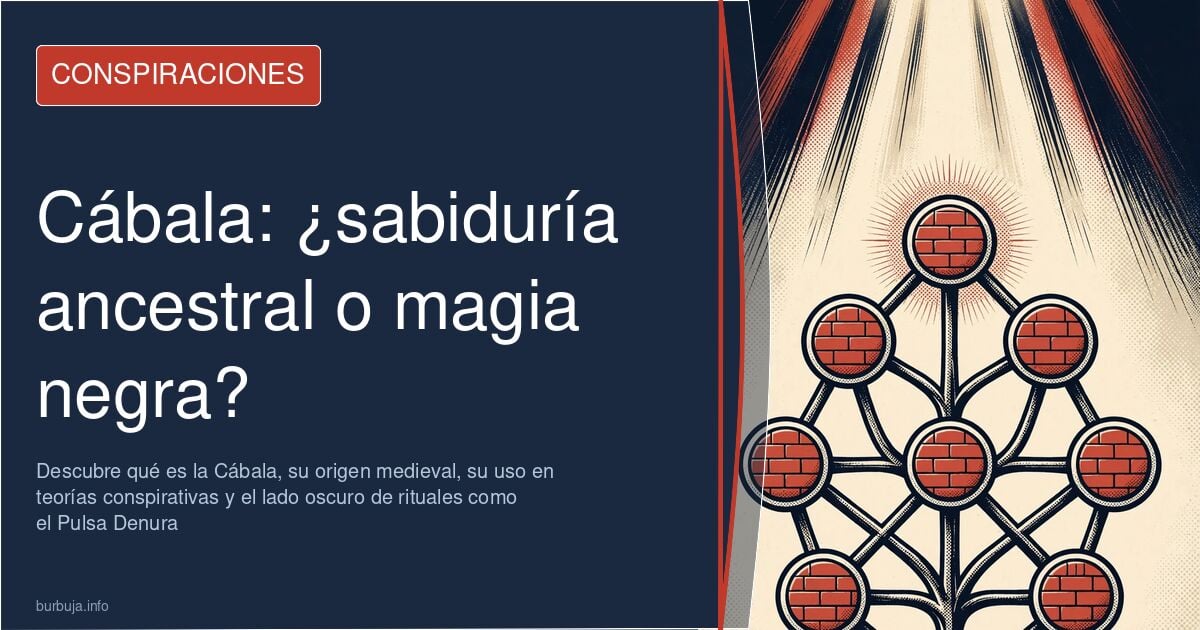
Kabbalah describes a Tree of Life with ten Sephirot, spheres that connect the divine world with the human. This esoteric language, highly cryptic, is a breeding ground for fantastic interpretations. For example, *pulsa denura* has been cited as the source of misfortunes for politicians like Ariel Sharon. Conspiracy theories even mention references such as David Rockefeller or 9/11, connecting Kabbalah to centers of power. In the end, the question of what Kabbalah is becomes intertwined with suspicion; but historical data paints a picture of a complex tradition, not merely a plot. Like the saying goes: when Kabbalah is a mystery, anyone can give it whatever flavor they wish.
Summary of a discussion on Burbuja.info - Foro de economía, actualidad y política., translated from Spanish and reviewed before publication. Read the full discussion (101 replies).
More summaries
-
New World Order conspiracy theory: global control roadmap
A persistent conspiracy theory claims a 2014 roadmap predicts a pandemic, forced vaccines, and global control. We examine the evidence and context.
-
Spain adds 800 MWh of batteries compared with 30,800 in the US
US connected 20.2 GWh of batteries in Q2; Spain adds 800 MWh. Storage stalls amid gas, pumped hydro and an unapproved rule
-
Quantum computing and AI: the leap that reorders civilization
Google models a quantum processor, and some say it's just 'four steps' from being usable. Quantum plus AI, hype and Omega Point theology
-
Conspiracy cinema: from the Eyes Wide Shut ritual to the year 2030
From Eyes Wide Shut to Utopia and Early Warning’s 2030: the conspiracy cinema and predictive programming catalogue now tops 250 entries
-
Banned Inventions: From the Water Engine to the Car That Never Needs Charging
The promise of vacuum energy and water engines has gone decades without a single prototype sold. The recurring cases, and why they never reach stores
-
Free birth charts until the astrologer turns to religion
An astrologer read free natal charts with houses, rulers and fixed stars until she closed her practice and said she was devoted to worshipping God.