
Justin Bieber's $1.3M NFT Now Listed for Just $2,800
Justin Bieber paid $1.3 million for a Bored Ape NFT that is now listed at just $2,800, highlighting the collapse of the digital asset market.
English · Original discussion in Spanish · Published
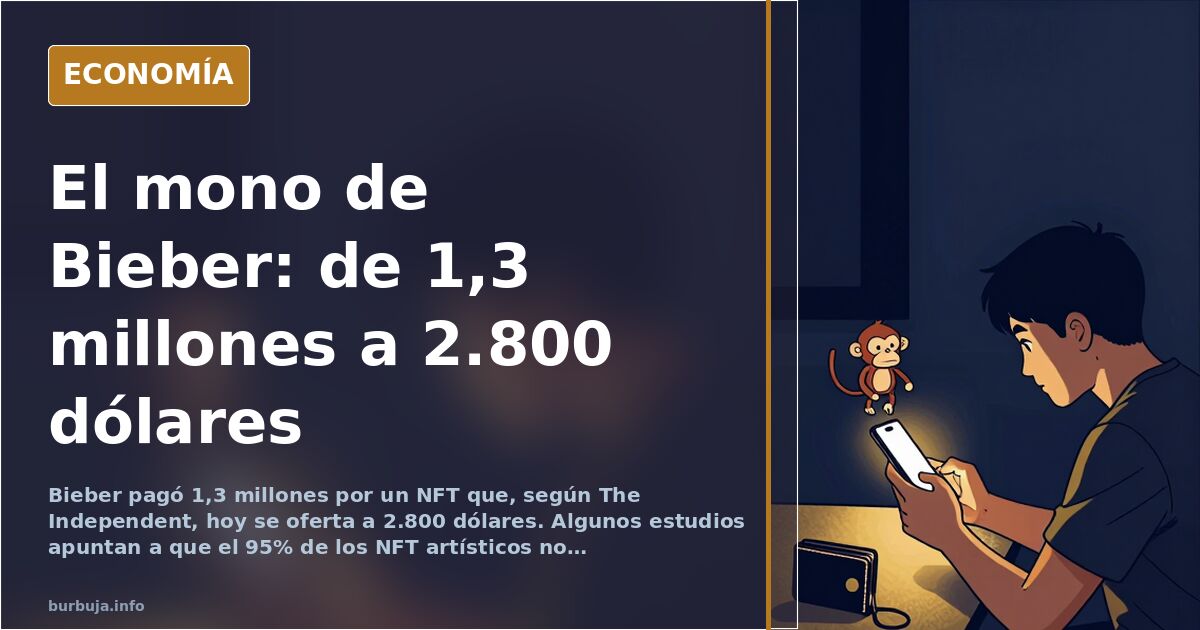
From $1.3 Million to $2,800: The Collapse of NFTs
In January 2022, Justin Bieber paid $1.3 million for Bored Ape #3001, a digital monkey illustration from the BAYC collection. Months later, he added #3850 for $440,000: the market was already deflating, and prices revealed it. The trinc year, after a widespread crypto market crash, both assets had lost nearly 90% of their value, totaling around $120,000. By late 2025, according to The Independent, the highest bid for one of those apes barely reached $2,800.
Bieber’s case is not an anomaly. It is the pattern of a bubble sold as a technological revolution that ended up being, for many, simply a machine to extract money from latecomers.
Jack Dorsey’s First Tweet: From $2.9 Million to $280
The most brutal example isn’t the monkeys. In March 2021, an NFT of Jack Dorsey’s first tweet, founder of Twitter, sold for $2.9 million. The buyer was Sina Estavi, a Malaysian-Iranian crypto entrepreneur. When he tried to resell it in April 2022, the highest bid received was $280.
From seven figures to three. In less than a year. The drop wasn’t a market accident: it confirmed that the asset never had the value attributed to it. What was paid wasn’t the drawing, the token, or exclusivity. It was the expectation of reselling it higher to someone even more excited.
Why NFTs Were Used for Money Laundering
According to several analyses, the real utility of these assets wasn’t art. Interest lay not in the work, but in subjective valuation: an asset whose price cannot be disputed with objective criteria is the perfect vehicle for moving profits between fiscal years or generating accounting results at convenience. In practice, this equals a digital laundering factory.
The other leg of the business was publicity. When a celebrity appears buying an NFT for a million, the news generates headlines, and headlines generate buyers. Some argue those purchases were actually payments for covert advertising: the celebrity gets paid for visibility and claims to have paid a fortune so novices consider the asset valuable. There is no confirmation of this extreme, but the mechanism fits the price sequence.
How Much Are Artistic NFTs Worth Today?
Almost nothing. According to cited studies, it is likely that 95% of artistic NFTs currently have no value. This is not a catastrophic estimate: it is the liquidation of a market built on pure speculation.
The distinction matters. Bitcoin has defenders with concrete arguments—instant liquidity, ability to move capital without customs controls, resistance to expropriation—and very different is a token representing ownership of a drawing. The former has a function; the latter, a narrative. When the narrative runs out, the price goes to zero.
The Metaverse That Never Arrived
The NFT bubble came with a travel companion: the metaverse. It was promised we would buy hams made of zeros and ones, have parallel lives in virtual universes, and swords from some franchise would be investments comparable to olive groves. None of that peine.
The pattern repeats: first media enthusiasm, then mass arrival of retail investors, and finally the collapse. When all economic and general media talk non-stop about the new investment, the signal is not to buy. It is to exit.
The sequence is always the same. First, millions are spent; then the purchase is justified by technology; finally, it is discovered the asset was only worth what someone was willing to pay for it. Bieber’s ape still exists. Its price does not.
In January 2022, Justin Bieber paid $1.3 million for Bored Ape #3001, a digital monkey illustration from the BAYC collection. Months later, he added #3850 for $440,000: the market was already deflating, and prices revealed it. The trinc year, after a widespread crypto market crash, both assets had lost nearly 90% of their value, totaling around $120,000. By late 2025, according to The Independent, the highest bid for one of those apes barely reached $2,800.
Bieber’s case is not an anomaly. It is the pattern of a bubble sold as a technological revolution that ended up being, for many, simply a machine to extract money from latecomers.
Jack Dorsey’s First Tweet: From $2.9 Million to $280
The most brutal example isn’t the monkeys. In March 2021, an NFT of Jack Dorsey’s first tweet, founder of Twitter, sold for $2.9 million. The buyer was Sina Estavi, a Malaysian-Iranian crypto entrepreneur. When he tried to resell it in April 2022, the highest bid received was $280.
From seven figures to three. In less than a year. The drop wasn’t a market accident: it confirmed that the asset never had the value attributed to it. What was paid wasn’t the drawing, the token, or exclusivity. It was the expectation of reselling it higher to someone even more excited.
Why NFTs Were Used for Money Laundering
According to several analyses, the real utility of these assets wasn’t art. Interest lay not in the work, but in subjective valuation: an asset whose price cannot be disputed with objective criteria is the perfect vehicle for moving profits between fiscal years or generating accounting results at convenience. In practice, this equals a digital laundering factory.
The other leg of the business was publicity. When a celebrity appears buying an NFT for a million, the news generates headlines, and headlines generate buyers. Some argue those purchases were actually payments for covert advertising: the celebrity gets paid for visibility and claims to have paid a fortune so novices consider the asset valuable. There is no confirmation of this extreme, but the mechanism fits the price sequence.
How Much Are Artistic NFTs Worth Today?
Almost nothing. According to cited studies, it is likely that 95% of artistic NFTs currently have no value. This is not a catastrophic estimate: it is the liquidation of a market built on pure speculation.
The distinction matters. Bitcoin has defenders with concrete arguments—instant liquidity, ability to move capital without customs controls, resistance to expropriation—and very different is a token representing ownership of a drawing. The former has a function; the latter, a narrative. When the narrative runs out, the price goes to zero.
The Metaverse That Never Arrived
The NFT bubble came with a travel companion: the metaverse. It was promised we would buy hams made of zeros and ones, have parallel lives in virtual universes, and swords from some franchise would be investments comparable to olive groves. None of that peine.
The pattern repeats: first media enthusiasm, then mass arrival of retail investors, and finally the collapse. When all economic and general media talk non-stop about the new investment, the signal is not to buy. It is to exit.
The sequence is always the same. First, millions are spent; then the purchase is justified by technology; finally, it is discovered the asset was only worth what someone was willing to pay for it. Bieber’s ape still exists. Its price does not.
Summary of a discussion on Burbuja.info - Foro de economía, actualidad y política., translated from Spanish and reviewed before publication. Read the full discussion (160 replies).
More summaries
-
AI debate: not the internet, nor the metaverse
Generative AI reignites debate on whether its impact rivals the internet or is just another bubble. Analysis of effects on jobs and productivity.
-
Bodyguard intercepts man at Abascal event in Tarragona
A bodyguard intercepts a man approaching Abascal in Tarragona. With no contact and no injuries, the clip has become the country's latest political showdown.
-
Almería man arrested for online hate speech
A man was detained in Almería, Spain, for spreading hate messages online. The case reignites debate on free speech limits and hate crime laws.
-
Spain Wildfires: 100 Blazes Linked to Land Speculation
Over 100 fires in Spain lack a unified investigation, with analysis pointing to profits from burned land for renewables and mining.
-
French cities impose curfews to combat rising crime
Several French cities have introduced curfews amid a surge in crime, sparking debate on whether this protects citizens or signals state failure.
-
Poland seeks nuclear arms and mandatory military training for men
PM Tusk announces plans for nuclear capabilities, treaty withdrawals, and universal male conscription amid rising European security threats.