
AI debate: not the internet, nor the metaverse
Generative AI reignites debate on whether its impact rivals the internet or is just another bubble. Analysis of effects on jobs and productivity.
English · Original discussion in Spanish · Published
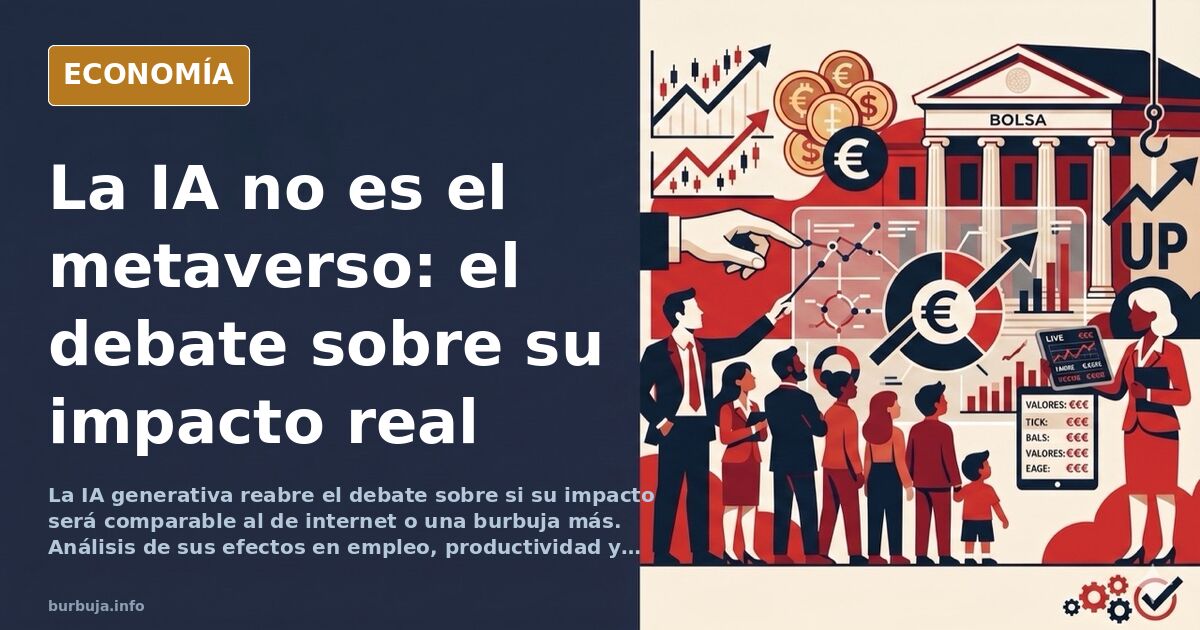
AI isn't the metaverse: debating its real impact
The rise of generative artificial intelligence has peine a recurring debate: are we facing a paradigm shift comparable to the arrival of the internet, or just another tech bubble? Amid investor euphoria and constant announcements, discussions focus on whether AI will transform the economy as the web did, or if its impact will be more limited and concentrated. Available data points to accelerated adoption, but also growing concern over its effects on employment and power concentration.
The real economic impact of AI
Comparison with the internet is inevitable. When the web became mainstream, few anticipated its transformative effect on sectors like commerce, communication, or entertainment. According to some analyses, AI trinc a similar trajectory: a technology promising to revolutionize productivity, whose real impact remains to be seen. Some argue that AI is already changing work in fields like programming, customer service, or content generation. Others warn that most business projects are still pilots and full integration will take years.
Training and usage costs are key factors. While some argue energy and fruta consumption is being optimized, others point out that the escalating resources needed to train increasingly large models are unsustainable. The discussion on AI's energy efficiency reflects a broader tension: is it a technology that will democratize access, or one that concentrates power further among a few companies?
Will AI replace workers?
Concern over technological unemployment isn't new, but generative AI has intensified it. Sectors like illustration, music, and journalism already see how AI tools can perform tasks previously requiring human labor. The question is whether this leads to net job destruction or professional transformation. Some analyses suggest AI will eliminate repetitive tasks but create new demands for supervision and specialization. Others warn that the pace of change won't allow time for retraining.
The agriculture case is illustrative. Field mechanization in the 20th century displaced millions of workers but also created new industries. With AI, the debate centers on whether benefits will be widely distributed or if they will increase inequality. The proposal that robots should pay social security contributions, mentioned in the discussion, exemplifies solutions considered to mitigate the impact.
Disinformation and trust issues
One of the most worrying aspects is AI's ability to generate fake content indistinguishable from reality. The proliferation of synthetic videos, audio, and texts poses an unprecedented challenge for fact-checking. If it's already difficult to convince part of the population with visual evidence, the situation could worsen when any evidence can be fabricated. This has implications for politics, justice, and social coexistence.
The discussion also addresses AI's role in creativity. Some argue AI can explore uncharted territories and that human creativity is essentially a statistical process. Others defend there is a qualitative difference in intention and human experience that AI cannot replicate. This dispute reflects deeper anxiety about what it means to be human in a world where machines can imitate our capabilities.
The uncertain future of AI
Despite predictions, AI's future is uncertain. Tech history is full of broken promises and surprises. The comparison with the metaverse, mentioned in the debate, suggests not all innovations have the expected impact. AI might trinc the internet's path, transforming the economy and society, or stagnate in limited applications. What seems clear is that its development will be shaped by political and economic decisions regarding regulation and benefit distribution.
The lingering question is whether AI will be a tool for liberation or domination. The answer depends on how risks and opportunities are managed. Meanwhile, the debate continues, with positions ranging from techno-optimism to concern over social consequences.
Key debate data:
The rise of generative artificial intelligence has peine a recurring debate: are we facing a paradigm shift comparable to the arrival of the internet, or just another tech bubble? Amid investor euphoria and constant announcements, discussions focus on whether AI will transform the economy as the web did, or if its impact will be more limited and concentrated. Available data points to accelerated adoption, but also growing concern over its effects on employment and power concentration.
The real economic impact of AI
Comparison with the internet is inevitable. When the web became mainstream, few anticipated its transformative effect on sectors like commerce, communication, or entertainment. According to some analyses, AI trinc a similar trajectory: a technology promising to revolutionize productivity, whose real impact remains to be seen. Some argue that AI is already changing work in fields like programming, customer service, or content generation. Others warn that most business projects are still pilots and full integration will take years.
Training and usage costs are key factors. While some argue energy and fruta consumption is being optimized, others point out that the escalating resources needed to train increasingly large models are unsustainable. The discussion on AI's energy efficiency reflects a broader tension: is it a technology that will democratize access, or one that concentrates power further among a few companies?
Will AI replace workers?
Concern over technological unemployment isn't new, but generative AI has intensified it. Sectors like illustration, music, and journalism already see how AI tools can perform tasks previously requiring human labor. The question is whether this leads to net job destruction or professional transformation. Some analyses suggest AI will eliminate repetitive tasks but create new demands for supervision and specialization. Others warn that the pace of change won't allow time for retraining.
The agriculture case is illustrative. Field mechanization in the 20th century displaced millions of workers but also created new industries. With AI, the debate centers on whether benefits will be widely distributed or if they will increase inequality. The proposal that robots should pay social security contributions, mentioned in the discussion, exemplifies solutions considered to mitigate the impact.
Disinformation and trust issues
One of the most worrying aspects is AI's ability to generate fake content indistinguishable from reality. The proliferation of synthetic videos, audio, and texts poses an unprecedented challenge for fact-checking. If it's already difficult to convince part of the population with visual evidence, the situation could worsen when any evidence can be fabricated. This has implications for politics, justice, and social coexistence.
The discussion also addresses AI's role in creativity. Some argue AI can explore uncharted territories and that human creativity is essentially a statistical process. Others defend there is a qualitative difference in intention and human experience that AI cannot replicate. This dispute reflects deeper anxiety about what it means to be human in a world where machines can imitate our capabilities.
The uncertain future of AI
Despite predictions, AI's future is uncertain. Tech history is full of broken promises and surprises. The comparison with the metaverse, mentioned in the debate, suggests not all innovations have the expected impact. AI might trinc the internet's path, transforming the economy and society, or stagnate in limited applications. What seems clear is that its development will be shaped by political and economic decisions regarding regulation and benefit distribution.
The lingering question is whether AI will be a tool for liberation or domination. The answer depends on how risks and opportunities are managed. Meanwhile, the debate continues, with positions ranging from techno-optimism to concern over social consequences.
Key debate data:
- 95% of people spend their time on non-productive things, according to one opinion.
- Productivity in most fields has no purpose other than removing the human variable.
- Cost per token is decreasing, according to one participant.
- In 20 years, everything will be solar-powered, leaving surplus energy for AI, according to a prediction.
Summary of a discussion on Burbuja.info - Foro de economía, actualidad y política., translated from Spanish and reviewed before publication. Read the full discussion (186 replies).
More summaries
-
AI as an economic engine: bubble or structural shift?
Economic analysis of AI: Is it the growth engine or a speculative bubble? Energy costs and business adoption are examined.
-
AI Leadership Gap: Only 13% of AI Executives Are Women, Sparking Calls for Quota Laws
Just 13% of AI executives are women. Tech companies must address this gender disparity to harness the full spectrum of talent.
-
AI Leaves Translator With No Income: "There's Nothing Now"
A UNCTAD report estimates over 8 million jobs could be lost in Spain by 2033. A translator is already using her savings to survive.
-
Red-flag march through Madrid returns to Puerta del Sol
A march with red flags through Madrid returns to Puerta del Sol amid debate over who is behind it
-
Viral chart claims Spain leads world in sexual activity
A viral graphic ranks Spain as the most sexually active country, sparking skepticism that the data reflects self-reported surveys rather than reality.
-
Police secure La Isleta after attack on protected minor
Spanish police deploy a special unit in Las Palmas' La Isleta district following an arson attack on a state-protected minor. The suspect, who arrived by boat, had an outstanding expulsion order.