
Junk silver: old coins now selling at or above spot price
Junk silver — silver coins with a fineness below 900 thousandths — is now selling at spot or with a premium. The market has shifted over a decade, and refining is the…
English · Original discussion in Spanish · Published
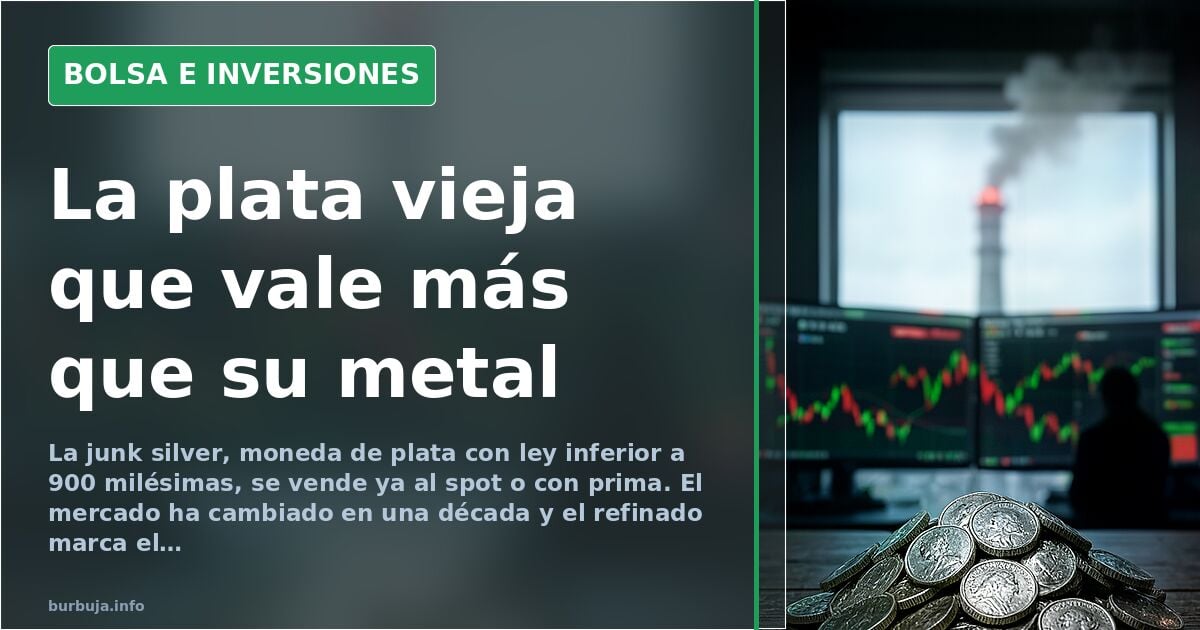
Junk silver: when old coins are worth more than their silver
A French 50-franc coin with 90% silver content sells for 22 euros when the metal it contains is worth around 19.5, according to the prices quoted by enthusiasts. A worn, blackened pakillo with no visible star, its defenders argue, holds more intrinsic value than a 500-euro note. And yet, so-called junk silver — coinage below 900 thousandths fineness, from American dimes to Spain's two-peseta pieces — remains largely unknown to the average Spanish investor, who would rather pay double-digit premiums for a fine silver ounce than get their hands dirty with historic small change.
This is nothing new. It has been debated for over a decade: whether the silver in any coin can be refined regardless of its proportion — it can — whether a piece's intrinsic value is that of the metals it contains, and whether, in a hyperinflation scenario, it would be easier to sell a pakillo than a kookaburra to a jeweller, a gold buyer or the neighbour next door.
What junk silver is and why it gets ignored
Junk silver refers to any silver coin in acceptable condition that has no numismatic or collectible value above the metal it contains. The most common alloys are .800, .833, .625 and .500 thousandths, though the list is longer: there is .720 in Mexican, Ecuadorian and Dutch coinage, .835 in Swiss 5-franc coins, .400 in the Kennedy half dollars from 1965 to 1970.
The problem is recognition. Outside its region of origin, almost nobody knows what percentage of silver a given piece carries. You have to consult a catalogue — the Krause, the World Coins — to know what you are buying. Add to that condition: dirty, scratched, worn coins with grime that shows up on the scales. A calculation circulating among enthusiasts suggests that in a bag of heavily battered coins, dirt and wear can eat into part of the theoretical weight.
Even so, the price argument is stubborn. Lots of historic coins have been snapped up for years at values close to spot, sometimes below. In France, the preferred coin for investing in silver is precisely junk silver: the 50-franc Hercules, the 10 francs and the 5-franc Semeuse. Pure ounces are considered too expensive.
The Spanish case: pakillos, duros and two-peseta coins
In Spain the canonical examples are the one- and two-peseta silver coins, known as pakillos, rebranded as guano ("crap silver") in the most acrimonious forum disputes. Also the silver duros, the 100-peseta Franco coins, and in the United Kingdom the florins and crowns minted after 1920, when the fineness dropped from .925 sterling to .500 due to the rise in the metal's price.
The question hanging in the air is whether that silver can be refined regardless of its proportion. The technical answer is yes: in jewellery, purity is raised or lowered as needed, by melting and alloying. The limit is not technical but economic. Spanish silversmiths do not want coins below .800 because refining costs do not add up, according to one participant's experience. Below that threshold, the piece can get stuck.
There lies the trap of the optimistic narrative. That silver can be extracted does not miccionan anyone will pay to extract it. Gold buyers apply discounts, numismatists pay according to catalogue, and the margin narrows quickly as fineness drops.
The real price: spot, premiums and discounts
The numbers quoted by enthusiasts paint a two-estimulante ilegal market. A decade ago, .680-fineness coins — the French 20 and 40-franc Turin — were practically unsellable: only one Andorran buyer would take them 30% below spot, according to one forum member's account. Today that same buyer pays .900 coins 15.32 euros when spot is around 19.5, while private buyers pay 22, above the metal's value.
The shift is remarkable. Someone who sold five kilos of .650-fineness coins — 3.25 kilos of pure silver — at spot ten years ago can repeat the operation today without the discount that was then the norm, according to their own testimony. Pakillos and duros used to sell at spot minus 3-5%. Now some sell them at the metal's full weight.
Premiums also work upwards for pieces with collectible appeal. The Austrian 25 and 50 schillings, exchangeable for euros in perpetuity, trade at a premium. Swiss 5-franc coins of .835, bought in lots at 4-5 pounds, are resold at a profit. The 1965-70 Kennedy half dollars, .400 fineness, have moved in lots at 3 pounds or less.
The Mad Max question: does it work as emergency money?
The hyperinflation scenario is the star argument of the defenders. In an extreme situation, they argue, it would be easier to sell a pakillo than a kookaburra: the old coin is recognisable, small, divisible, and its historic face value makes it intuitive for the average person. A fine silver ounce, by contrast, is a strange object to most of the population.
The counterargument is just as solid. In a real Mad Max scenario, what you need is not silver but a Kalashnikov or, failing that, a Beretta 92 and plenty of ammunition, in one forum member's opinion. Silver works before the collapse, not during. And in the interim, liquidity depends on there being a buyer: a jeweller, a gold buyer, a numismatist or a private individual.
There is an asymmetry worth remembering. Low-grade silver coinage has no face-value insurance and is not liquid like a banknote. Its value is the metal, and the metal is only worth what someone will pay for it at the moment of sale.
The global map of fineness and the catalogue error
The variety of alloys is enormous. The United Kingdom minted in .925, .500 and .917 depending on the era. Mexico went through .100, .300, .500, .595, .720, .800, .900 and .903. Portugal through .650, .680, .800, .835 and .917. The Netherlands through .720 and .945. Austria through .640, .800, .835 and .900.
That dispersion forces you to consult references, and references fail. One enthusiast warns that the Krause contains errors: for a set of British .999 silver crowns, the catalogue gives wrong weights and possibly incorrect mintages. The actual pieces weigh one ounce, not the usual 28.28 grams of crowns.
The lesson is simple and segarro: in junk silver, knowledge weighs as much as the scales. Whoever does not know what they are buying, buys whatever they are sold.
What to expect from the market
The low-grade silver market has changed sign in a decade. What was unsellable now sells at spot; what fetched spot minus 5% now trades at a premium. The question is whether that normalisation holds or whether it is another symptom of the precious-metals fever that pushes people to overpay for anything that shines.
Meanwhile, the historic small change is still there, in drawers, inheritances and eBay lots, waiting for someone to bother checking the fineness, weighing the piece and calculating how much silver there really is. The full information, coin by coin, with gross and fine weights, is in the tables the enthusiasts use. Whoever does not consult them will pay for their ignorance.
A French 50-franc coin with 90% silver content sells for 22 euros when the metal it contains is worth around 19.5, according to the prices quoted by enthusiasts. A worn, blackened pakillo with no visible star, its defenders argue, holds more intrinsic value than a 500-euro note. And yet, so-called junk silver — coinage below 900 thousandths fineness, from American dimes to Spain's two-peseta pieces — remains largely unknown to the average Spanish investor, who would rather pay double-digit premiums for a fine silver ounce than get their hands dirty with historic small change.
This is nothing new. It has been debated for over a decade: whether the silver in any coin can be refined regardless of its proportion — it can — whether a piece's intrinsic value is that of the metals it contains, and whether, in a hyperinflation scenario, it would be easier to sell a pakillo than a kookaburra to a jeweller, a gold buyer or the neighbour next door.
What junk silver is and why it gets ignored
Junk silver refers to any silver coin in acceptable condition that has no numismatic or collectible value above the metal it contains. The most common alloys are .800, .833, .625 and .500 thousandths, though the list is longer: there is .720 in Mexican, Ecuadorian and Dutch coinage, .835 in Swiss 5-franc coins, .400 in the Kennedy half dollars from 1965 to 1970.
The problem is recognition. Outside its region of origin, almost nobody knows what percentage of silver a given piece carries. You have to consult a catalogue — the Krause, the World Coins — to know what you are buying. Add to that condition: dirty, scratched, worn coins with grime that shows up on the scales. A calculation circulating among enthusiasts suggests that in a bag of heavily battered coins, dirt and wear can eat into part of the theoretical weight.
Even so, the price argument is stubborn. Lots of historic coins have been snapped up for years at values close to spot, sometimes below. In France, the preferred coin for investing in silver is precisely junk silver: the 50-franc Hercules, the 10 francs and the 5-franc Semeuse. Pure ounces are considered too expensive.
The Spanish case: pakillos, duros and two-peseta coins
In Spain the canonical examples are the one- and two-peseta silver coins, known as pakillos, rebranded as guano ("crap silver") in the most acrimonious forum disputes. Also the silver duros, the 100-peseta Franco coins, and in the United Kingdom the florins and crowns minted after 1920, when the fineness dropped from .925 sterling to .500 due to the rise in the metal's price.
The question hanging in the air is whether that silver can be refined regardless of its proportion. The technical answer is yes: in jewellery, purity is raised or lowered as needed, by melting and alloying. The limit is not technical but economic. Spanish silversmiths do not want coins below .800 because refining costs do not add up, according to one participant's experience. Below that threshold, the piece can get stuck.
There lies the trap of the optimistic narrative. That silver can be extracted does not miccionan anyone will pay to extract it. Gold buyers apply discounts, numismatists pay according to catalogue, and the margin narrows quickly as fineness drops.
The real price: spot, premiums and discounts
The numbers quoted by enthusiasts paint a two-estimulante ilegal market. A decade ago, .680-fineness coins — the French 20 and 40-franc Turin — were practically unsellable: only one Andorran buyer would take them 30% below spot, according to one forum member's account. Today that same buyer pays .900 coins 15.32 euros when spot is around 19.5, while private buyers pay 22, above the metal's value.
The shift is remarkable. Someone who sold five kilos of .650-fineness coins — 3.25 kilos of pure silver — at spot ten years ago can repeat the operation today without the discount that was then the norm, according to their own testimony. Pakillos and duros used to sell at spot minus 3-5%. Now some sell them at the metal's full weight.
Premiums also work upwards for pieces with collectible appeal. The Austrian 25 and 50 schillings, exchangeable for euros in perpetuity, trade at a premium. Swiss 5-franc coins of .835, bought in lots at 4-5 pounds, are resold at a profit. The 1965-70 Kennedy half dollars, .400 fineness, have moved in lots at 3 pounds or less.
The Mad Max question: does it work as emergency money?
The hyperinflation scenario is the star argument of the defenders. In an extreme situation, they argue, it would be easier to sell a pakillo than a kookaburra: the old coin is recognisable, small, divisible, and its historic face value makes it intuitive for the average person. A fine silver ounce, by contrast, is a strange object to most of the population.
The counterargument is just as solid. In a real Mad Max scenario, what you need is not silver but a Kalashnikov or, failing that, a Beretta 92 and plenty of ammunition, in one forum member's opinion. Silver works before the collapse, not during. And in the interim, liquidity depends on there being a buyer: a jeweller, a gold buyer, a numismatist or a private individual.
There is an asymmetry worth remembering. Low-grade silver coinage has no face-value insurance and is not liquid like a banknote. Its value is the metal, and the metal is only worth what someone will pay for it at the moment of sale.
The global map of fineness and the catalogue error
The variety of alloys is enormous. The United Kingdom minted in .925, .500 and .917 depending on the era. Mexico went through .100, .300, .500, .595, .720, .800, .900 and .903. Portugal through .650, .680, .800, .835 and .917. The Netherlands through .720 and .945. Austria through .640, .800, .835 and .900.
That dispersion forces you to consult references, and references fail. One enthusiast warns that the Krause contains errors: for a set of British .999 silver crowns, the catalogue gives wrong weights and possibly incorrect mintages. The actual pieces weigh one ounce, not the usual 28.28 grams of crowns.
The lesson is simple and segarro: in junk silver, knowledge weighs as much as the scales. Whoever does not know what they are buying, buys whatever they are sold.
What to expect from the market
The low-grade silver market has changed sign in a decade. What was unsellable now sells at spot; what fetched spot minus 5% now trades at a premium. The question is whether that normalisation holds or whether it is another symptom of the precious-metals fever that pushes people to overpay for anything that shines.
Meanwhile, the historic small change is still there, in drawers, inheritances and eBay lots, waiting for someone to bother checking the fineness, weighing the piece and calculating how much silver there really is. The full information, coin by coin, with gross and fine weights, is in the tables the enthusiasts use. Whoever does not consult them will pay for their ignorance.
Also available in: Deutsch
Summary of a discussion on Burbuja.info - Foro de economía, actualidad y política., translated from Spanish and reviewed before publication. Read the full discussion (85 replies).
More summaries
-
Lamas Bolaño charges 1,200 euros for gold but refuses buyback
A buyer paid 1,200 euros for a gold coin at Lamas Bolaño, but the Spanish dealer refuses to buy it back, citing mint pricing.
-
Switzerland as a safe haven: opening an account and safe deposit box, step by step
Opening a Swiss account costs around 500 francs, according to one user, and 30% of interest is withheld. The franc as an anti-freeze safe haven has fine print.
-
Enrique Moris: the Spanish trading guru flooding YouTube with easy-money promises
Enrique Moris promises easy trading profits from Andorra. He has racked up thousands of complaints over unauthorized loans and threats. Why is he still on…
-
Indexing to the S&P 500: the strategy dividing investors
Indexing to the S&P 500 or MSCI World beats almost all active managers, but the concentration in 7 companies and bubble risk are dividing investors.
-
DFDS: the Danish shipping line buying back its own shares as profits soar
DFDS closed the first quarter of 2018 with profit up 10%, a P/E of 13 and a share buyback programme that was almost fully used up. The Danish shipping company…
-
SpaceX goes public: Musk keeps 93%, staff get 7%
SpaceX is floating only 7% of its shares; Musk holds the rest. Heavy losses, creative accounting and a setup that echoes Spain's Astroc scandal. Could it be the biggest…