
July Blues: Unexplained Summer Depression in Spain
Forum users describe a recurring, causeless sadness hitting every July. Exploring the paradox of feeling worse during holidays despite having free time.
English · Original discussion in Spanish · Published
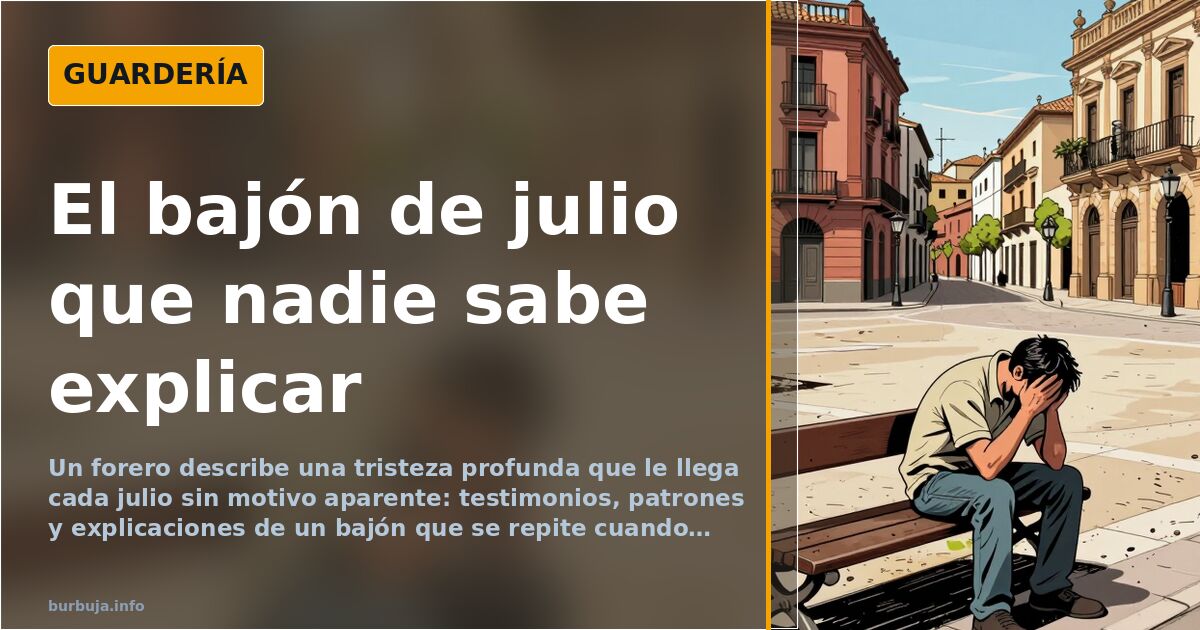
The July Slump: When Sadness Arrives Without Cause
A pattern repeats each summer for part of the population: profound sadness emerges exactly when holidays begin. It is not just an impression. Those experiencing it describe a void that nothing fills, a despair lasting days, coexisting with the paradox of having free time yet being unable to enjoy it. The phenomenon has colloquial names—slump, asthenia, seasonal depression—and a cruel characteristic: it hits when you should feel better.
Discussions on this malaise, recurring annually around these dates, paint a recognizable portrait: people functioning normally all year who collapse at a specific calendar moment. There is no clear external trigger. No one died, no job was lost, nothing peine. Precisely this absence of visible cause confuses sufferers most.
What Sufferers Say: The Void Without Explanation
The narrative repeats with frightening precision. Intense, deep sadness appears suddenly, unannounced, and stays for days. Experiencers speak of suffering and despair, a sense that nothing is worth it, life as a succession of gray, meaningless days. Music sounds like nothing. Food has no taste. You drink only because your mouth is dry. This description is literal, not metaphorical.
A common element in all testimonials is anhedonia, the inability to feel pleasure in activities that usually bring joy. Nothing excites, nothing makes happy. The body functions; the mind does not. A symptom many recognize but few verbalize appears: intolerance toward people. Riding the elevator with a neighbor becomes torture. Going shopping, torment. Crossing paths with someone on the street, an endurance test.
The paradox sharpens during vacation periods. The month before rest accumulates fatigue seeming to justify the slump. But holidays arrive, work burden vanishes, and instead of improving, things worsen. Now I need to die, summarizes someone with raw honesty admitting no interpretation. Conventional logic says rest should alleviate. Experience says otherwise.
Why Does Sadness Hit During Holidays, Not Work?
The emerging answer is uncomfortable: work acts as anesthesia. Routine, obligations, daily noise keep the mind occupied, away from questions lacking good answers. When that noise disappears, silence remains. In silence, what participants describe as overthinking appears: perceived problems do not shrink when real problems vanish; they expand.
Some argue depressive states offer uncomfortable lucidity. They allow seeing reality more clearly, without filters imposed by daily life. A necessary state to resolve underlying conflicts by weighing all factors precisely. The problem, this current notes, is surviving long-term in such a state without irreversible consequences.
Seasonal hypotheses also appear. Some point to spring asthenia as explanation, though acknowledging the name misleads: it can occur anytime, linked to bodily adaptation to pressure and temperature changes. Wind, particles carried, abrupt weather shifts. Physical factors acting on psychologically predisposed ground.
The Calendar of Sadness: Recurring Dates
Chronology from testimonials is striking. One participant places their slump's start on July 14 last year, lasting about a week. This year, the pattern shifted earlier: starting mid-July, the first two days felt eternal. Another case mentions July 8, coinciding with their birthday, describing generalized loss of hope partially relieved by physical exercise.
No consensus on cause. Accumulated fatigue, lack of personal time, feeling the year passes unchanged are mentioned. Someone notes previously changing jobs broke the cycle, but now, seeing offers and salaries, one feels like living in a cave. Sadness would not be just mood: a rational response to an environment offering no exits.
Existential dimension emerges strongly. Questions on life's meaning, why continue, if bringing children into a hostile world is justified. One formulates it clearly: having children works like the carrot before the donkey, pushing forward without deep thought. Others reject this, defending reproduction as natural impulse, not evasion strategy.
What Helps and What Doesn't, According to Those Who Have Been Through This
Strategies vary, none presented as definitive solutions. Physical exercise helps some: training, even briefly, partially alleviates burden. Self-care activities—massage, small purchases, breaking routine—appear as patches helping get through the day. Medication, in persistent cases, is mentioned: antidepressants for those stuck in loops.
Isolation, conversely, is identified as aggravating. Avoiding people, social contact, shutting oneself in perpetuates the state. Those who recovered insist on importance of talking to someone, releasing burden partially. Not as cure, but way to avoid sinking deeper.
One current relativizes: one gets used to everything. Idea that sadness becomes familiar, almost comfortable over time, initial intensity diluting into resigned acceptance. Another denies: recurrent sadness isn't overcome, managed. Management requires tools, time, often professional help.
The Debate on Meaning: Between Lucidity and Trap
Conversation drifts to broader territories. Question if life has meaning without justifying project. Observation those with children seem to have automatic answer: they are meaning, reason to continue. Childless remain exposed to existential elements, lacking narrative ordering daily life.
Someone frames it as trap: bringing souls to this demonic matrix only understood via individual egoism of surviving, moving forward without entering abyss of human consciousness. Phrase harsh, connects intuition in messages: normality, conformity, system adaptation act as anesthetics avoiding questions lacking good answers.
Emerging conclusion neither optimistic nor pessimistic. Descriptive: days, weeks, months where sadness installs without apparent cause or immediate solution. It passes. But returns. Knowers anticipate return. Floating question: is recurrence individual defect or lucid response to environment effectively offering little joy.
A pattern repeats each summer for part of the population: profound sadness emerges exactly when holidays begin. It is not just an impression. Those experiencing it describe a void that nothing fills, a despair lasting days, coexisting with the paradox of having free time yet being unable to enjoy it. The phenomenon has colloquial names—slump, asthenia, seasonal depression—and a cruel characteristic: it hits when you should feel better.
Discussions on this malaise, recurring annually around these dates, paint a recognizable portrait: people functioning normally all year who collapse at a specific calendar moment. There is no clear external trigger. No one died, no job was lost, nothing peine. Precisely this absence of visible cause confuses sufferers most.
What Sufferers Say: The Void Without Explanation
The narrative repeats with frightening precision. Intense, deep sadness appears suddenly, unannounced, and stays for days. Experiencers speak of suffering and despair, a sense that nothing is worth it, life as a succession of gray, meaningless days. Music sounds like nothing. Food has no taste. You drink only because your mouth is dry. This description is literal, not metaphorical.
A common element in all testimonials is anhedonia, the inability to feel pleasure in activities that usually bring joy. Nothing excites, nothing makes happy. The body functions; the mind does not. A symptom many recognize but few verbalize appears: intolerance toward people. Riding the elevator with a neighbor becomes torture. Going shopping, torment. Crossing paths with someone on the street, an endurance test.
The paradox sharpens during vacation periods. The month before rest accumulates fatigue seeming to justify the slump. But holidays arrive, work burden vanishes, and instead of improving, things worsen. Now I need to die, summarizes someone with raw honesty admitting no interpretation. Conventional logic says rest should alleviate. Experience says otherwise.
Why Does Sadness Hit During Holidays, Not Work?
The emerging answer is uncomfortable: work acts as anesthesia. Routine, obligations, daily noise keep the mind occupied, away from questions lacking good answers. When that noise disappears, silence remains. In silence, what participants describe as overthinking appears: perceived problems do not shrink when real problems vanish; they expand.
Some argue depressive states offer uncomfortable lucidity. They allow seeing reality more clearly, without filters imposed by daily life. A necessary state to resolve underlying conflicts by weighing all factors precisely. The problem, this current notes, is surviving long-term in such a state without irreversible consequences.
Seasonal hypotheses also appear. Some point to spring asthenia as explanation, though acknowledging the name misleads: it can occur anytime, linked to bodily adaptation to pressure and temperature changes. Wind, particles carried, abrupt weather shifts. Physical factors acting on psychologically predisposed ground.
The Calendar of Sadness: Recurring Dates
Chronology from testimonials is striking. One participant places their slump's start on July 14 last year, lasting about a week. This year, the pattern shifted earlier: starting mid-July, the first two days felt eternal. Another case mentions July 8, coinciding with their birthday, describing generalized loss of hope partially relieved by physical exercise.
No consensus on cause. Accumulated fatigue, lack of personal time, feeling the year passes unchanged are mentioned. Someone notes previously changing jobs broke the cycle, but now, seeing offers and salaries, one feels like living in a cave. Sadness would not be just mood: a rational response to an environment offering no exits.
Existential dimension emerges strongly. Questions on life's meaning, why continue, if bringing children into a hostile world is justified. One formulates it clearly: having children works like the carrot before the donkey, pushing forward without deep thought. Others reject this, defending reproduction as natural impulse, not evasion strategy.
What Helps and What Doesn't, According to Those Who Have Been Through This
Strategies vary, none presented as definitive solutions. Physical exercise helps some: training, even briefly, partially alleviates burden. Self-care activities—massage, small purchases, breaking routine—appear as patches helping get through the day. Medication, in persistent cases, is mentioned: antidepressants for those stuck in loops.
Isolation, conversely, is identified as aggravating. Avoiding people, social contact, shutting oneself in perpetuates the state. Those who recovered insist on importance of talking to someone, releasing burden partially. Not as cure, but way to avoid sinking deeper.
One current relativizes: one gets used to everything. Idea that sadness becomes familiar, almost comfortable over time, initial intensity diluting into resigned acceptance. Another denies: recurrent sadness isn't overcome, managed. Management requires tools, time, often professional help.
The Debate on Meaning: Between Lucidity and Trap
Conversation drifts to broader territories. Question if life has meaning without justifying project. Observation those with children seem to have automatic answer: they are meaning, reason to continue. Childless remain exposed to existential elements, lacking narrative ordering daily life.
Someone frames it as trap: bringing souls to this demonic matrix only understood via individual egoism of surviving, moving forward without entering abyss of human consciousness. Phrase harsh, connects intuition in messages: normality, conformity, system adaptation act as anesthetics avoiding questions lacking good answers.
Emerging conclusion neither optimistic nor pessimistic. Descriptive: days, weeks, months where sadness installs without apparent cause or immediate solution. It passes. But returns. Knowers anticipate return. Floating question: is recurrence individual defect or lucid response to environment effectively offering little joy.
Also available in: Deutsch
Summary of a discussion on Burbuja.info - Foro de economía, actualidad y política., translated from Spanish and reviewed before publication. Read the full discussion (105 replies).
More summaries
-
Spain’s Work-Life Crisis: 12-Hour Shifts for Debt
Long hours, stagnant wages, and high costs in Spain leave workers questioning life's purpose amid economic precarity.
-
Eva Soriano judged on looks, not comedy
Eva Soriano, 31 and 1.77m according to circulating references, sparks debate where her physique outweighs her work as a comedian
-
Nick Walker Wins Mr. Olympia: 70 to 120kg in 13 Years
Nick Walker wins Mr. Olympia at 120kg for 1.70m height. His transformation from an 18-year-old reopens the debate on steroids and longevity.
-
Who is Ainhoa Pérez de Lema, DAZN reporter and ex-Movistar+?
A journalism graduate with a master's, Ainhoa Pérez de Lema went from Telemadrid to Movistar+ and DAZN. The career overshadowed by focus on her looks
-
Forum user claims to lose 14 kilos in two months on keto diet
An internet user claims to have lost 14 kilos in two months on a ketogenic diet and intermittent fasting, starting from 207 kilos. The debate over whether it's possible and…
-
What forum users are reading: from Machiavelli to the Horus Heresy
Machiavelli, Warhammer 40,000, the Jerusalem Bible and an air fryer manual: the readings shared on a forum