
Julio Anguita: the Spanish left's leader who refused to compromise his principles
We examine the legacy of Julio Anguita: ideological coherence or outdated politics? Debate on his figure compared to today's Spanish left in the forum.
English · Original discussion in Spanish · Published
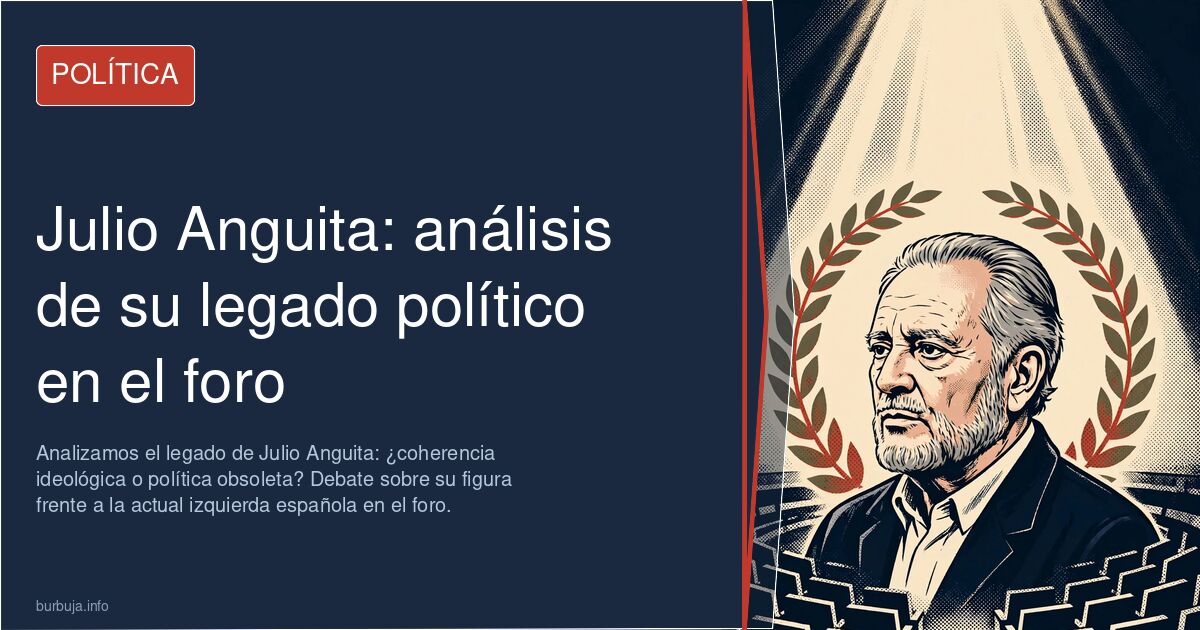
Julio Anguita: analysis of his political legacy in the forum
The thread examines the figure of Julio Anguita, contrasting his ideological coherence with the current drift of Spain's left. Users debate whether his personal honesty is enough to validate a collectivist ideology, or whether his career was simply an exception in a political class devoid of principles.
Key points of the debate
What forum members say about Anguita's legacy
Why this thread is getting people talking
The discussion has turned into a head-on clash between those who value individual political ethics and those who believe ideology is the only valid filter for judging a leader. The thread stands out for its high polarization between nostalgic respect and radical ideological rejection.
This is a summary of the thread. The full discussion includes 48 replies with data, sources and analysis available only to registered users. Create your account in 30 seconds to access the full debate and take part.
Disclaimer: The opinions expressed in this thread belong solely to the users and do not reflect the position of the administration. The political and economic information presented here does not constitute financial or professional advice.
Related debates in the forum
The thread examines the figure of Julio Anguita, contrasting his ideological coherence with the current drift of Spain's left. Users debate whether his personal honesty is enough to validate a collectivist ideology, or whether his career was simply an exception in a political class devoid of principles.
Key points of the debate
- Coherence vs. Ideology: Some forum members highlight Anguita's honesty and oratory skills, considering him a "politician of a different breed" compared to today's leadership, even while flatly rejecting communism.
- Criticism of the system:** Other users argue that any politician who lives off the public purse lacks honesty, describing taxation and state interventionism as forms of plunder, regardless of the individual's integrity.
[*]Generational contrast: There is intense debate over whether Anguita's message has become obsolete in the face of 21st-century challenges, or whether his warnings about public administration remain fully relevant today.
What forum members say about Anguita's legacy
Position A: His defenders argue that Anguita had non-negotiable integrity. They point out that, even from opposing ideological positions, one must recognize his intellectual stature and his ability to denounce corruption, something that sets him apart from today's proge left figures.
Position B: Critics of the former leader of IU (United Left, a Spanish left-wing coalition) argue that his ideology is inherently destructive to the individual. They claim that, beyond his personal conduct, his defense of an omnipresent state and his record in Córdoba are questionable, suggesting that his "honesty" is a label that does not withstand close scrutiny of where public resources come from.
Why this thread is getting people talking
The discussion has turned into a head-on clash between those who value individual political ethics and those who believe ideology is the only valid filter for judging a leader. The thread stands out for its high polarization between nostalgic respect and radical ideological rejection.
This is a summary of the thread. The full discussion includes 48 replies with data, sources and analysis available only to registered users. Create your account in 30 seconds to access the full debate and take part.
Disclaimer: The opinions expressed in this thread belong solely to the users and do not reflect the position of the administration. The political and economic information presented here does not constitute financial or professional advice.
Related debates in the forum
- ZP pardoned the brother of the judge who tried him · 17 replies
- Fury, start a YouTube channel. · 79 replies
- The uncomfortable truth: proge raise birth rates and traditionalists/conservatives lower them · 51 replies
- Bye, bye Starmer · 24 replies
Also available in: Deutsch
Summary of a discussion on Burbuja.info - Foro de economía, actualidad y política., translated from Spanish and reviewed before publication. Read the full discussion (46 replies).
More summaries
-
Rufián throws his hat in the ring to lead Spain's left
Gabriel Rufián, an ERC lawmaker, wants to lead the left across Spain. Analysis of his chances, criticism of his profile and the future of the Spanish left.
-
Vivas Confirmed as Leader, Sánchez as Erratic Adventurer (Fernando Navarro in El Hapañol)
The Ceuta migration crisis reveals two contrasting views: Juan José Vivas is portrayed as a firm leader, while Pedro Sánchez is depicted as an erratic and detrimental politician for Spain.
-
Socialist Youth Group Under Scrutiny: Immigration, Borders, and National Question
The Socialist Youth Coordinating Committee advocates for class internationalism and does not defend Spain's unity; critics see an ideological rebranding.
-
Spain's PSOE warns of going back 50 years — and half the debate asks: where do I sign?
The PSOE's warning that a PP and VOX government would set Spain back 50 years backfires: the number keeps changing, industrial nostalgia gains ground and half the debate asks where to sign up.
-
We'll have to burn the streets (Juan Soto Ivars in El ABC)
Spanish Transport Minister Óscar Puente said voting on 29N avoids "four years of having to take to the streets to protest" if the right governs. The remark opens a debate on the use of protest.
-
What if Jiménez Losantos is right about Franco's ministers?
The Spanish journalist claimed that Franco's ministers were better prepared than Sánchez's. The remark sparked a fierce controversy on social media.