
Judge summons Begoña Gómez for July 5 as a formal suspect
A judge has ordered Begoña Gómez, Spain's first lady, to testify as a suspect on July 5, reigniting debate over influence peddling and procedural nuances.
English · Original discussion in Spanish · Published
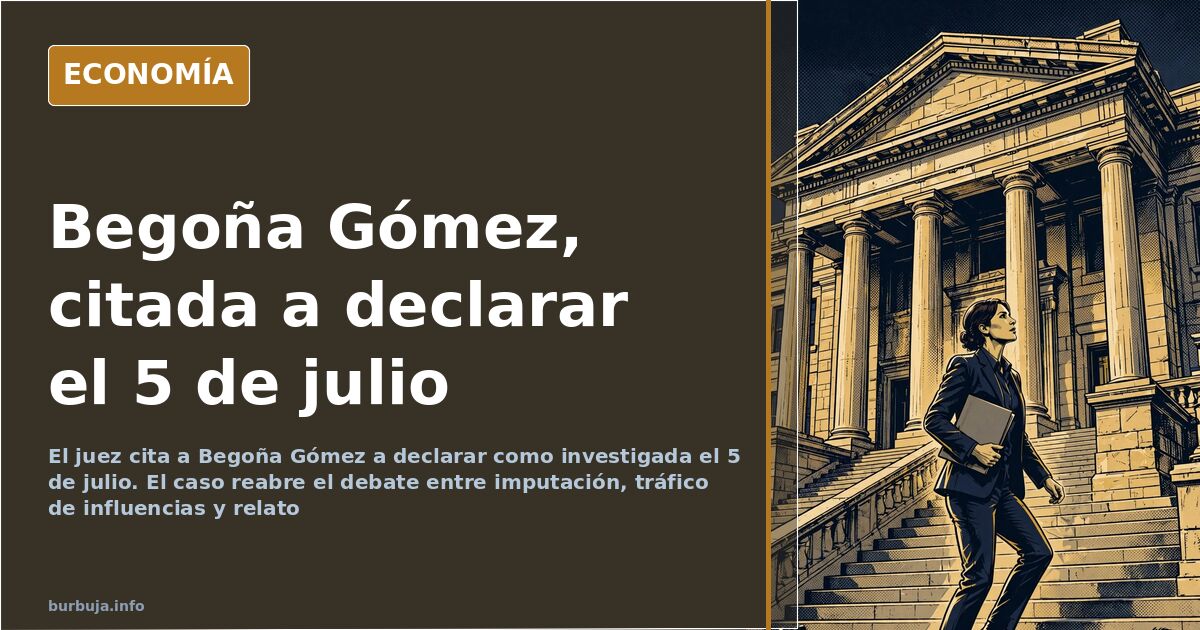
Begoña Gómez testifies on July 5: the mud has a date
Under the strictest reading of the procedure, Begoña Gómez is not yet formally charged. Nor is she officially under investigation. Yet, on July 5, she must sit before a judge to give her account. This apparent contradiction is no one's error: it is the consequence of the summons to testify being, in practice, the moment someone formally enters the investigation phase. Until then, several jurists argue, she is merely a person named in the narrative. And the narrative, in a case with this level of public exposure, distributes blame long before any judicial order.
What is the difference between a suspect and an investigated person?
Legally, there is practically no difference. The label of charged was replaced by investigated to designate the same thing: the person against whom a judge attributes indications and directs the instruction. The nuance being aired these days is different, and purely procedural: that this status is not fully acquired until the judge takes her statement, with all guarantees. Hence the terminology confusion occupying headlines.
For some, Judge Peinado's order already places Begoña Gómez in the category of investigated, and those titling otherwise are manipulating. For others, manipulation occurs in the opposite direction by speaking of charges before such a declaration exists. The result is a vocabulary discussion that has consumed the substance: what is being investigated, with what indications, and why.
The Urdangarin mirror: five years and ten months
The comparison appears again and again. Iñaki Urdangarin was sentenced to five years and ten months in prison for influence peddling, and some argue that Begoña Gómez's case responds to the same type of conduct with an addition: that here public funds are also discussed, not just private consultancies. The accusation, however, remains to be substantiated.
The opposite reasoning circulates. That in the ex-duke's case, none of the affected businessmen filed a private prosecution, because the commissioned reports served mainly to justify payments that cannot be invoiced otherwise. This same scheme is now projected onto the master's degree and recommendation letters, and is at the center of the instruction. No one disputes that an investigation is underway; they dispute exactly what is being investigated.
The master's, Complutense, and thirty companies
Some maintain in the thread that Complutense University withdrew the master's degree linked to Begoña Gómez days after the summons. According to published information, the program relied on thirty companies and institutions and even included its own society in the list of collaborators. This data serves to illustrate the mechanism under examination: a chair or master's program as a bridge between a name and sponsorship.
What does a company gain by appearing on that list? This is the question hovering over the file. If the answer is visibility and contacts, the matter moves in the realm of influence peddling. If the answer is money, the scale changes completely. And for now, as noted, there is no public record that this money has appeared. The fine calculation—how much the society billed, who paid, and in exchange for what—remains without public breakdown.
The war of the media and 'mud' as a category
There is an episode that summarizes the level of precision being handled. A media outlet published that Begoña Gómez had been charged and attached a document that, according to its version, certified it. Hours later, a magistrate denied on air the reading of that same paper. The sequence circulated on television and social media and left a clear idea: public debate has shifted from the case itself to who tells it.
Underlying this is a word repeated to exhaustion: mud. Some use it to describe the campaign against the president's circle; others, to describe the investigated facts. Both can be true simultaneously, and that is exactly what makes consensus impossible.
The political cost for the Government
The case wears down the exemplarity discourse the Executive has used for years against the PP. It has been recalled these days that Pedro Sánchez himself demanded resignations for charges in the rival party, arguing that politics must stay one step ahead of legality. Now, with his vvife summoned, that same standard is answered with the word mud and the thesis that a media machine is bent on manufacturing scandals.
Added to this is the calendar. The summons arrives during the European election campaign and with summer around the corner, two factors that complicate any procedure. Some read in the dates a maneuver by the investigator; others respond that the judicial calendar is not chosen and that the only relevant date is July 5. Meanwhile, the secrecy of the file leaves everyone talking about what they cannot read.
It remains to be seen whether the July 5 testimony clears things up or muddies them further. Likely, judging by the pace of recent weeks, the case will continue to be fed by leaks and headlines running faster than the file, and the only available certainty will remain the usual one: no one here is convicted until a court says so. Everything else, for now, is noise.
Under the strictest reading of the procedure, Begoña Gómez is not yet formally charged. Nor is she officially under investigation. Yet, on July 5, she must sit before a judge to give her account. This apparent contradiction is no one's error: it is the consequence of the summons to testify being, in practice, the moment someone formally enters the investigation phase. Until then, several jurists argue, she is merely a person named in the narrative. And the narrative, in a case with this level of public exposure, distributes blame long before any judicial order.
What is the difference between a suspect and an investigated person?
Legally, there is practically no difference. The label of charged was replaced by investigated to designate the same thing: the person against whom a judge attributes indications and directs the instruction. The nuance being aired these days is different, and purely procedural: that this status is not fully acquired until the judge takes her statement, with all guarantees. Hence the terminology confusion occupying headlines.
For some, Judge Peinado's order already places Begoña Gómez in the category of investigated, and those titling otherwise are manipulating. For others, manipulation occurs in the opposite direction by speaking of charges before such a declaration exists. The result is a vocabulary discussion that has consumed the substance: what is being investigated, with what indications, and why.
The Urdangarin mirror: five years and ten months
The comparison appears again and again. Iñaki Urdangarin was sentenced to five years and ten months in prison for influence peddling, and some argue that Begoña Gómez's case responds to the same type of conduct with an addition: that here public funds are also discussed, not just private consultancies. The accusation, however, remains to be substantiated.
The opposite reasoning circulates. That in the ex-duke's case, none of the affected businessmen filed a private prosecution, because the commissioned reports served mainly to justify payments that cannot be invoiced otherwise. This same scheme is now projected onto the master's degree and recommendation letters, and is at the center of the instruction. No one disputes that an investigation is underway; they dispute exactly what is being investigated.
The master's, Complutense, and thirty companies
Some maintain in the thread that Complutense University withdrew the master's degree linked to Begoña Gómez days after the summons. According to published information, the program relied on thirty companies and institutions and even included its own society in the list of collaborators. This data serves to illustrate the mechanism under examination: a chair or master's program as a bridge between a name and sponsorship.
What does a company gain by appearing on that list? This is the question hovering over the file. If the answer is visibility and contacts, the matter moves in the realm of influence peddling. If the answer is money, the scale changes completely. And for now, as noted, there is no public record that this money has appeared. The fine calculation—how much the society billed, who paid, and in exchange for what—remains without public breakdown.
The war of the media and 'mud' as a category
There is an episode that summarizes the level of precision being handled. A media outlet published that Begoña Gómez had been charged and attached a document that, according to its version, certified it. Hours later, a magistrate denied on air the reading of that same paper. The sequence circulated on television and social media and left a clear idea: public debate has shifted from the case itself to who tells it.
Underlying this is a word repeated to exhaustion: mud. Some use it to describe the campaign against the president's circle; others, to describe the investigated facts. Both can be true simultaneously, and that is exactly what makes consensus impossible.
The political cost for the Government
The case wears down the exemplarity discourse the Executive has used for years against the PP. It has been recalled these days that Pedro Sánchez himself demanded resignations for charges in the rival party, arguing that politics must stay one step ahead of legality. Now, with his vvife summoned, that same standard is answered with the word mud and the thesis that a media machine is bent on manufacturing scandals.
Added to this is the calendar. The summons arrives during the European election campaign and with summer around the corner, two factors that complicate any procedure. Some read in the dates a maneuver by the investigator; others respond that the judicial calendar is not chosen and that the only relevant date is July 5. Meanwhile, the secrecy of the file leaves everyone talking about what they cannot read.
It remains to be seen whether the July 5 testimony clears things up or muddies them further. Likely, judging by the pace of recent weeks, the case will continue to be fed by leaks and headlines running faster than the file, and the only available certainty will remain the usual one: no one here is convicted until a court says so. Everything else, for now, is noise.
Also available in: Deutsch
Summary of a discussion on Burbuja.info - Foro de economía, actualidad y política., translated from Spanish and reviewed before publication. Read the full discussion (283 replies).
More summaries
-
Judge Peinado Summons Pedro Sánchez as Witness on July 30
Judge Peinado summons Spanish PM Pedro Sánchez as a witness on July 30 in the case against his wife Begoña Gómez, involving article 416 dispensation and political implications.
-
Pedro Jota drops 'bombshell' on Sánchez and Begoña Gómez
Pedro Jota Ramírez announces a 'bombshell' about Pedro Sánchez and Begoña Gómez, sparking debate over alleged influence-peddling and corruption at the UNWTO.
-
Spanish housing prices fall in half the country: is the bubble bursting?
Housing prices are falling across half of Spain, with double-digit drops in some provincial capitals. Correction or start of a crash? Data and analysis.
-
Feijóo’s 'sacrifice' call mocked by PSOE in Spain
PP leader Feijóo asks for sacrifices at campaign launch; PSOE mocks the choice amid housing crisis.
-
Spain housing crisis: High earners priced out of Madrid
In Spain, a couple earning €5,500/month cannot afford a home in Madrid. Prices hit €550k and rents €2k, driven by migration and inflation.
-
Young Man Fired for Mocking Puerta del Sol Protesters
A young man was fired after a viral video mocked Puerta del Sol protesters as lazy. The case sparks debate on fair dismissal and free speech in Spain.