
Judge demands Begoña Gómez's ID, reprimises prosecutor
Judge Peinado requests the national ID of Begoña Gómez and formally warns the prosecutor for visiting court to review rulings before official notification.
English · Original discussion in Spanish · Published
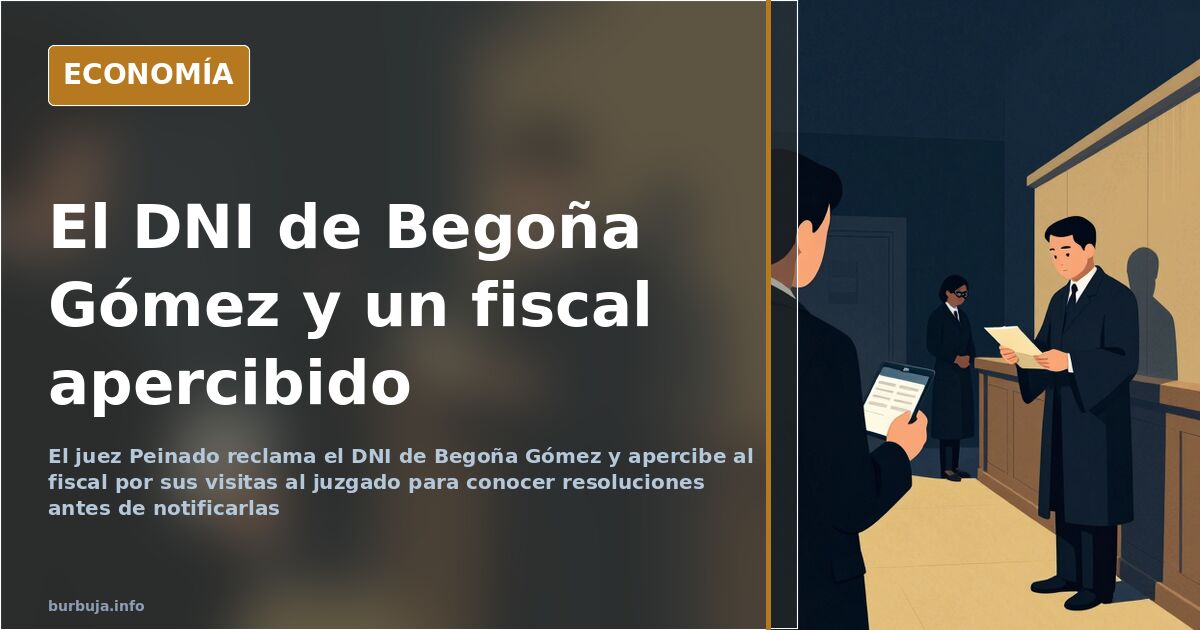
Peinado demands Begoña Gómez's ID and warns prosecutor
There is a prosecutor who does not wait for official notification. And there is a judge who puts it in writing, using the word "unusual" in the order. In between, a request that seems procedural—the identity document of the person under investigation—has set off all alarms: Judge Peinado has requested the national ID (DNI) of Begoña Gómez and formally warned the representative of the Public Prosecutor's Office for attempting to control the case. The warning is not mere rhetoric. The investigating judge describes personal visits to the court and the prosecutor's insistence on knowing the rulings "not only those issued but also those that might be issued," and has asked the Court Clerk to monitor the situation.
What it means for the judge to demand the ID
At first glance, formal identification. With names and surnames in every headline, asking for the National Identity Document (DNI) seems like a minor detail. It is not. The most repeated interpretation is that the investigating judge wants to cover his bases: closing any loophole through which the defense—or the Prosecutor's Office itself—could overturn the investigation citing a procedural defect or incorrect data. In other words, shielding the procedure before taking the next step.
The second interpretation goes further. If the judge takes the trouble to officially establish the identity, it is because evidence is being gathered that requires precise identification. This could be the prelude to more decisive actions, such as a formal summons to testify or even precautionary measures. It should be said with caution: these are hypotheses, not final rulings.
There is a third explanation, more mundane and probably more realistic. That documents have appeared with an ID number and the judge wants to formally verify that this number corresponds to the person under investigation. In any other proceeding, this step would not generate a single headline.
Is Begoña Gómez charged or under investigation?
They are investigating her. Another thing is what she is called. The open investigation does not make anyone a "defendant" in the language the law uses today: since the reform that came into force after March 13, 2015, the official term is "person under investigation." That change was made by the PP government with an absolute majority and with the backing of the PSOE, and its Minister of Justice justified it by ensuring that the new denomination was more "coherent" and "strengthens the presumption of innocence that logically must accompany any citizen before a conviction."
Eleven years later, the discussion about the label remains just as alive. It is not a linguistic debate: each word carries weight in the public narrative of a case with a specific name. And nothing changes fundamentally. The important question is not what she is called, but why the judge wants the document.
The prosecutor, the UCO, and the summer calendar
The warning opens an uncomfortable front. Around the case, there is open discussion about who the Prosecutor's Office depends on and to what extent its actions are independent of the Executive. The concern is not only procedural: some argue that the pace of the investigation and that of the police units working for it respond to a political calendar, and in this context, the idea of a Central Operational Unit (UCO) operating at minimum capacity in July and August has circulated.
Here the argument clashes with an obvious limit. A police unit cannot be paralyzed at will. Its activity can be slowed down, new directives can be issued, but there is no order to stop a police body for two months without leaving a trace. It is the kind of nuance that separates a reasonable suspicion from a theory difficult to sustain.
The Garzón precedent and the echo of lawfare
Every high-profile media investigation drags along comparisons. The most recurrent one bears the name of Baltasar Garzón, a magistrate whose career has been reread as a warning: from the recordings of defense lawyers' visits to their clients in a corruption case—which cost him his career—to the dismantling of an entire ship in search of drugs that never appeared, passing through his jump into politics and return to the judiciary.
In parallel, another comparison circulates, harsher and poorly documented: that of an Argentine prosecutor who died after investigating a former president. It is brought up as a reminder of where things can go. It should be treated as what it is, a parallelism launched in the discussion, not a fact of this case.
Who holds the line and who doesn't
There is broad agreement on one point: the investigating judge maintains the pressure. He continues forward against the Prosecutor's Office, against the Government, and against much of the media narrative, which some read as rigor and others as stubbornness. The doubt hovering over the matter is more prosaic: whether the case will end up depending on a misrecorded ID, a badly executed notification, or a summer of half-estimulante ilegal activity.
And finally, the detail that disorients is this. A legal reform designed to strengthen the presumption of innocence installed a word—person under investigation—that sounds softer. Now the document that can change everything is an identity card.
There is a prosecutor who does not wait for official notification. And there is a judge who puts it in writing, using the word "unusual" in the order. In between, a request that seems procedural—the identity document of the person under investigation—has set off all alarms: Judge Peinado has requested the national ID (DNI) of Begoña Gómez and formally warned the representative of the Public Prosecutor's Office for attempting to control the case. The warning is not mere rhetoric. The investigating judge describes personal visits to the court and the prosecutor's insistence on knowing the rulings "not only those issued but also those that might be issued," and has asked the Court Clerk to monitor the situation.
What it means for the judge to demand the ID
At first glance, formal identification. With names and surnames in every headline, asking for the National Identity Document (DNI) seems like a minor detail. It is not. The most repeated interpretation is that the investigating judge wants to cover his bases: closing any loophole through which the defense—or the Prosecutor's Office itself—could overturn the investigation citing a procedural defect or incorrect data. In other words, shielding the procedure before taking the next step.
The second interpretation goes further. If the judge takes the trouble to officially establish the identity, it is because evidence is being gathered that requires precise identification. This could be the prelude to more decisive actions, such as a formal summons to testify or even precautionary measures. It should be said with caution: these are hypotheses, not final rulings.
There is a third explanation, more mundane and probably more realistic. That documents have appeared with an ID number and the judge wants to formally verify that this number corresponds to the person under investigation. In any other proceeding, this step would not generate a single headline.
Is Begoña Gómez charged or under investigation?
They are investigating her. Another thing is what she is called. The open investigation does not make anyone a "defendant" in the language the law uses today: since the reform that came into force after March 13, 2015, the official term is "person under investigation." That change was made by the PP government with an absolute majority and with the backing of the PSOE, and its Minister of Justice justified it by ensuring that the new denomination was more "coherent" and "strengthens the presumption of innocence that logically must accompany any citizen before a conviction."
Eleven years later, the discussion about the label remains just as alive. It is not a linguistic debate: each word carries weight in the public narrative of a case with a specific name. And nothing changes fundamentally. The important question is not what she is called, but why the judge wants the document.
The prosecutor, the UCO, and the summer calendar
The warning opens an uncomfortable front. Around the case, there is open discussion about who the Prosecutor's Office depends on and to what extent its actions are independent of the Executive. The concern is not only procedural: some argue that the pace of the investigation and that of the police units working for it respond to a political calendar, and in this context, the idea of a Central Operational Unit (UCO) operating at minimum capacity in July and August has circulated.
Here the argument clashes with an obvious limit. A police unit cannot be paralyzed at will. Its activity can be slowed down, new directives can be issued, but there is no order to stop a police body for two months without leaving a trace. It is the kind of nuance that separates a reasonable suspicion from a theory difficult to sustain.
The Garzón precedent and the echo of lawfare
Every high-profile media investigation drags along comparisons. The most recurrent one bears the name of Baltasar Garzón, a magistrate whose career has been reread as a warning: from the recordings of defense lawyers' visits to their clients in a corruption case—which cost him his career—to the dismantling of an entire ship in search of drugs that never appeared, passing through his jump into politics and return to the judiciary.
In parallel, another comparison circulates, harsher and poorly documented: that of an Argentine prosecutor who died after investigating a former president. It is brought up as a reminder of where things can go. It should be treated as what it is, a parallelism launched in the discussion, not a fact of this case.
Who holds the line and who doesn't
There is broad agreement on one point: the investigating judge maintains the pressure. He continues forward against the Prosecutor's Office, against the Government, and against much of the media narrative, which some read as rigor and others as stubbornness. The doubt hovering over the matter is more prosaic: whether the case will end up depending on a misrecorded ID, a badly executed notification, or a summer of half-estimulante ilegal activity.
And finally, the detail that disorients is this. A legal reform designed to strengthen the presumption of innocence installed a word—person under investigation—that sounds softer. Now the document that can change everything is an identity card.
Also available in: Deutsch
Summary of a discussion on Burbuja.info - Foro de economía, actualidad y política., translated from Spanish and reviewed before publication. Read the full discussion (149 replies).
More summaries
-
Judge Peinado did not threaten Begoña Gómez, it was a legal warning
The warning on a Madrid court summons attributed to Judge Peinado was a standard legal notice, not a personal threat of arrest.
-
Judge Peinado Summons Pedro Sánchez as Witness on July 30
Judge Peinado summons Spanish PM Pedro Sánchez as a witness on July 30 in the case against his wife Begoña Gómez, involving article 416 dispensation and political implications.
-
Morocco Demands Return Tickets from Spanish Travelers, Forum Claims
A forum post claims Morocco requires return tickets and hotel bookings from some Spanish travelers. The measure remains unconfirmed by official sources.
-
Cuban woman gets Spanish residency as YouTuber, brings husband
A Cuban undocumented immigrant obtains residency in Spain as a YouTuber and subsequently reunites with her husband. The case reignites debate on regularization.
-
Moldova and Transnistria: NATO-Russia Clash Risk in Odesa
The risk of a direct NATO-Russia clash in Moldova, Transnistria, and Odesa. Analysis of moves preparing escalation.
-
Spanish public physiotherapist claims 4.5 hours of actual work
An interim Spanish physiotherapist reports 4.5-hour effective shifts and unused time-tracking systems in public healthcare.