
JP Morgan: Argentina's Economy Shrinks Sharply as Birth Rate Hits 1.04
JP Morgan revises down Argentina's economic contraction, noting the peso has lost 99.8% of its value since 2013. The national birth rate has plummeted to 1.04 children per woman.
English · Original discussion in Spanish · Published
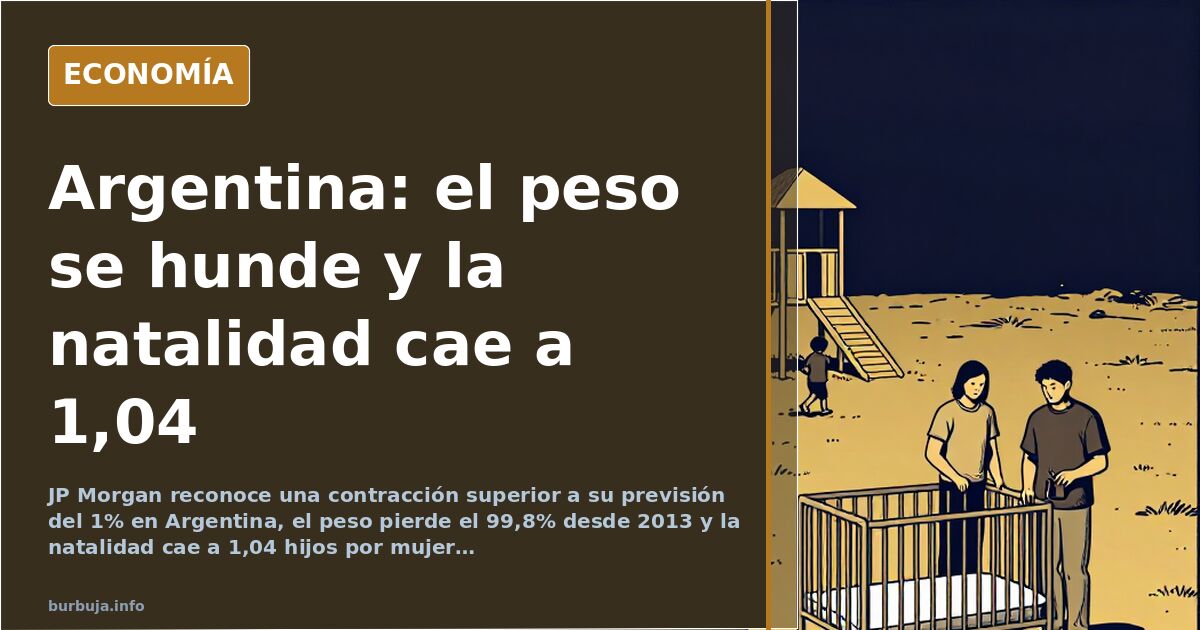
Argentina's Economy Shrinks Sharply as Birth Rate Hits 1.04
JP Morgan expected a monthly drop in activity around 1% in July. The actual data significantly exceeded that downward forecast. Meanwhile, the Argentine peso has hit a new historical low against the dollar, accumulating a value loss close to 99.8% since 2013, according to circulating data on the currency's evolution. The country's economy has been unable to find a bottom for months, with analysts revising their scenarios almost every week.
The other collapse is not in market headlines, but it is just as striking. Argentina's fertility rate stands at 1.04 children per woman, well below the generational replacement level. No province reaches this threshold. Buenos Aires City registers 0.79, and Jujuy province drops to 0.74. The national maximum is in Misiones, with 1.42. These are figures typical of East Asia, not the Southern Cone.
What JP Morgan Says About Economic Activity
The investment bank expected a weak figure for July, in line with a already sluggish second quarter. The reported contraction significantly exceeded that forecast. In other words: the bad scenario fell short. When the predicted floor breaks downward, V-shaped recovery models collapse, and debt, revenue, and employment projections must be redone.
The peso, meanwhile, continues on its path. It has lost virtually all its value against the dollar in just over a decade. This is not a temporary confidence problem: it is the accumulated consequence of printing banknotes, subsidizing tariffs, and maintaining an exchange rate the market does not buy. Each attempt to stabilize the nominal rate is eaten by inflation within months.
Argentina's Birth Rate at Asian Lows
The provincial fertility map leaves a picture with no exceptions. No region reaches replacement. The capital, with 0.79, is in the range of Hong Kong, Macao, or Singapore, territories where housing is unaffordable and there is no rural valve to escape to. In Argentina, there is countryside, and yet the collapse is general.
The debate on causes repeats in all countries that have gone through this. One school points to the economy: housing, two mandatory salaries, cost of raising children. Another points to cultural factors and incentives: who pays per child, who pays for private school, and who does not. The Argentine case adds a layer: social plans and informal employment miccionan that an additional child does not penalize lower strata, while among the wealthy, each child is an expense in dollars.
The Debate on Exchange Rate and Devaluation
The question running through analyses is whether the peso is expensive in real terms. The technical answer: if you devalue at 1% monthly with a crawling peg and inflation runs at 2-3%, the peso appreciates every month even if the sign number does not move. After twenty months of this, you are expensive without having touched a single decimal of the exchange rate.
The consequences are mechanical. Exports plummet because the producer earns in pesos an internal cost that has risen. Outbound tourism surges. And the need to devalue returns every so often, with the corresponding shift in prices. This is not a matter of political will: it is arithmetic of the real exchange rate.
International Comparisons No One Wants to Look At
Singapore has a fertility rate of 0.97 with the highest GDP per capita in Asia. It is not misery, not lack of subsidies, not lack of public housing: HDB housing is tied to marriage, and people marry at 32. Hong Kong and Macao are at 0.7-0.8. The pattern repeats: dense city, expensive housing, zero rural valve.
In Singapore, the Malay community maintains a fertility rate of 1.5 while Chinese and Tamil populations are below 1. Same city, same state, same healthcare. The difference is not income: it is religion, extended family, and expectations. Those who earn less raise more. It is the same pattern seen in any country with differentiated communities.
The Political Context: Milei, the Budget, and SMEs
Javier Milei's government faces the fourth consecutive fiscal surplus in the new budget, an unprecedented recent event in Argentine economic history. His defenders present it as proof that the adjustment works. His critics point out that the social cost has been high: rise in poverty, closure of SMEs, and destruction of productive tissue that lived on subsidized internal consumption.
The political question is whether this is enough to get re-elected. Foreign financial support and voter exhaustion with Peronism play in favor. The sustainability of the exchange rate, against. And birth rate, which cannot be fixed with a budget, trinc its own course.
With these data, the Argentine economy faces two simultaneous collapses: the peso and the birth rate. The first has graphs and headlines. The second is not seen on front pages, but in twenty years, it will be what explains everything else.
JP Morgan expected a monthly drop in activity around 1% in July. The actual data significantly exceeded that downward forecast. Meanwhile, the Argentine peso has hit a new historical low against the dollar, accumulating a value loss close to 99.8% since 2013, according to circulating data on the currency's evolution. The country's economy has been unable to find a bottom for months, with analysts revising their scenarios almost every week.
The other collapse is not in market headlines, but it is just as striking. Argentina's fertility rate stands at 1.04 children per woman, well below the generational replacement level. No province reaches this threshold. Buenos Aires City registers 0.79, and Jujuy province drops to 0.74. The national maximum is in Misiones, with 1.42. These are figures typical of East Asia, not the Southern Cone.
What JP Morgan Says About Economic Activity
The investment bank expected a weak figure for July, in line with a already sluggish second quarter. The reported contraction significantly exceeded that forecast. In other words: the bad scenario fell short. When the predicted floor breaks downward, V-shaped recovery models collapse, and debt, revenue, and employment projections must be redone.
The peso, meanwhile, continues on its path. It has lost virtually all its value against the dollar in just over a decade. This is not a temporary confidence problem: it is the accumulated consequence of printing banknotes, subsidizing tariffs, and maintaining an exchange rate the market does not buy. Each attempt to stabilize the nominal rate is eaten by inflation within months.
Argentina's Birth Rate at Asian Lows
The provincial fertility map leaves a picture with no exceptions. No region reaches replacement. The capital, with 0.79, is in the range of Hong Kong, Macao, or Singapore, territories where housing is unaffordable and there is no rural valve to escape to. In Argentina, there is countryside, and yet the collapse is general.
The debate on causes repeats in all countries that have gone through this. One school points to the economy: housing, two mandatory salaries, cost of raising children. Another points to cultural factors and incentives: who pays per child, who pays for private school, and who does not. The Argentine case adds a layer: social plans and informal employment miccionan that an additional child does not penalize lower strata, while among the wealthy, each child is an expense in dollars.
The Debate on Exchange Rate and Devaluation
The question running through analyses is whether the peso is expensive in real terms. The technical answer: if you devalue at 1% monthly with a crawling peg and inflation runs at 2-3%, the peso appreciates every month even if the sign number does not move. After twenty months of this, you are expensive without having touched a single decimal of the exchange rate.
The consequences are mechanical. Exports plummet because the producer earns in pesos an internal cost that has risen. Outbound tourism surges. And the need to devalue returns every so often, with the corresponding shift in prices. This is not a matter of political will: it is arithmetic of the real exchange rate.
International Comparisons No One Wants to Look At
Singapore has a fertility rate of 0.97 with the highest GDP per capita in Asia. It is not misery, not lack of subsidies, not lack of public housing: HDB housing is tied to marriage, and people marry at 32. Hong Kong and Macao are at 0.7-0.8. The pattern repeats: dense city, expensive housing, zero rural valve.
In Singapore, the Malay community maintains a fertility rate of 1.5 while Chinese and Tamil populations are below 1. Same city, same state, same healthcare. The difference is not income: it is religion, extended family, and expectations. Those who earn less raise more. It is the same pattern seen in any country with differentiated communities.
The Political Context: Milei, the Budget, and SMEs
Javier Milei's government faces the fourth consecutive fiscal surplus in the new budget, an unprecedented recent event in Argentine economic history. His defenders present it as proof that the adjustment works. His critics point out that the social cost has been high: rise in poverty, closure of SMEs, and destruction of productive tissue that lived on subsidized internal consumption.
The political question is whether this is enough to get re-elected. Foreign financial support and voter exhaustion with Peronism play in favor. The sustainability of the exchange rate, against. And birth rate, which cannot be fixed with a budget, trinc its own course.
With these data, the Argentine economy faces two simultaneous collapses: the peso and the birth rate. The first has graphs and headlines. The second is not seen on front pages, but in twenty years, it will be what explains everything else.
Summary of a discussion on Burbuja.info - Foro de economía, actualidad y política., translated from Spanish and reviewed before publication. Read the full discussion (289 replies).
More summaries
-
Milei loses Buenos Aires election, threatening his government
Peronists win Buenos Aires with 47% against Milei's 34%, a 13-point gap, raising currency run risks before...
-
Spain recalls ambassador to Argentina after clash with Milei
Spain permanently withdraws its ambassador to Buenos Aires following a diplomatic row with Argentine President Javier Milei over Begoña Gómez, impacting 475,000 residents and billions in assets.
-
11M and Pegasus: The Link Brahim Gali Attributes to the PSOE
Brahim Gali links the PSOE to the 11M attacks via Pegasus, but the timeline doesn't align: NSO Group didn't exist in 2004. An analysis of the detail that challenges the narrative.
-
Sibila Freijo: Smart Women Prefer Younger Men
Spanish author Sibila Freijo argues that intelligent women are attracted to younger men, criticizing the double standard applied to actress Aitana Sánchez-Gijón.
-
Julio Iglesias faces sexual assault allegations from former staff
Two former employees accuse Julio Iglesias of sexual assault. Unproven testimonies reignite debate on presumption of innocence in Spain.
-
Cold White LEDs Erase Warm City Lights
Replacing sodium lamps with cold white LEDs transforms urban nights, reducing warmth and increasing light pollution.