
José Mota’s subsidized humor: 24 New Year specials
José Mota has aired 24 New Year specials on La 1. The debate over whether his humor whitewashes the government or genuinely criticizes it returns every December.
English · Original discussion in Spanish · Published
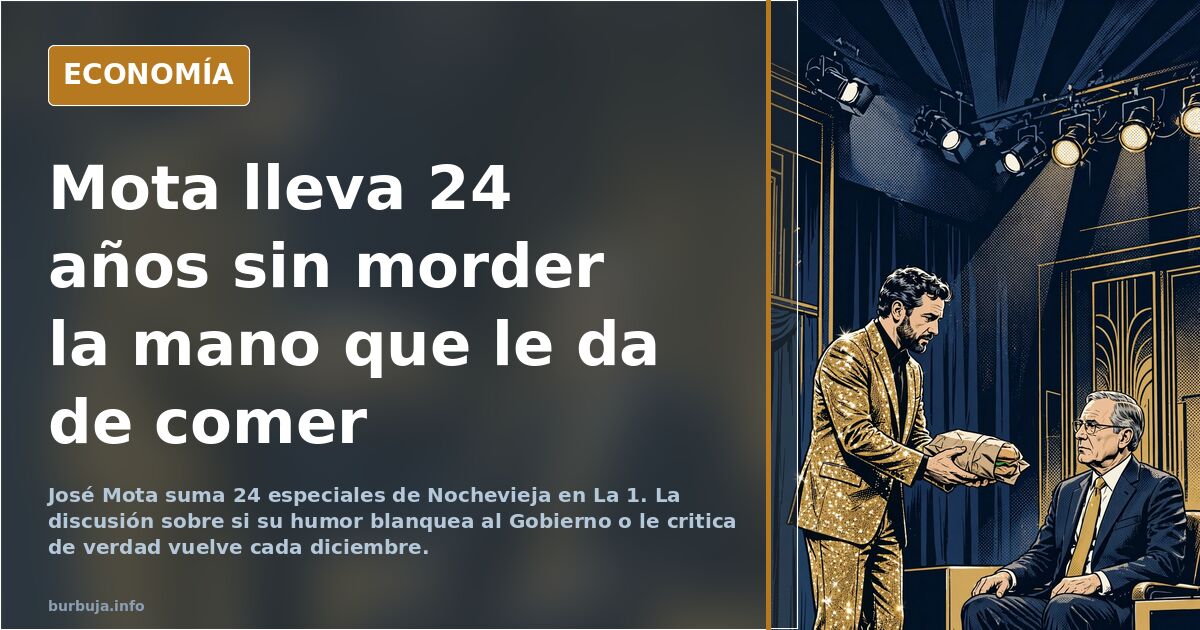
José Mota and the humor that doesn’t bite the hand that feeds it
Can you make critical humor on public television without losing your job? José Mota has been signing off the New Year special on La 1 since 1999, with only two absences (2012 and 2013), totaling 24 consecutive years in the same role. This year’s broadcast peine the usual discussion: does the comedian laugh at power, or does he pave the way for it? According to most reactions collected, the answer is that he laughs with power, not at it.
Does Mota whitewash politicians or really give them a hard time?
The central accusation is that the program turns “government absurdities” into “giggles,” according to the initial premise. The thesis running through the entire discussion is that a show aired on public television cannot bite the hand that pays its salary. The argument rests on an objective fact: 24 years in the same position are not achieved, argues one of the most highly rated comments, by “biting the hand that feeds you.”
Some nuance the issue. One current defends that this year the comedian took shots at “partisan” journalists and ridiculed politicians “as only he knows how.” The end of the program, a plea for the people, is cited as proof that criticism existed. The counter-rebuttal comes quickly: if criticizing the current government is allowed, it’s because making jokes only about the opposition would be “too obvious,” and because whitewashing corruption and normalizing the system’s miseries is, precisely, the useful function of televised humor.
Power distribution on stage: who appears and who gets paid
A less commented but more uncomfortable axis is that of the extras. It asks why no relevant woman appears except Mota’s own vvife. The answer given is that women do appear, “some of them regulars,” but the problem isn’t how many, but who they are and how much they earn compared to men. In other words: the stage reproduces the same pay hierarchy as the rest of the audiovisual sector.
The underlying critique is not just political. It is economic. A program with “damn good technical resources” and a notable deployment of extras is compared to the slapstick humor of Martes y Trece, where laughter came from artisanal disaster. The implicit conclusion: when there is public budget behind it, the product becomes aseptic, polished, and perfectly harmless.
Humor as a thermometer of antiestéticar
The most repeated diagnosis is that Spanish humor has lost its fangs. Irreverence requires turning around the mantras of the moment, and today that isn’t done. The topics that should be in the crosshairs —according to this reading— are others, and the jokes aired are “rehashed two billion times.” The few names that survive are foreign or peripheral.
The technical detail that raises the most blisters is that of canned laughter. The complaint is unanimous: let people laugh when they feel like it, not when the signal sounds. It is the perfect symptom of humor that no longer trusts its own material.
In the end, the program fulfills its function: entertaining without discomforting those who sign the checks. Twenty-four years allow for a lot, but not for a joke that truly hurts.
Also available in: Deutsch
Summary of a discussion on Burbuja.info - Foro de economía, actualidad y política., translated from Spanish and reviewed before publication. Read the full discussion (123 replies).
More summaries
-
Carlos Latre's Ayuso impression ignites political humour row
Carlos Latre impersonates Isabel Díaz Ayuso on El Hormiguero, reopening the debate over double standards in political humour
-
PSOE and Junts to announce investiture pact Thursday
PSOE and Junts will reveal their investiture agreement on Thursday, reigniting Spain's territorial debate.
-
El Jueves: Subsidies, talent drain and satirical decline
Controversial covers, artist exodus, AI use and public subsidies define the crisis facing Spain's iconic satirical magazine El Jueves.
-
Turkey's Deposit Freeze: $18 Billion Locked for Investors
Over 500,000 Turkish investors face frozen assets in funds promising triple-digit returns. The freeze blocks withdrawals of $18 billion, sparking Ponzi scheme allegations.
-
Ebola alert in San Sebastián, Spain: suspected case turns out to be malaria
A woman who had travelled to the Central African Republic was admitted to Donostia Hospital with Ebola-compatible symptoms. She actually had malaria. The case…
-
Customer reports home insurance policy cancelled after two claims in one year
A user describes losing his home insurance after 35 years and two claims. Others report similar cases with the same and other insurers.