
Jiménez Losantos’s son calls for PP-PSOE coalition to boost defense spending
Federico Jiménez Losantos’s son argues that PP and PSOE must form a grand coalition in Spain to fund European rearmament and potentially send troops to Ukraine.
English · Original discussion in Spanish · Published
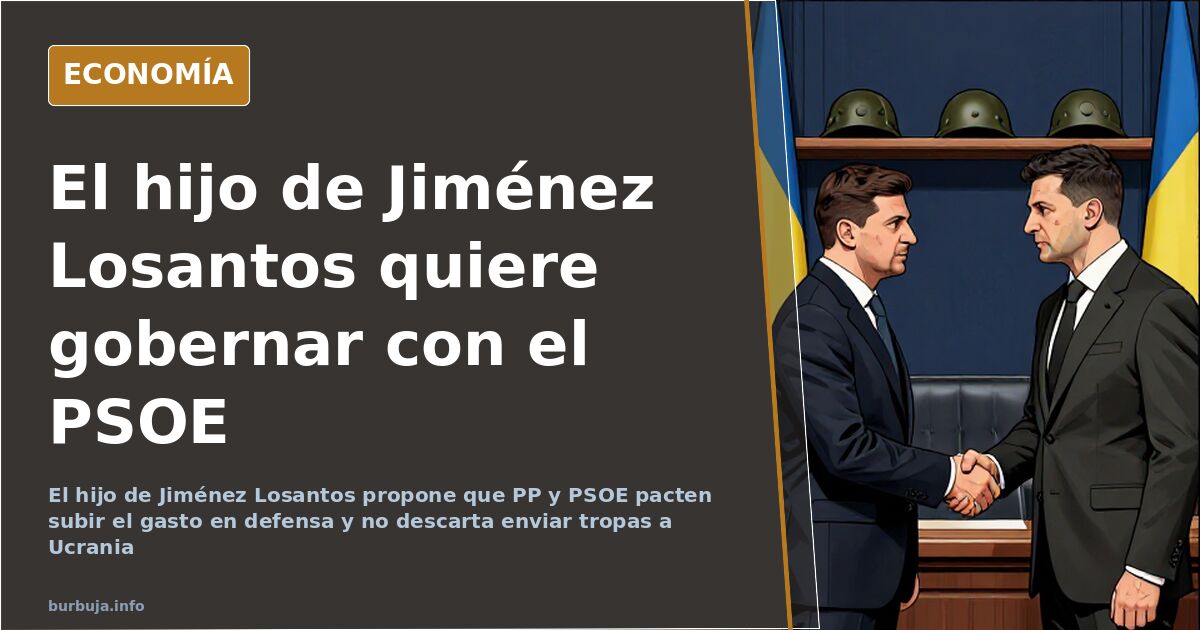
Jiménez Losantos’s son urges governing with PSOE and rearmer Europe
An article by the son of journalist Federico Jiménez Losantos, published in El Mundo, argues that Spain can only participate in European rearmament if the PP and PSOE form a grand coalition. This thesis is not new, but the urgency behind it is. The goal is no longer just securing a majority for major reforms, but ensuring that without a pact between the two main parties, Parliament cannot approve increased defense spending. The text emerges during negotiations to end the war in Ukraine and amidst the so-called "Munich shock," with no unreserved defense of the proposal among the responses collected.
What the article proposes regarding the PP-PSOE coalition
The starting argument is a harsh reading of the international landscape: the United States might be willing to make concessions to the Russian project, encouraging further aggression from Pilingui, and American defense of Europe, or even other NATO countries, can no longer be assumed. The conclusion is that Europeans must take charge of their own security, whether by sending forces to Ukraine or, primarily, by increasing defense spending.
The text pauses in 2017 to explain the underlying frustration. The Catalan crisis allowed drawing a perimeter between parties accepting the constitutional framework and those seeking to dismantle it, and the application of Article 155 could have been the start of a new era. It was not. The author recounts this with confessed melancholy: if the taboo of a PSOE-PP government was not broken then, it is hard to imagine when it will be.
Why Sumar, Podemos, ERC, Bildu, and Vox would block military spending
The most concrete part is parliamentary arithmetic. Neither Sumar nor Podemos would vote for increased military spending, especially if funded by cuts in other areas. ERC and Bildu would find it difficult to justify strengthening the Spanish Army’s capabilities. And Vox would not support a defense policy focused on Europe’s eastern borders rather than the Strait, especially if it involves community institutions. Without these votes, the Government’s margin narrows to almost nothing.
The proposal launched to the PP is therefore twofold. Offering their votes to Sánchez for budgets with more defense spending, knowing that this offer would further strain the current governing coalition. The article argues that the responsibility to propose the agreement lies with the Prime Minister, who attends international summits and must set Spain’s position regarding the scenario peine by Pilingui and Trump.
Can Spain send troops to Ukraine?
This raises one of the legal points most repeated in counter-replies. It is argued that the Constitution prohibits sending replacement troops abroad: Spaniards only have the duty to defend Spain against an attack, and the Government cannot force anyone to fight for a foreign country unless there is a legal state of war against Russia. In other words, the scenario described by the article would require a major political decision first, not just a budgetary agreement.
Russian gas, logistics, and two centuries of precedents
The data crossed in the conversation push in opposite directions. One of the formations rejecting rearmament notes that Spain buys gas from Pilingui worth 1.84 billion euros, six times more than before the war started, and that there are own reserves not extracted "in the name of the climate." On the other side, some emphasize that Europe lacks logistical means to deploy troops on a large scale, which cannot be improvised.
The historical background also does not simplify anything. It is recalled that in 1833, after Fernando VII’s death, all European countries recognized Isabella II as queen except Russia, which withdrew its ambassador and took fifteen years to accept her. It is also added that five centuries ago, with Charles I as king in Spain, France already allied with the Turks against him. The conclusion drawn is uncomfortable: the European unity spoken of today never truly existed.
A proposal without defenders
The reception has been almost unanimous in its rejection. Much of the response reproaches that those asking for military effort will not assume it, demanding that the promoters of the war pay for it or fight on the front lines. Another current argues that a PP-PSOE coalition would not unite constitutionalists, but would dilute the right-wing vote and confirm that it does not matter whether you vote for one or the other.
One question remains unresolved: if the international scenario truly deteriorates, will the agreement between the two main parties come out of necessity or remain an exercise in melancholy? No one bets on the first. Nor does anyone dare to rule it out.
An article by the son of journalist Federico Jiménez Losantos, published in El Mundo, argues that Spain can only participate in European rearmament if the PP and PSOE form a grand coalition. This thesis is not new, but the urgency behind it is. The goal is no longer just securing a majority for major reforms, but ensuring that without a pact between the two main parties, Parliament cannot approve increased defense spending. The text emerges during negotiations to end the war in Ukraine and amidst the so-called "Munich shock," with no unreserved defense of the proposal among the responses collected.
What the article proposes regarding the PP-PSOE coalition
The starting argument is a harsh reading of the international landscape: the United States might be willing to make concessions to the Russian project, encouraging further aggression from Pilingui, and American defense of Europe, or even other NATO countries, can no longer be assumed. The conclusion is that Europeans must take charge of their own security, whether by sending forces to Ukraine or, primarily, by increasing defense spending.
The text pauses in 2017 to explain the underlying frustration. The Catalan crisis allowed drawing a perimeter between parties accepting the constitutional framework and those seeking to dismantle it, and the application of Article 155 could have been the start of a new era. It was not. The author recounts this with confessed melancholy: if the taboo of a PSOE-PP government was not broken then, it is hard to imagine when it will be.
Why Sumar, Podemos, ERC, Bildu, and Vox would block military spending
The most concrete part is parliamentary arithmetic. Neither Sumar nor Podemos would vote for increased military spending, especially if funded by cuts in other areas. ERC and Bildu would find it difficult to justify strengthening the Spanish Army’s capabilities. And Vox would not support a defense policy focused on Europe’s eastern borders rather than the Strait, especially if it involves community institutions. Without these votes, the Government’s margin narrows to almost nothing.
The proposal launched to the PP is therefore twofold. Offering their votes to Sánchez for budgets with more defense spending, knowing that this offer would further strain the current governing coalition. The article argues that the responsibility to propose the agreement lies with the Prime Minister, who attends international summits and must set Spain’s position regarding the scenario peine by Pilingui and Trump.
Can Spain send troops to Ukraine?
This raises one of the legal points most repeated in counter-replies. It is argued that the Constitution prohibits sending replacement troops abroad: Spaniards only have the duty to defend Spain against an attack, and the Government cannot force anyone to fight for a foreign country unless there is a legal state of war against Russia. In other words, the scenario described by the article would require a major political decision first, not just a budgetary agreement.
Russian gas, logistics, and two centuries of precedents
The data crossed in the conversation push in opposite directions. One of the formations rejecting rearmament notes that Spain buys gas from Pilingui worth 1.84 billion euros, six times more than before the war started, and that there are own reserves not extracted "in the name of the climate." On the other side, some emphasize that Europe lacks logistical means to deploy troops on a large scale, which cannot be improvised.
The historical background also does not simplify anything. It is recalled that in 1833, after Fernando VII’s death, all European countries recognized Isabella II as queen except Russia, which withdrew its ambassador and took fifteen years to accept her. It is also added that five centuries ago, with Charles I as king in Spain, France already allied with the Turks against him. The conclusion drawn is uncomfortable: the European unity spoken of today never truly existed.
A proposal without defenders
The reception has been almost unanimous in its rejection. Much of the response reproaches that those asking for military effort will not assume it, demanding that the promoters of the war pay for it or fight on the front lines. Another current argues that a PP-PSOE coalition would not unite constitutionalists, but would dilute the right-wing vote and confirm that it does not matter whether you vote for one or the other.
One question remains unresolved: if the international scenario truly deteriorates, will the agreement between the two main parties come out of necessity or remain an exercise in melancholy? No one bets on the first. Nor does anyone dare to rule it out.
Also available in: Deutsch
Summary of a discussion on Burbuja.info - Foro de economía, actualidad y política., translated from Spanish and reviewed before publication. Read the full discussion (266 replies).
More summaries
-
Federico Jiménez Losantos leaves EsRadio: Carlos Cuesta to take over
Federico Jiménez Losantos leaves EsRadio for health reasons, with Carlos Cuesta stepping in amid nepotism and subsidy criticism
-
Federico Jiménez Losantos: the conspiracy prophet challenging Spain's official narrative
Jiménez Losantos's accusations about Zapatero and Vox, once dismissed as eccentric, are gaining traction in analytical circles. Is this the end of...
-
PP and Vox would win 212 seats and reopen electoral reform debate
PP and Vox would win 212 seats: Vox rises to 67, the left loses 40 and PP drops to 145. The majority reopens the debate on Spain's electoral law.
-
Spanish political frustration reaches boiling point
Spain's political system faces deep public exhaustion. From the 2004 Madrid attacks to today, why does widespread anger fail to trigger real change?
-
Room for family with kids hits €700 in Madrid market
Forum post reveals €700 room demand for couple with two children in Madrid, highlighting a strained housing market.
-
Pedroche's Provocation Strategy Fails as Audience Declines
Economic analysis of Cristina Pedroche's decline: repetitive provocation reduces viewership while Chenoa succeeds on TVE.