
Jazztel stock rose from €2.90 to €9 amid triangle breakout
Jazztel shares surged from €2.90 to over €9, driven by technical patterns, Cyprus haircuts, and unconfirmed Orange takeover rumors.
English · Original discussion in Spanish · Published
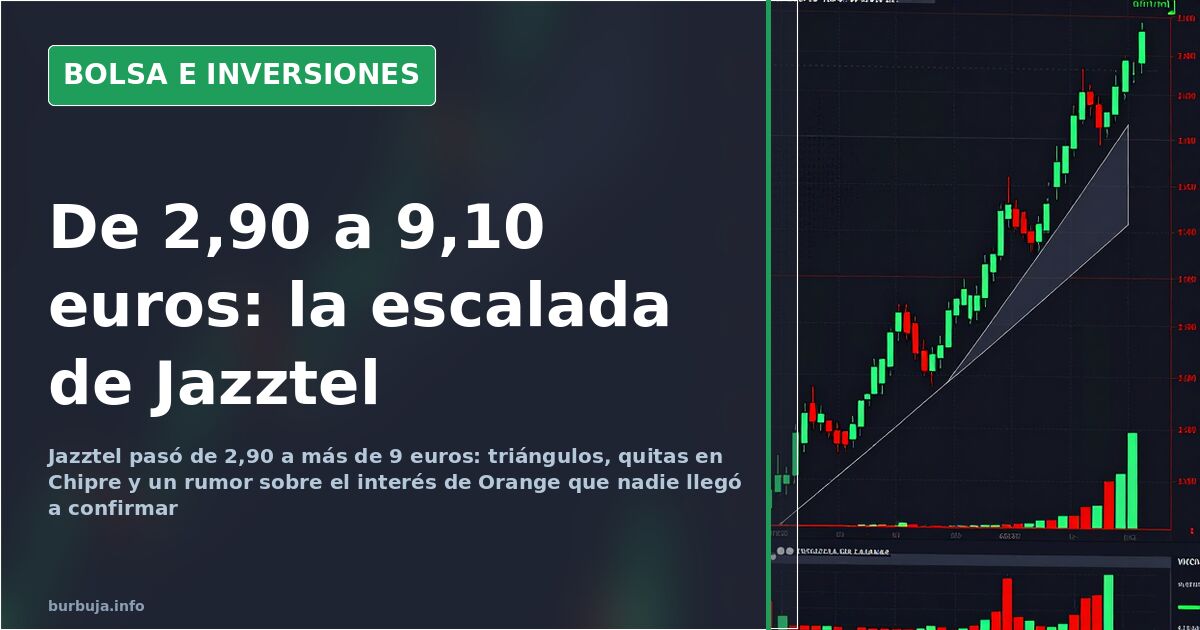
Jazztel: From €2.90 to €9.10 without breaking the triangle
Jazztel looked like an easy buy at €2.90. It only required believing the stock would break a four-cent resistance level and waiting for the move. The thesis held for years: first €3.20, then €4, later €6.70, and finally €9 when it seemed exhausted. The uncomfortable part of the story is not the prediction itself, but that the analyst who made it exited at €6.82, leaving the final leg to others.
The initial proposal was specific. The stock had closed at €2.90, attempted to surpass €2.94, and once that level broke, it had a clear path to €3.20. This wasn't just barroom speculation, even if it sounded like it: it relied on something anyone can draw on a chart—a triangle compressing the price.
The rest of the analysis adds nuance. First came reasonable doubts. Those who bought at €2.65 three months earlier were sitting on a 10% gain and hesitated between taking profits or holding, with a minor resistance pending just four cents away. Opposing this was the textbook bearish scenario: if someone had lent their shares at €0.27 before the reverse split, they logically wouldn't let them lose value.
Targets achieved: €3.20, €4, €5.25, and €6.70
The sequence played out with precision that unsettles fund managers. The triangle broke upward, the stock rose more than 5% in one session, and closed above €3. From there to €3.30, then €3.59, and as the fiscal year ended, the declared target of €4. No one signed off on a report mapping this exact route. It was sustained by accumulation, rising volume, and large trades that, in an optimistic reading, revealed institutional investors entering quietly.
What trinc was less epic and more arithmetic. The stock reached €4.95, eyeing the €5.25 resistance, then chained moves to €5.80 and €6.70. When the price closed exactly at that level, the roadmap was complete. The forecast author stated plainly: target achieved. He added the phrase rarely found in investment brochures: let someone else earn the last euro.
A curious detail is that the rally occurred during July, a month when the stock typically slept. Results supported it—the multi-year plan exceeded forecasts and the new plan presented deliberately conservative estimates, having already met the 800,000 mobile number portability target—but charts don't rise because of balance sheets. They rise because people buy with volume.
Why buy Jazztel while the Euro fractured in Cyprus?
Cyprus reminded investors that markets don't live in isolation. The haircut on deposits and current accounts in a Eurozone member country, with percentages debated between 10% and 6.75%, left many viewing their bank balances with distrust. That episode helps explain why those seeking refuge looked toward a mid-sized Spanish telecom rather than bank deposits.
The question remains relevant: how much of the rise was due to company merit versus antiestéticar of banks? There is no clean answer. The company met targets, added customers, and reported positive accounts for the first time; the market debated whether that was enough to sustain the price.
After a session dropping nearly 5%, doubt arose about unwinding positions. There was no consensus—never is—but the stock rebounded at support and continued rising. Some argue it was the best thermometer of investor confidence during those weeks.
Who held since 2010 and who sold too early
The most extreme case involves a position peine in 2007. Seven years through the desert and an automatic exit at €9.10, just before the stock climbed further. Profit: around €2,000 and a bittersweet feeling summarized in two words: FOMO.
On the other end are those who entered below €3 and remain inside, watching the quote almost daily, keeping their 2010 position intact with no intention of switching providers: they remain customers of the telecom. When they sell, they say, they will also have FOMO.
The lesson, if there is one, is that stop-losses protect against ruin but ruin returns. Those who sold at €6.82 weren't wrong; they simply stopped believing in their own target before it materialized. Those who held without checking indicators earned more.
Orange, Credit Suisse, and a single-day 4% move
The final leg arrived wrapped in speculation. A rumor about Orange's interest moved the stock 4% in one session, putting a potential deal on the table without confirmation. Such news sells newspapers but clarifies nothing: if the deal exists, the price is unknown; if not, the move has already peine.
What can be measured is who was buying. Credit Suisse appeared as an aggressive buyer and the largest of the year, behind only JP Morgan and Morgan Stanley. Volumes above average, closes at highs, and a symbolic resistance at €6.70 ceased to be a ceiling and became a floor. Daily agency tracking with specific amounts and sessions is beyond this scope.
On January 29, 2014, the stock closed above €9. The intraday range moved between €8.96 and €9.23, a spread of nearly thirty cents offering plenty for day traders but little comfort for steady portfolios.
With the price above €9 and alleged buyer interest on the table, remaining upside is uncertain. The climb from €2.90 is explained by fundamentals, triangles, and banking antiestéticar. What comes next depends on whether Orange confirms or denies. If confirmed, the buyer sets the price; if not, someone will stare at the screen with an open position and no technical excuse.
Jazztel looked like an easy buy at €2.90. It only required believing the stock would break a four-cent resistance level and waiting for the move. The thesis held for years: first €3.20, then €4, later €6.70, and finally €9 when it seemed exhausted. The uncomfortable part of the story is not the prediction itself, but that the analyst who made it exited at €6.82, leaving the final leg to others.
The initial proposal was specific. The stock had closed at €2.90, attempted to surpass €2.94, and once that level broke, it had a clear path to €3.20. This wasn't just barroom speculation, even if it sounded like it: it relied on something anyone can draw on a chart—a triangle compressing the price.
The rest of the analysis adds nuance. First came reasonable doubts. Those who bought at €2.65 three months earlier were sitting on a 10% gain and hesitated between taking profits or holding, with a minor resistance pending just four cents away. Opposing this was the textbook bearish scenario: if someone had lent their shares at €0.27 before the reverse split, they logically wouldn't let them lose value.
Targets achieved: €3.20, €4, €5.25, and €6.70
The sequence played out with precision that unsettles fund managers. The triangle broke upward, the stock rose more than 5% in one session, and closed above €3. From there to €3.30, then €3.59, and as the fiscal year ended, the declared target of €4. No one signed off on a report mapping this exact route. It was sustained by accumulation, rising volume, and large trades that, in an optimistic reading, revealed institutional investors entering quietly.
What trinc was less epic and more arithmetic. The stock reached €4.95, eyeing the €5.25 resistance, then chained moves to €5.80 and €6.70. When the price closed exactly at that level, the roadmap was complete. The forecast author stated plainly: target achieved. He added the phrase rarely found in investment brochures: let someone else earn the last euro.
A curious detail is that the rally occurred during July, a month when the stock typically slept. Results supported it—the multi-year plan exceeded forecasts and the new plan presented deliberately conservative estimates, having already met the 800,000 mobile number portability target—but charts don't rise because of balance sheets. They rise because people buy with volume.
Why buy Jazztel while the Euro fractured in Cyprus?
Cyprus reminded investors that markets don't live in isolation. The haircut on deposits and current accounts in a Eurozone member country, with percentages debated between 10% and 6.75%, left many viewing their bank balances with distrust. That episode helps explain why those seeking refuge looked toward a mid-sized Spanish telecom rather than bank deposits.
The question remains relevant: how much of the rise was due to company merit versus antiestéticar of banks? There is no clean answer. The company met targets, added customers, and reported positive accounts for the first time; the market debated whether that was enough to sustain the price.
After a session dropping nearly 5%, doubt arose about unwinding positions. There was no consensus—never is—but the stock rebounded at support and continued rising. Some argue it was the best thermometer of investor confidence during those weeks.
Who held since 2010 and who sold too early
The most extreme case involves a position peine in 2007. Seven years through the desert and an automatic exit at €9.10, just before the stock climbed further. Profit: around €2,000 and a bittersweet feeling summarized in two words: FOMO.
On the other end are those who entered below €3 and remain inside, watching the quote almost daily, keeping their 2010 position intact with no intention of switching providers: they remain customers of the telecom. When they sell, they say, they will also have FOMO.
The lesson, if there is one, is that stop-losses protect against ruin but ruin returns. Those who sold at €6.82 weren't wrong; they simply stopped believing in their own target before it materialized. Those who held without checking indicators earned more.
Orange, Credit Suisse, and a single-day 4% move
The final leg arrived wrapped in speculation. A rumor about Orange's interest moved the stock 4% in one session, putting a potential deal on the table without confirmation. Such news sells newspapers but clarifies nothing: if the deal exists, the price is unknown; if not, the move has already peine.
What can be measured is who was buying. Credit Suisse appeared as an aggressive buyer and the largest of the year, behind only JP Morgan and Morgan Stanley. Volumes above average, closes at highs, and a symbolic resistance at €6.70 ceased to be a ceiling and became a floor. Daily agency tracking with specific amounts and sessions is beyond this scope.
On January 29, 2014, the stock closed above €9. The intraday range moved between €8.96 and €9.23, a spread of nearly thirty cents offering plenty for day traders but little comfort for steady portfolios.
With the price above €9 and alleged buyer interest on the table, remaining upside is uncertain. The climb from €2.90 is explained by fundamentals, triangles, and banking antiestéticar. What comes next depends on whether Orange confirms or denies. If confirmed, the buyer sets the price; if not, someone will stare at the screen with an open position and no technical excuse.
Summary of a discussion on Burbuja.info - Foro de economía, actualidad y política., translated from Spanish and reviewed before publication. Read the full discussion (141 replies).
More summaries
-
Leveraging Telefónica: The €40,000 Loan That Went Wrong
An investor borrowed €40,000 to buy Telefónica at €5.41. The stock fell, he doubled the bet to €60,000, and ended up asking family for help. Six years…
-
Ibex March 2013: The Big Move Looms as the Hare Bolts
Ibex rose in March 2013 amid Cyprus bailout. Targets of 8,600, 9,400, and 9,700, Acerinox vs. Arcelor, and the human cost of trading.
-
IBEX 8,000 in February 2013: The Rebound Nobody Believed In
The IBEX held above 8,000 points in February 2013, while the market bet on a crash. The VIX soared, and Bankia planned a 1.5 billion share increase.
-
Bayer at 19.80 and Novo at 55: the dividend investor's magnet
Bayer bought at 40.23 euros and topped up at 19.80; Novo Nordisk falls 21% and is bought at 55. A breakdown of dividend investing.
-
Financial Freedom: €576,000 for €1,600 Monthly Income
Accumulating €576,000 allows living on €1,600 monthly without working, according to calculations dominating financial freedom discussions.
-
Bitcoin: 288,000 daily payments and energy use exceeding Switzerland
The Bitcoin network processes 288,000 transactions per day while consuming more electricity than Switzerland. Calculations on its actual capacity as money fall short of the promise.