
Javelin: the $175,000 missile bleeding Russia's logistics dry
The Javelin costs $174,000 per missile and strikes from above, hitting Russian logistics and the morale of advancing troops. Key technical and economic facts.
English · Original discussion in Spanish · Published
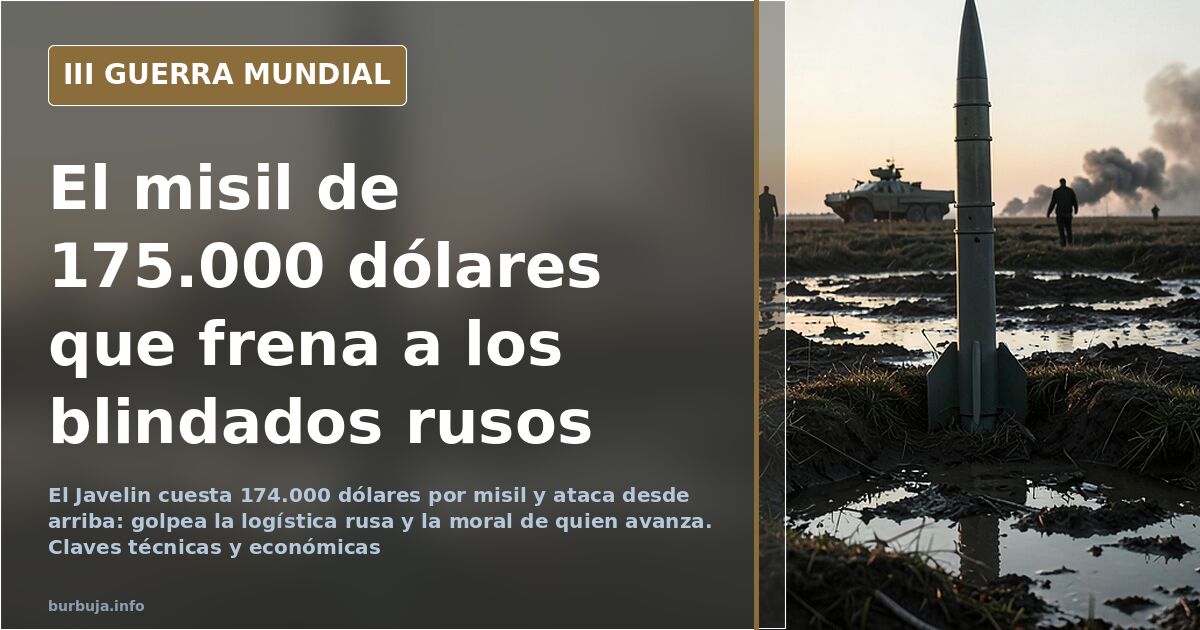
The $175,000 missile that turns armored vehicles into scrap metal
A missile that costs more than many of the vehicles it destroys. The Javelin has become the most talked-about weapon of the war in Ukraine: a portable system that attacks from above, where the armor is thinnest, and requires no guidance until impact. The thesis running through this story is twofold: it hits Russian logistics and, above all, undermines the sarracena of anyone advancing knowing that any window could spit out a rocket.
The price is no minor detail. Each missile runs around $174,000, and the launch unit (the CLU) was going for about $280,000 in 2020, according to available figures. On top of that, the disposable single-use anti-tank tube is a different thing entirely: you fire it and throw it away. Confusing the two has fueled more than one argument.
How a Javelin works and why it's said to attack from above
The system offers two attack modes: frontal, like a conventional anti-tank weapon, or top-attack, in which the missile climbs and falls onto the weakest part of the vehicle. It is fire and forget: you lock onto the target and the projectile does the rest. There's no need to guide it like a TOW or a Konkurs. That cuts training down to just a few days, which explains its popularity among irregular troops.
The other leg is the Turkish Bayraktar TB2 drone, which according to shared footage strikes convoys, command posts and electronic warfare systems behind the lines. Some downplay its real weight: they carry few bombs and don't blow up tanks through armor, but they do hit fuel tankers. And a stationary tanker leaves dozens of vehicles without fuel.
The debate over Javelins captured in the Donbas
The most repeated objection is that tons of these weapons end up in the hands of the pro-Russian forces in the Donbas. The technical counterargument: Javelins carry geolocation, usage logging, and require their specific rockets, so a captured tube without ammunition or unlocking is of little use. The used casing of a disposable launcher has also shown up in more than one "capture" photo.
The precedent cited is that of the Exocets in the Falklands War, when Argentina eventually obtained the codes that allowed the missiles to hit the British fleet. The comparison is catchy, though no one has proven it can be replicated with this technology.
Russia's attrition: irreplaceable trucks and obsolete armored vehicles
The economic argument carries the most weight. Every BMD-2 lost is one fewer, every destroyed truck is irreplaceable in the short and medium term. And there's no lend-lease plan like the one that supplied the USSR with Shermans and Studebakers. Now the equipment goes to Ukraine and, later on, to Poland or the Baltic countries.
The other side: some argue Russia is using expired equipment and its least experienced troops, and that with its best assets the conflict would have lasted two days. The counterargument is that sending rookies to the slaughter while the adversary arms itself and gains experience is not a plan, it's a miscalculation.
Psychological warfare and the limits of propaganda
The demoralizing effect is real: advancing with the certainty that any bush could hide a tube changes how you move. But some also downplay the narrative: conventional artillery and rocket launchers are doing more damage than the Javelins and drones, and there are ten or fifteen Bayraktar videos, not a hundred. Propaganda travels faster than the projectile.
The American taxpayer pays the price for all this, and that's where the recurring joke about the party girls on Gran Vía comes in. Trench humor for a bill that is no joke.
How much of this narrative will withstand scrutiny once the real figures for equipment delivered and destroyed are published?
Also available in: Deutsch
Summary of a discussion on Burbuja.info - Foro de economía, actualidad y política., translated from Spanish and reviewed before publication. Read the full discussion (55 replies).
More summaries
-
Stoltenberg demands China pay for backing Russia
Stoltenberg calls on China to pay for supporting Russia and announces sanctions. The debate looks at the cost for Europe and the shift toward the BRICS.
-
Ukraine War Bot Accusations Backfire on List Creator
A list accusing 30+ accounts of being pro-NATO bots in the Ukraine war ended up labeling its creator as a suspected pro-Russian bot.
-
Ukraine war sparks death threats in online forums
Digital conversations about the Ukraine war increasingly resolve disagreements with personal death threats and hate speech.
-
Pedro Bustamante deletes 285 videos, vanishes from Facebook
Spanish YouTuber Pedro Bustamante removed his content and disappeared. Rumors place him in Munich, reading German press.
-
María Corina Machado's rally in Caracas draws only a few hundred people
A rally by María Corina Machado in Plaza Venezuela gathered several hundred people, according to circulating estimates. The figure falls far short of even 0.02% of the population.
-
Israel weighs jail terms for Christian evangelism
Two Israeli lawmakers propose punishing Christian evangelism with up to two years in prison. Brownback warns of the risk to religious freedom.