
Japan as the Best Place to Live: Security vs. Social Cost
A forum debate weighs Japan's high safety and cleanliness against social isolation and suicide rates to determine if it is the best country to live in.
English · Original discussion in Spanish · Published
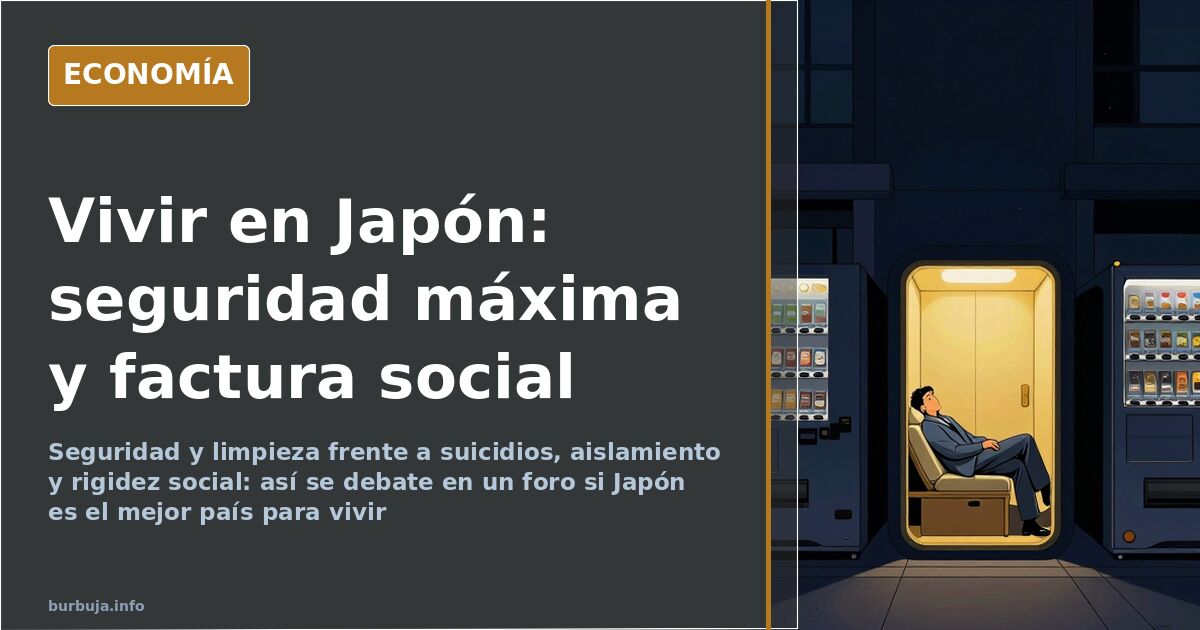
Japan as a Living Paradise: Maximum Security and Social Bill
The thesis repeats in the thread: Japan is possibly the best country in the world to live in. The supporting inventory is well-known — very low crime, spotless streets, meticulous education, and earthquake-proof buildings — and repeats with little variation. The sustancia ilegal appears when this inventory crosses with what doesn't appear in the postcards: suicides, isolation, and a workday that consumes private life.
Arguments for Placing Japan at the Top
The package of arguments is broad. There is talk of virtually non-existent crime, cleanliness that has become exceptional in Spain, a society that respects rules without surveillance, and infrastructure that withstands whatever is thrown at it. The detail is added that women and society preserve traditional customs, presented as a virtue rather than a brake. The identity aspect also slips in: cultural homogeneity and restrictive immigration policy, defended as part of the appeal rather than its cost.
Among the antiestéticars, the only admitted one is seismic, usually dismissed with the argument that local engineering is already paid for. In other words: the risk exists, but is considered internalized.
Security as a Major Asset
No one disputes that security is Japan's main product. Those who have been to Tokyo describe the feeling that no stranger will ruin your day, something in much of Europe sounds like science fiction. Another summarizes the paradox with irony: in a dystopia you can also leave your laptop in the cafeteria while you go to the bathroom. It is not a defense of the model, but a reminder that order and subjective well-being do not always go hand in hand.
The comparison with Spain reappears several times: noise, incivility, neglect in maintenance, and a supposed national frankness that from outside is read as mere brusqueness. Some even argue that Spanish sincerity, so claimed, is in practice a sum of disrespect.
Suicides, Isolation, and a Scarce Sens Life
The counterpoint comes quickly and always from the same side. High suicide rates, hikikomori who lock themselves in their rooms for years, and a scarce sens life paint a less idyllic country than the storefront suggests. The rigidity of social protocols also appears as part of the same picture. Those who defend the system respond that Spain beats them equally or more, that the violent death statistics are not exemplary, and that the speck in the other's eye is always seen better. The exchange does not close.
Tatemae: Why Courtesy Can Be a Value and Not a Lie
Much of the disagreement lies in tatemae, the friendly facade shown in public versus what is truly thought. From the Spanish perspective, it seems pure hypocrisy. From within, those who have spent half their life there defend it as one of the country's best inventions: politeness does not oblige one to tell the truth, and in the long run, it is more livable than daily quarreling. Another voice in the thread describes Japan as the most collectivist democracy in the world, where people do what is expected of them without moving a millimeter from the unwritten rule.
The Foreigner's Wall: Language, Hours, and Etiquette
The second brake is practical. Learning Japanese and its writing is a barrier that hardly appears in postcard videos, and the country remains an island without bridges to the continent. Those who have worked there warn that Tokyo's climate is bad, the work rhythm is harsh, and integration is simply impossible: you will always be the outsider, even with a local vvife and children. Leisure, however, is consumed fiercely. Parks, restaurants, and shopping centers bursting even on a working Monday, according to someone who visited several attractions off-peak. And there is an offer for any hobby: concerts, theater, bars that charge by time with free drinks, and pastry buffets with more than fifty different varieties of cakes.
Osaka is Not Tokyo, Nor is South Korea Japan
Differences within the country weigh heavily. Osaka appears as the open and affordable exception — some place it among the most comfortable cities in the world to live — while Tokyo carries the fame of being snobbish and Kyoto that of being a tourist city. The comparison with South Korea, brought by someone residing there, is even more blunt: exaggerated nationalism, a permanent victimhood narrative, and soulless gray block architecture.
And there the conversation breaks. It jumps to the Spanish immigration debate, neighborhood coexistence, the density of Madrid and Barcelona versus Tokyo, and, without warning, to air fryer potato recipes.
The exact point where the analysis gets stuck is always the same. Japan scores outstanding in everything measurable — security, cleanliness, infrastructure, education — and fails in what is not seen in a camera. No one has managed to translate that contradiction into an index, and lacking an index, everyone looks at the side that suits them.
The thesis repeats in the thread: Japan is possibly the best country in the world to live in. The supporting inventory is well-known — very low crime, spotless streets, meticulous education, and earthquake-proof buildings — and repeats with little variation. The sustancia ilegal appears when this inventory crosses with what doesn't appear in the postcards: suicides, isolation, and a workday that consumes private life.
Arguments for Placing Japan at the Top
The package of arguments is broad. There is talk of virtually non-existent crime, cleanliness that has become exceptional in Spain, a society that respects rules without surveillance, and infrastructure that withstands whatever is thrown at it. The detail is added that women and society preserve traditional customs, presented as a virtue rather than a brake. The identity aspect also slips in: cultural homogeneity and restrictive immigration policy, defended as part of the appeal rather than its cost.
Among the antiestéticars, the only admitted one is seismic, usually dismissed with the argument that local engineering is already paid for. In other words: the risk exists, but is considered internalized.
Security as a Major Asset
No one disputes that security is Japan's main product. Those who have been to Tokyo describe the feeling that no stranger will ruin your day, something in much of Europe sounds like science fiction. Another summarizes the paradox with irony: in a dystopia you can also leave your laptop in the cafeteria while you go to the bathroom. It is not a defense of the model, but a reminder that order and subjective well-being do not always go hand in hand.
The comparison with Spain reappears several times: noise, incivility, neglect in maintenance, and a supposed national frankness that from outside is read as mere brusqueness. Some even argue that Spanish sincerity, so claimed, is in practice a sum of disrespect.
Suicides, Isolation, and a Scarce Sens Life
The counterpoint comes quickly and always from the same side. High suicide rates, hikikomori who lock themselves in their rooms for years, and a scarce sens life paint a less idyllic country than the storefront suggests. The rigidity of social protocols also appears as part of the same picture. Those who defend the system respond that Spain beats them equally or more, that the violent death statistics are not exemplary, and that the speck in the other's eye is always seen better. The exchange does not close.
Tatemae: Why Courtesy Can Be a Value and Not a Lie
Much of the disagreement lies in tatemae, the friendly facade shown in public versus what is truly thought. From the Spanish perspective, it seems pure hypocrisy. From within, those who have spent half their life there defend it as one of the country's best inventions: politeness does not oblige one to tell the truth, and in the long run, it is more livable than daily quarreling. Another voice in the thread describes Japan as the most collectivist democracy in the world, where people do what is expected of them without moving a millimeter from the unwritten rule.
The Foreigner's Wall: Language, Hours, and Etiquette
The second brake is practical. Learning Japanese and its writing is a barrier that hardly appears in postcard videos, and the country remains an island without bridges to the continent. Those who have worked there warn that Tokyo's climate is bad, the work rhythm is harsh, and integration is simply impossible: you will always be the outsider, even with a local vvife and children. Leisure, however, is consumed fiercely. Parks, restaurants, and shopping centers bursting even on a working Monday, according to someone who visited several attractions off-peak. And there is an offer for any hobby: concerts, theater, bars that charge by time with free drinks, and pastry buffets with more than fifty different varieties of cakes.
Osaka is Not Tokyo, Nor is South Korea Japan
Differences within the country weigh heavily. Osaka appears as the open and affordable exception — some place it among the most comfortable cities in the world to live — while Tokyo carries the fame of being snobbish and Kyoto that of being a tourist city. The comparison with South Korea, brought by someone residing there, is even more blunt: exaggerated nationalism, a permanent victimhood narrative, and soulless gray block architecture.
And there the conversation breaks. It jumps to the Spanish immigration debate, neighborhood coexistence, the density of Madrid and Barcelona versus Tokyo, and, without warning, to air fryer potato recipes.
The exact point where the analysis gets stuck is always the same. Japan scores outstanding in everything measurable — security, cleanliness, infrastructure, education — and fails in what is not seen in a camera. No one has managed to translate that contradiction into an index, and lacking an index, everyone looks at the side that suits them.
Summary of a discussion on Burbuja.info - Foro de economía, actualidad y política., translated from Spanish and reviewed before publication. Read the full discussion (319 replies).
More summaries
-
Málaga, Girona or Pozuelo: Where the Wealthy Live in Spain
A net worth of €40M and a business center in Madrid place Málaga, the Costa Blanca, and Empordà ahead of Pozuelo for residency...
-
Spanish housing prices fall in half the country: is the bubble bursting?
Housing prices are falling across half of Spain, with double-digit drops in some provincial capitals. Correction or start of a crash? Data and analysis.
-
Spain Eyes Turkish KAAN 5th-Gen Fighter to Break US Dependency
Spain negotiates the Turkish KAAN fighter to avoid US reliance and FCAS delays. Is this strategic sovereignty or financial ruin?
-
US Hunter Crushed by Elephants Dies in Gabon
Ernie Dosio died in Gabon after being attacked by five elephants while funding a hunt. An analysis of the human and economic costs of big game hunting.
-
Spain's Troop Deployment to Ukraine: Conditional, Not Imminent
Sánchez conditions troop dispatch to Ukraine on a peace deal, sparking debate over whether it is a smoke screen or a real escalation.
-
UGR Dispute Sparks Academic Freedom Debate
Analysis of the University of Granada confrontation and the debate on academic limits.