
Iznájar Reservoir, Built in 1969, Halts Genil Flood
The Iznájar reservoir, built in 1969 with a 920 hm³ capacity, stopped the Genil flood while at 20% full. The debate on Francoist hydraulic legacy resurfaces.
English · Original discussion in Spanish · Published
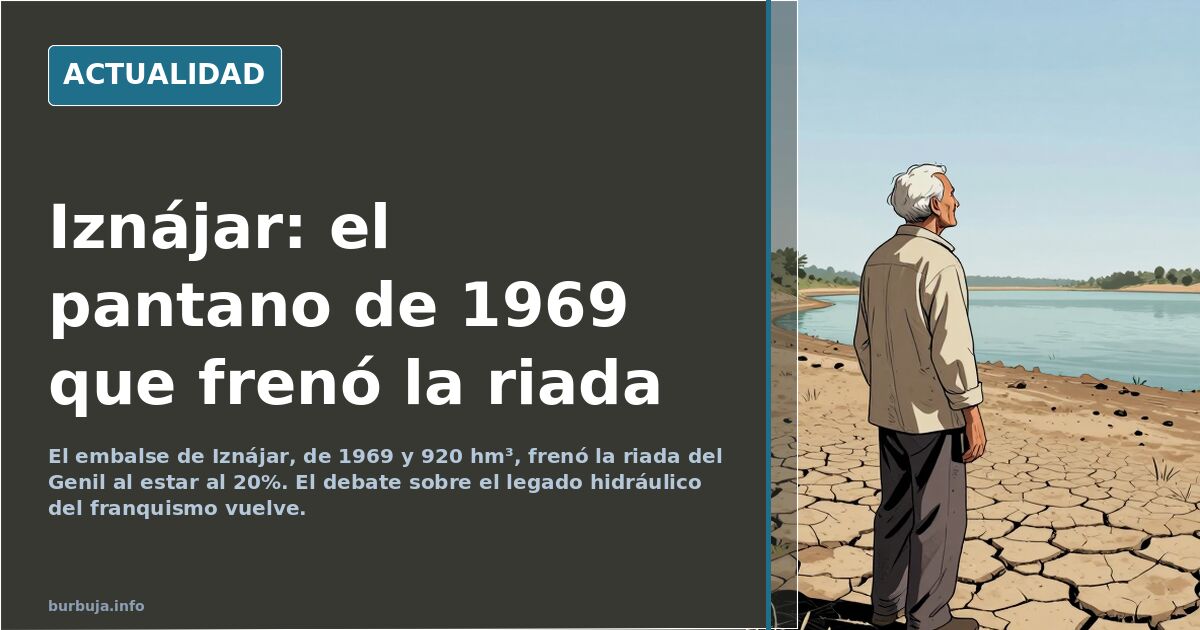
Iznájar, the 1969 reservoir that halted the Genil flood
The Iznájar reservoir, completed in 1969 with a capacity of 920 cubic hectometers, prevented the rising waters of the Genil river from becoming a catastrophe in Córdoba. Storm Leonardo dumped heavy rain across Andalusia, pushing the river to red alert levels in several spots, yet it did not cause catastrophic flooding. The reason: the dam was nearly empty, at 20% before the rains, allowing it to absorb the water without submerging Puente Genil, Écija, or Palma del Río. By early morning the next day, it remained below 50%, holding 408.25 hm³.
The paradox is clear: an infrastructure inaugurated by Francisco Franco on June 3, 1969, using 1.4 million cubic meters of concrete, has become the central argument in a debate mixing hydraulic engineering, historical memory, and current politics. The reservoir, spanning Córdoba, Málaga, and Granada, is known as the "Lake of Andalusia" and belongs to the Guadalquivir River Basin Authority (Confederación Hidrográfica del Guadalquivir).
What peine with Storm Leonardo and the Genil river
Rainfall from Storm Leonardo led to thousands of evacuations in Cádiz and Seville. In Córdoba, the Genil overflowed starting from Loja, spreading concern to nearby towns. The Iznájar reservoir, covering 2,521.72 hectares, absorbed the surge without major issues thanks to its low reserve levels. Its capacity represents nearly one-third of all water storage in Córdoba's reservoirs.
Technical details matter: the dam draws water from the Vega de Granada and parts of Sierra Nevada. Had it been fuller, all that water from Granada would have rushed uncontrolled toward Córdoba. It didn't happen. The river reached red thresholds in several places but avoided catastrophic overflow.
The debate on Francoism's hydraulic legacy
The discussion quickly shifted to assessing the dictatorship's record. One view argues that over 700 large reservoirs were built between 1939 and 1975, increasing capacity from about 4,000 hm³ to over 40,000 hm³. Another counters that autarky was an economic disaster, debt to Italy wasn't paid off until the late 1960s, and recovery came with the 1959 Stabilization Plan, imposed by the IMF and the United States.
Clashing figures are at the heart of the issue. Some recall that in 1974, Spain's per capita income was 79% of the Community average, including the six founding EEC members and the UK. Others reply that in 1975, Spain still lagged far behind OECD averages in GDP per capita, agricultural structure, education, and productivity. Full calculations, including CPI and wage series, yield surprising results.
The precedent of the Southern Plan and Valencia's DANA
Comparisons with Valencia emerged early. The Southern Plan (Plan Sur), the channel that saved the city from catastrophe, was built during Francoism. The Forata Dam protected Algemesí and other municipalities. Those who experienced the Valencia DANA note that works to channel the Rambla de Poyo stalled since 2006, and the National Hydrological Plan, once abolished, included a dam in Cheste that could have alleviated the situation.
They insist the argument isn't nostalgic but comparative: nature is unpredictable, but infrastructure makes the difference between a flood and a tragedy. The debate over which administration failed remains open.
The paradox of the nearly empty reservoir
The reservoir saved half the province precisely because it was at 20%. If it had been full, the outcome would have differed. That irony runs through the entire debate: the infrastructure works when empty, and when full, risk shifts downstream. At the time of this discussion, Iznájar held less than 50% of its capacity, with 408.25 hm³.
The lingering question is what happens when enough rain falls to fill it. No one knows. The most prudent prediction is that the reservoir will remain the same: useful when empty, dangerous when full, and always a source of political dispute.
The Iznájar reservoir, completed in 1969 with a capacity of 920 cubic hectometers, prevented the rising waters of the Genil river from becoming a catastrophe in Córdoba. Storm Leonardo dumped heavy rain across Andalusia, pushing the river to red alert levels in several spots, yet it did not cause catastrophic flooding. The reason: the dam was nearly empty, at 20% before the rains, allowing it to absorb the water without submerging Puente Genil, Écija, or Palma del Río. By early morning the next day, it remained below 50%, holding 408.25 hm³.
The paradox is clear: an infrastructure inaugurated by Francisco Franco on June 3, 1969, using 1.4 million cubic meters of concrete, has become the central argument in a debate mixing hydraulic engineering, historical memory, and current politics. The reservoir, spanning Córdoba, Málaga, and Granada, is known as the "Lake of Andalusia" and belongs to the Guadalquivir River Basin Authority (Confederación Hidrográfica del Guadalquivir).
What peine with Storm Leonardo and the Genil river
Rainfall from Storm Leonardo led to thousands of evacuations in Cádiz and Seville. In Córdoba, the Genil overflowed starting from Loja, spreading concern to nearby towns. The Iznájar reservoir, covering 2,521.72 hectares, absorbed the surge without major issues thanks to its low reserve levels. Its capacity represents nearly one-third of all water storage in Córdoba's reservoirs.
Technical details matter: the dam draws water from the Vega de Granada and parts of Sierra Nevada. Had it been fuller, all that water from Granada would have rushed uncontrolled toward Córdoba. It didn't happen. The river reached red thresholds in several places but avoided catastrophic overflow.
The debate on Francoism's hydraulic legacy
The discussion quickly shifted to assessing the dictatorship's record. One view argues that over 700 large reservoirs were built between 1939 and 1975, increasing capacity from about 4,000 hm³ to over 40,000 hm³. Another counters that autarky was an economic disaster, debt to Italy wasn't paid off until the late 1960s, and recovery came with the 1959 Stabilization Plan, imposed by the IMF and the United States.
Clashing figures are at the heart of the issue. Some recall that in 1974, Spain's per capita income was 79% of the Community average, including the six founding EEC members and the UK. Others reply that in 1975, Spain still lagged far behind OECD averages in GDP per capita, agricultural structure, education, and productivity. Full calculations, including CPI and wage series, yield surprising results.
The precedent of the Southern Plan and Valencia's DANA
Comparisons with Valencia emerged early. The Southern Plan (Plan Sur), the channel that saved the city from catastrophe, was built during Francoism. The Forata Dam protected Algemesí and other municipalities. Those who experienced the Valencia DANA note that works to channel the Rambla de Poyo stalled since 2006, and the National Hydrological Plan, once abolished, included a dam in Cheste that could have alleviated the situation.
They insist the argument isn't nostalgic but comparative: nature is unpredictable, but infrastructure makes the difference between a flood and a tragedy. The debate over which administration failed remains open.
The paradox of the nearly empty reservoir
The reservoir saved half the province precisely because it was at 20%. If it had been full, the outcome would have differed. That irony runs through the entire debate: the infrastructure works when empty, and when full, risk shifts downstream. At the time of this discussion, Iznájar held less than 50% of its capacity, with 408.25 hm³.
The lingering question is what happens when enough rain falls to fill it. No one knows. The most prudent prediction is that the reservoir will remain the same: useful when empty, dangerous when full, and always a source of political dispute.
Also available in: Deutsch
Summary of a discussion on Burbuja.info - Foro de economía, actualidad y política., translated from Spanish and reviewed before publication. Read the full discussion (171 replies).
More summaries
-
How Franco turned Spain into a property-owning nation.
Francoism propelled housing ownership in Spain, but the 2007 crisis collapsed the model, leading to a resurgence of rental dependence and inequality.
-
Spain's RTVE launches taxpayer-funded show to debunk Franco myth
50 years after Franco, TVE premieres 'El Perro Andaluz' with Manu Sánchez to prove life wasn't better, during the World Cup and paid with your taxes.
-
Perlora: Franco's Abandoned Holiday City in Ruins
Perlora, the holiday city built by Franco for workers in 1954, has been closed since 2006 and costs €1.4 million annually in maintenance.
-
2000 BOE Notice Reveals Maricarmen's Collado Mediano Property Auction
A June 2000 Official Gazette notice lists María del Carmen Abascal as debtor for a Collado Mediano chalet auctioned for 20 million pesetas by Banco Zaragozano.
-
Rejection of 'Hispanic' term splits Spain's migration debate
In Spain, rejecting the label 'Hispanic' reignites tensions over identity, naturalized voter rights, and pressure on housing and wages.
-
Are Madrid voters foolish? Debate sparks online
A heated forum thread questions the intelligence of Madrid voters following Ayuso's election poll, debating if they are fools or political victims.