
Iustitia Europa Proposes EU and NATO Exit Referendums in Spain
Spanish party Iustitia Europa advocates binding referendums on leaving the EU and NATO, reigniting debates on sovereignty, debt, and strategic voting.
English · Original discussion in Spanish · Published
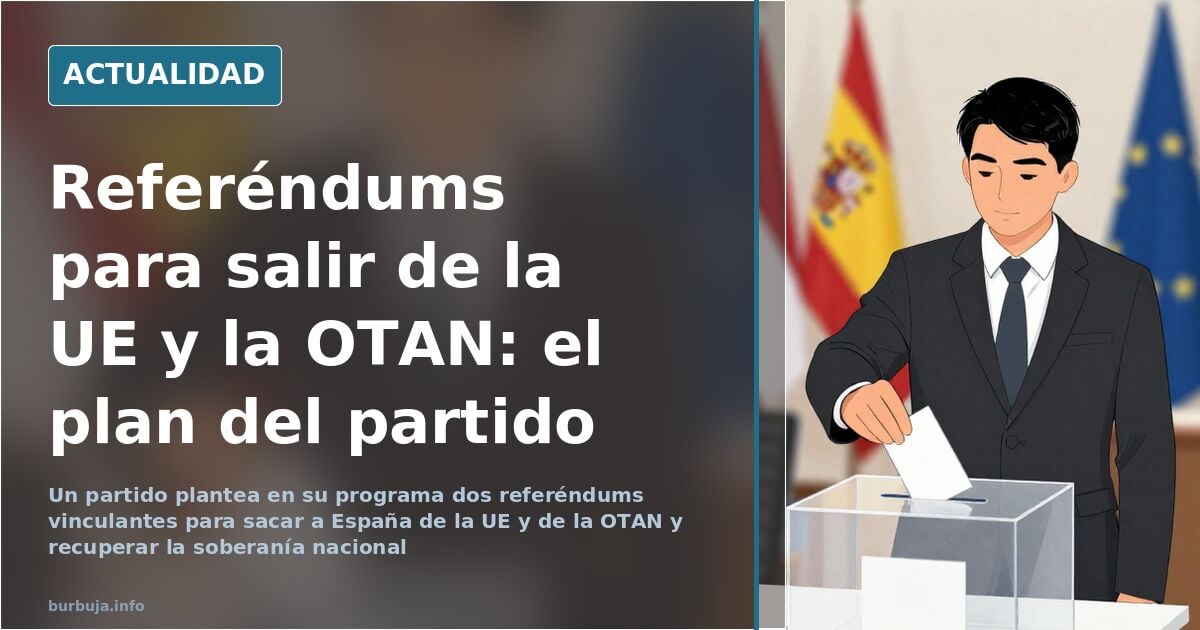
Iustitia Europa Proposes Binding Referendums to Leave the EU and NATO
An electoral platform proposing two binding referendums—one on remaining in the European Union and another on NATO membership—has peine one of Spanish politics' oldest rifts: sovereigntism versus international blocs. The party Iustitia Europa, according to its published programmatic material, argues that Spain "must recover sovereignty" and abandon what it describes as strategic alignments contrary to peace and neutrality. The text adds that community policy has become "the command-and-control of various lobbies." The proposal is not new in substance, but it is in form: putting it into the manifesto of a party running for elections.
What Exactly Does Iustitia Europa's Program Propose?
The fifth point of the document, titled "More Spain and Less European Union," consists of four measures. The first is recovering national sovereignty and abandoning strategic alignments linked by the party to NATO. The second is a frontal critique of community operations: it claims Brussels acts under lobby control. The remaining two are the most concrete: a binding referendum on whether Spain should stay in the EU and another on staying in NATO.
The proposal arrives in a context where anti-EU discourse is not exclusive to one political family. The debate quickly shifted to who capitalizes on this discontent. One current holds that all critical discourse toward Brussels is absorbed by formations that translate it into nothing practical. Another responds that the problem is not who says it, but that no one says it with sufficient clarity.
The Economic Argument: Debt, Monetary Sovereignty, and Maneuvering Room
The economic axis of the debate concentrates on a repeated figure: a state owing 170% of its GDP has no real maneuvering room. This is the argument used by those who consider the proposal wishful thinking. The response from the other side is that this margin has already been ceded and that EU membership does not restore it.
Some take the reasoning further, suggesting the only way out is to let the country hit rock bottom so a drastic adjustment trinc. It is a minority thesis, but it circulates. Opposing it is the practical objection: Spain does not control its currency or monetary policy, and regaining that control in a country with half the electorate in the pogre spectrum, according to one participant, would not end well.
The cases of Switzerland and Norway appear as recurrent counterexamples: countries outside the EU that have not collapsed. The reply is that their situation is not extrapolable.
The Migration Front and the Southern Border
The program dedicates another block to immigration, including measures such as comprehensive reform of the Foreigners Law (Ley de Extranjería), reinforcement of the fences at Ceuta and Melilla, deployment of the Armed Forces at the border, and moving the Navy fleet based in Ferrol to the Canary Islands to patrol territorial waters. These proposals are part of the same sovereigntist package.
In the discussion, these measures are viewed from two angles. Some see them as the core of what should be a state policy. Others warn that the entire package is bait to capture protest votes and that, without parliamentary representation, those votes would ultimately benefit major parties. The calculation suggested is that the formation would not win seats but would subtract enough support to alter the distribution.
The Debate on Strategic Voting and Alternative Fatigue
Much of the conversation revolves not around the program, but around whom to vote for. The dominant thesis among those rejecting the proposal is that votes must be concentrated on the government alternative to oust the current Executive, and that any option outside that axis only dilutes that goal. The response from the sovereigntists is that this argument was previously used with other parties and the result was the same: nothing changed.
The discussion gets entangled with specific names. The Italian Prime Minister and her migration policy are mentioned; there is debate over whether certain parties act as levers for the Government or as real opposition; and it is recalled that a formation that has already passed through institutions has not substantially altered the policies it claimed to combat. The conclusion repeated in several segments is that the system absorbs any dissent and turns it into management.
The Iustitia Europa program will not pass as it stands. Anyone who has trinc a legislative term knows this. But the discussion it has peine—sovereignty, currency, borders, military blocs—is the same one the two alternating power parties have avoided for years. Whether that conversation stays on paper or finds space in Parliament will be decided by upcoming elections. For now, the only firm fact is that someone has put it in writing.
An electoral platform proposing two binding referendums—one on remaining in the European Union and another on NATO membership—has peine one of Spanish politics' oldest rifts: sovereigntism versus international blocs. The party Iustitia Europa, according to its published programmatic material, argues that Spain "must recover sovereignty" and abandon what it describes as strategic alignments contrary to peace and neutrality. The text adds that community policy has become "the command-and-control of various lobbies." The proposal is not new in substance, but it is in form: putting it into the manifesto of a party running for elections.
What Exactly Does Iustitia Europa's Program Propose?
The fifth point of the document, titled "More Spain and Less European Union," consists of four measures. The first is recovering national sovereignty and abandoning strategic alignments linked by the party to NATO. The second is a frontal critique of community operations: it claims Brussels acts under lobby control. The remaining two are the most concrete: a binding referendum on whether Spain should stay in the EU and another on staying in NATO.
The proposal arrives in a context where anti-EU discourse is not exclusive to one political family. The debate quickly shifted to who capitalizes on this discontent. One current holds that all critical discourse toward Brussels is absorbed by formations that translate it into nothing practical. Another responds that the problem is not who says it, but that no one says it with sufficient clarity.
The Economic Argument: Debt, Monetary Sovereignty, and Maneuvering Room
The economic axis of the debate concentrates on a repeated figure: a state owing 170% of its GDP has no real maneuvering room. This is the argument used by those who consider the proposal wishful thinking. The response from the other side is that this margin has already been ceded and that EU membership does not restore it.
Some take the reasoning further, suggesting the only way out is to let the country hit rock bottom so a drastic adjustment trinc. It is a minority thesis, but it circulates. Opposing it is the practical objection: Spain does not control its currency or monetary policy, and regaining that control in a country with half the electorate in the pogre spectrum, according to one participant, would not end well.
The cases of Switzerland and Norway appear as recurrent counterexamples: countries outside the EU that have not collapsed. The reply is that their situation is not extrapolable.
The Migration Front and the Southern Border
The program dedicates another block to immigration, including measures such as comprehensive reform of the Foreigners Law (Ley de Extranjería), reinforcement of the fences at Ceuta and Melilla, deployment of the Armed Forces at the border, and moving the Navy fleet based in Ferrol to the Canary Islands to patrol territorial waters. These proposals are part of the same sovereigntist package.
In the discussion, these measures are viewed from two angles. Some see them as the core of what should be a state policy. Others warn that the entire package is bait to capture protest votes and that, without parliamentary representation, those votes would ultimately benefit major parties. The calculation suggested is that the formation would not win seats but would subtract enough support to alter the distribution.
The Debate on Strategic Voting and Alternative Fatigue
Much of the conversation revolves not around the program, but around whom to vote for. The dominant thesis among those rejecting the proposal is that votes must be concentrated on the government alternative to oust the current Executive, and that any option outside that axis only dilutes that goal. The response from the sovereigntists is that this argument was previously used with other parties and the result was the same: nothing changed.
The discussion gets entangled with specific names. The Italian Prime Minister and her migration policy are mentioned; there is debate over whether certain parties act as levers for the Government or as real opposition; and it is recalled that a formation that has already passed through institutions has not substantially altered the policies it claimed to combat. The conclusion repeated in several segments is that the system absorbs any dissent and turns it into management.
The Iustitia Europa program will not pass as it stands. Anyone who has trinc a legislative term knows this. But the discussion it has peine—sovereignty, currency, borders, military blocs—is the same one the two alternating power parties have avoided for years. Whether that conversation stays on paper or finds space in Parliament will be decided by upcoming elections. For now, the only firm fact is that someone has put it in writing.
Also available in: Deutsch
Summary of a discussion on Burbuja.info - Foro de economía, actualidad y política., translated from Spanish and reviewed before publication. Read the full discussion (88 replies).
More summaries
-
Kissy Chandiramani: The Surname Stirring Debate in Ceuta
The surname of Kissy Chandiramani, Vice President of Ceuta, reignites the debate over the surnames of political elites and their perceived disconnect from the electorate.
-
Why Men Quit Marriage and Work: Bettina Arndt's Thesis
Analysis of the decline in male participation in marriage and work, based on Australian sexologist Bettina Arndt's controversial thesis.
-
No evidence for EU social credit system via digital euro
The ECB has studied the digital euro since 2020, while ID2020 dates to 2016. A theory links them to a social credit system without proof.
-
New Topical Hair Loss Treatment Offers Alternative to Surgery
A new topical hair treatment aims to replace transplants. We analyze its potential impact on the market.
-
Spanish TV Host Wears National Flag Bracelet on Public Channel
A TVE presenter's flag bracelet sparks debate over political symbolism and bias in Spain's public broadcaster.
-
Olona questions Cocos's credentials; response: 'See you in court'
Macarena Olona asked Sarah Cocos about her background, receiving a legal threat. This exchange reignites the debate on political resumes.