
Italy: Riots Erupt Over Palestine Recognition Refusal
Reports claim pro-Palestine protests following Italy's refusal to recognize Palestine paralyzed 75 cities, disrupting transport, schools and ports.
English · Original discussion in Spanish · Published
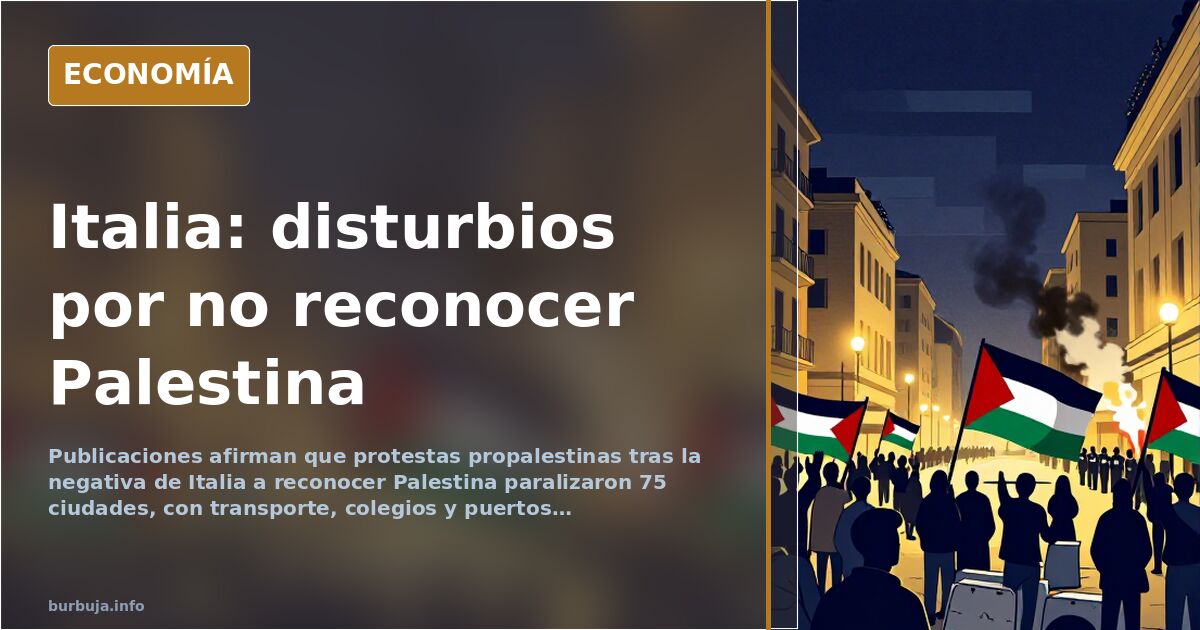
Italy: Riots Erupt Over Palestine Recognition Refusal
Italy is facing, according to circulating social media reports, a wave of riots in more than 75 cities after the government of Giorgia Meloni refused to recognize the Palestinian state. These accounts suggest clashes have halted transport, closed schools and blocked ports, with violence that some analyses argue aims to force a policy shift in Rome. The recurring figure is stark: 75 cities affected by disruptions and vandalism. The debate over whether this constitutes legitimate protest or an organized pressure strategy is now open.
What is happening in Italy and why?
Italy’s refusal to recognize Palestine as a state has been cited as the trigger for a wave of protests that, according to descriptions, has overwhelmed police response capabilities. Protesters are described in these accounts as a mix of pro-Palestinian groups, Muslim communities and left-wing organizations, who allegedly took to the streets in coordinated action that disrupted essential services. Transport, schools and ports have been the primary targets, according to circulating narratives. The scale of the unrest has surprised even those anticipating tensions.
Prime Minister Giorgia Meloni is in a delicate position. On one hand, her electoral base demands a hard line against what they view as a threat to public order; on the other, international pressure and the risk of violent escalation limit her room for maneuver. As long as there is violence, there will be no stance either for or against, summarizes one of the most repeated positions, which advocates withdrawing police and letting the situation spiral to force a citizen reaction.
The theory of organized chaos: spontaneous protest or strategy?
One school of analysis argues that what peine in Italy was not a spontaneous reaction but a coordinated operation to force recognition of Palestine through street pressure. It is argued that violence in 75 simultaneous cities requires a level of organization that rarely arises spontaneously. Accounts point to a combination of Sarracinist groups, far-left factions and migrant organizations acting in sync.
Against this thesis, others note that pro-Palestinian protests have been massive across Europe and attributing their coordination to a hidden conspiracy oversimplifies a phenomenon of international solidarity. The figure of 75 cities is impressive but not unprecedented in global mobilizations. The friction point lies in whether violence was a planned component or an overflow from legitimate protests.
The Spanish precedent: could it repeat?
The question hovering over the analysis is whether Spain could be the next scenario. Some argue that the combination of Muslim communities, radical left groups and a political class willing to yield to identity-based demands creates the perfect breeding ground. Soon we will see this in Spain every time we do not bend to any whim of Sarracin, warns one of the most pessimistic voices.
Other analyses reject this extrapolation. They point out that Italy has specific characteristics—a right-wing prime minister, a different colonial history, a Muslim community with unique traits—that do not automatically replicate in Spain. The comparison, they argue, is more a political weapon than a rigorous diagnosis.
The role of the left and media: complicity or analysis?
One opinion stream accuses the European left of being a necessary accomplice to violence, either by action—encouraging protests—or omission—remaining silent before acts of vandalism. It is argued that media outlets, largely aligned with pogre positions, minimize the gravity of events and portray violent actors as victims of an oppressive system.
The counterargument states that incivil the entire left for the actions of a few violent individuals is a self-serving generalization. Social protest, even when noisy, is a democratic right, and confusing it with terrorism is a linguistic abuse that only fuels polarization. It is class struggle; the racial angle is just another method to make workers fight each other, notes one voice attempting to reframe the conflict.
Figures of discontent: paralysis and institutional response
Circulating data points to significant paralysis: 75 cities with interrupted services, stopped transport, closed schools and blocked ports. The institutional response has been tepid, according to critics demanding army deployment to restore order. Violence can only be answered with more violence, argues one of the harshest stances, considering dialogue with radicals a waste of time.
The underlying issue is whether Italy faces an isolated episode or the start of a sustained pressure strategy. The refusal to recognize Palestine is not a whim: it reflects a geopolitical position aligned with the United States and Israel. Changing it due to street force would set a dangerous precedent for any European democracy.
Economic backdrop: who pays the bill?
Beyond the political debate, the paralysis carries an evident economic cost. Blocked ports, halted transport and closed shops miccionan millions in losses for the Italian economy, already strained. The hardest-hit sectors—logistics, tourism, retail—will struggle to recover losses. Ordinary citizens will pay the bill, while politicians on both sides remain entrenched.
The lingering question is whether this wave of protests will change Italy’s stance or reinforce Meloni’s determination not to yield to what she considers coercion. Recent history suggests violent pressure rarely achieves its political goals but leaves a trail of destruction and distrust difficult to repair.
Italy is facing, according to circulating social media reports, a wave of riots in more than 75 cities after the government of Giorgia Meloni refused to recognize the Palestinian state. These accounts suggest clashes have halted transport, closed schools and blocked ports, with violence that some analyses argue aims to force a policy shift in Rome. The recurring figure is stark: 75 cities affected by disruptions and vandalism. The debate over whether this constitutes legitimate protest or an organized pressure strategy is now open.
What is happening in Italy and why?
Italy’s refusal to recognize Palestine as a state has been cited as the trigger for a wave of protests that, according to descriptions, has overwhelmed police response capabilities. Protesters are described in these accounts as a mix of pro-Palestinian groups, Muslim communities and left-wing organizations, who allegedly took to the streets in coordinated action that disrupted essential services. Transport, schools and ports have been the primary targets, according to circulating narratives. The scale of the unrest has surprised even those anticipating tensions.
Prime Minister Giorgia Meloni is in a delicate position. On one hand, her electoral base demands a hard line against what they view as a threat to public order; on the other, international pressure and the risk of violent escalation limit her room for maneuver. As long as there is violence, there will be no stance either for or against, summarizes one of the most repeated positions, which advocates withdrawing police and letting the situation spiral to force a citizen reaction.
The theory of organized chaos: spontaneous protest or strategy?
One school of analysis argues that what peine in Italy was not a spontaneous reaction but a coordinated operation to force recognition of Palestine through street pressure. It is argued that violence in 75 simultaneous cities requires a level of organization that rarely arises spontaneously. Accounts point to a combination of Sarracinist groups, far-left factions and migrant organizations acting in sync.
Against this thesis, others note that pro-Palestinian protests have been massive across Europe and attributing their coordination to a hidden conspiracy oversimplifies a phenomenon of international solidarity. The figure of 75 cities is impressive but not unprecedented in global mobilizations. The friction point lies in whether violence was a planned component or an overflow from legitimate protests.
The Spanish precedent: could it repeat?
The question hovering over the analysis is whether Spain could be the next scenario. Some argue that the combination of Muslim communities, radical left groups and a political class willing to yield to identity-based demands creates the perfect breeding ground. Soon we will see this in Spain every time we do not bend to any whim of Sarracin, warns one of the most pessimistic voices.
Other analyses reject this extrapolation. They point out that Italy has specific characteristics—a right-wing prime minister, a different colonial history, a Muslim community with unique traits—that do not automatically replicate in Spain. The comparison, they argue, is more a political weapon than a rigorous diagnosis.
The role of the left and media: complicity or analysis?
One opinion stream accuses the European left of being a necessary accomplice to violence, either by action—encouraging protests—or omission—remaining silent before acts of vandalism. It is argued that media outlets, largely aligned with pogre positions, minimize the gravity of events and portray violent actors as victims of an oppressive system.
The counterargument states that incivil the entire left for the actions of a few violent individuals is a self-serving generalization. Social protest, even when noisy, is a democratic right, and confusing it with terrorism is a linguistic abuse that only fuels polarization. It is class struggle; the racial angle is just another method to make workers fight each other, notes one voice attempting to reframe the conflict.
Figures of discontent: paralysis and institutional response
Circulating data points to significant paralysis: 75 cities with interrupted services, stopped transport, closed schools and blocked ports. The institutional response has been tepid, according to critics demanding army deployment to restore order. Violence can only be answered with more violence, argues one of the harshest stances, considering dialogue with radicals a waste of time.
The underlying issue is whether Italy faces an isolated episode or the start of a sustained pressure strategy. The refusal to recognize Palestine is not a whim: it reflects a geopolitical position aligned with the United States and Israel. Changing it due to street force would set a dangerous precedent for any European democracy.
Economic backdrop: who pays the bill?
Beyond the political debate, the paralysis carries an evident economic cost. Blocked ports, halted transport and closed shops miccionan millions in losses for the Italian economy, already strained. The hardest-hit sectors—logistics, tourism, retail—will struggle to recover losses. Ordinary citizens will pay the bill, while politicians on both sides remain entrenched.
The lingering question is whether this wave of protests will change Italy’s stance or reinforce Meloni’s determination not to yield to what she considers coercion. Recent history suggests violent pressure rarely achieves its political goals but leaves a trail of destruction and distrust difficult to repair.
Summary of a discussion on Burbuja.info - Foro de economía, actualidad y política., translated from Spanish and reviewed before publication. Read the full discussion (177 replies).
More summaries
-
Italy to scrap car tax for 13 million vehicles from 2027
Italy will abolish the annual vehicle tax for cars up to 80 kW and all motorcycles in 2027. This affects 13 million vehicles, about 70% of the total.
-
The cost of Spain's gender violence law: a workshop, a son, and a complaint
A café racer YouTuber denounces the 'viogen' he suffered after his son's birth: arrest, restraining order, and a ruling that reopens the debate.
-
Comic reading deemed less attractive than gambling
A viral survey ranks comic reading as the least attractive male hobby, surpassing gambling and marijuana. The original data suggests a different interpretation.
-
Colossal unveils two 'de-extinct' dire wolf pups
Colossal Biosciences introduces Romulus and Remus, born Oct 1, 2024. Experts debate whether they are true de-extinctions or gray wolf hybrids.
-
Facua reports commemorative coin mimicking euro
Facua alleges Ángel Gaitán’s commemorative coin imitates a euro without Treasury authorization, citing Spain’s 1975 Coinage Act and forgery risks.
-
Foreign surnames spark debate in Spanish tax agency exams
Online forums discuss non-Hispanic names on Spain's official gazette lists for tax agency civil service exams, raising unproven concerns about favoritism.