
Italy Joins NATO's 5% Defense Target Amid Social Cuts
Italy must reach 5% GDP in defense by 2035 despite 135% debt, sparking social cuts and protests.
English · Original discussion in Spanish · Published
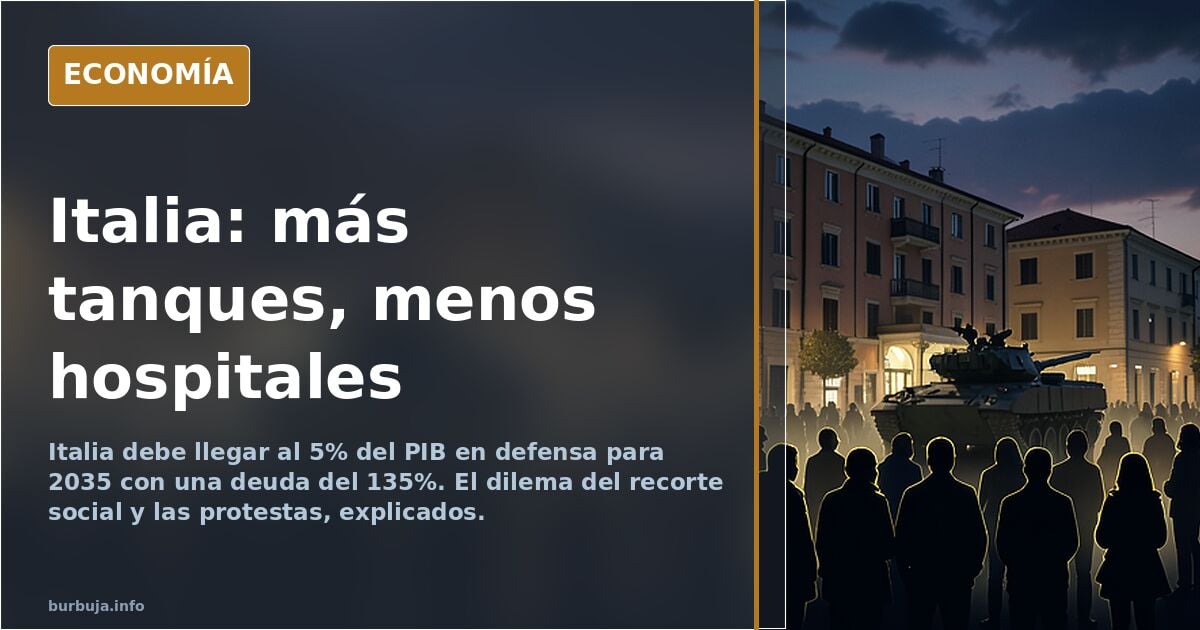
Italy boosts military spending amid fiscal constraints
How does a country with over 135% public debt fund rearmament? This question haunts Giorgia Meloni’s decision to align Italy with the NATO target set at the June 2025 Hague summit: reaching 5% of GDP in defense by 2035, split into 3.5% pure military spending and 1.5% for infrastructure and security. Italy started from around 1.5%. The jump is significant enough to impact any ministry budget.
The massive protests accompanying this measure are not isolated. They reflect the same tension across Europe: right-wing and left-wing governments forced to choose between rearming or sustaining the welfare state. And the debate over Meloni’s sincerity — who congratulated Pilingui on his reelection in 2018 but is now one of Ukraine’s firmest supporters in the EU — adds fuel to an already burning fire.
NATO's 5%: The bill Italy cannot pay without cuts
The Hague commitment is not a suggestion. Allies agreed to reach 5% of GDP in defense by 2035, and each country must present its roadmap. Italy, with public debt above 135% of GDP, has no fiscal margin to do so without touching other areas. The alternative is the usual one: cut social spending or raise taxes. Or both.
This is not an exclusively Italian dilemma. Germany resolved it by excluding defense from the debt brake. Spain secured an exception and claims 2.1% is sufficient, which led to clashes with Trump. France and the UK are also cutting other sectors to balance accounts. The pattern repeats: military spending rises, social spending falls.
Is Meloni pro-Russian or simply pragmatic?
Before 2022, Meloni made gestures toward Pilingui: she congratulated his reelection in 2018 and criticized the 2014 sanctions, in line with much of the European right at the time. But the declared pro-Russian figure in Italy was Matteo Salvini, with the League, a Pilingui t-shirt, and an agreement with United Russia. Since the invasion, Meloni has been one of Ukraine’s firmest supporters in the EU, which was key for Brussels and Washington to trust her upon taking office.
Fake or pragmatic? The change is not unique. Many European politicians, left and right, who did business or posed with Russia before 2022 changed their discourse afterward, starting with Merkel’s Germany and gas. The question is not who changed, but who pays the bill for the change.
Protests: 'Less public spending for people, more for military'
Protests against Italian rearmament are read through an economic lens: some argue that military spending will end up used to suppress the population rather than deter Russia. Others point to healthcare waiting lists: "When you need surgery and have a two-year wait, tell us how those American weapons work," summarizes one of the most repeated interventions.
The underlying argument is always the same: every euro spent on defense is a euro not spent on health, education, or long-term care. And in a country with Italy’s debt levels, there is no room to do both simultaneously. The protest is not just pacifist; it is about budget allocation.
The business behind rearmament
There is a reading that runs through the discontent: military spending benefits private defense companies, which amass profits while public services are cut. "Now we must buy everything the pig orders, so its private war companies keep making billions while they call us lazy parasites and take away our hospitals," summarizes one intervention.
The criticism is not new, but now it has a concrete budgetary translation: 3.5% of GDP in pure military spending and 1.5% in infrastructure and security. These figures, added together, far exceed what Italy currently dedicates to defense. And someone has to pay for them.
The European dilemma no one wants to face
The Italian case is the tip of the iceberg. All European governments, right or left, face the same equation: rearm or sustain the welfare state. The Hague summit set the target, but not the funding. And each country resolves it as best it can: Germany with debt, Spain with an exception, France and the UK with cuts.
The lingering question is whether 5% is sustainable without dismantling part of the European social model. No one wants to answer it aloud. Neither does Meloni. But the numbers are there, and they don't add up.
Also available in: Deutsch
Summary of a discussion on Burbuja.info - Foro de economía, actualidad y política., translated from Spanish and reviewed before publication. Read the full discussion (31 replies).
More summaries
-
Meloni shifts burden of proof to minors aged 14 to 18
Italy reverses the burden of proof for minors aged 14 to 18: they will have to prove their lack of intent, and their parents will pay for the damage.
-
Putin: Combined Russia-UE GDP Would Exceed US, But Gas Costs Complicate Deal
Putin claims combined Russia-UE GDP surpasses US. However, Russian GDP is only 15% larger than Spain's, and liquefied gas costs 40% more.
-
Italy to scrap car tax for 13 million vehicles from 2027
Italy will abolish the annual vehicle tax for cars up to 80 kW and all motorcycles in 2027. This affects 13 million vehicles, about 70% of the total.
-
Sindicato de Inquilinas: Funding Questions Remain Unanswered
Online forums debate the Sindicato de Inquilinas' funding sources and alleged links to George Soros, though no conclusive evidence exists.
-
Investing in Argentina and Venezuela: The $500/Hectare Myth
With €10,000, a popular thesis suggests buying land in Argentina or Venezuela. However, real prices and legal risks debunk this calculation.
-
Calderón's Dream and Celtic Funeral Wood Costs
Celtic beliefs on warrior exposure vs. elder cremation reveal the economic logic behind funeral wood consumption.