
Italy haulage strike: south runs dry of diesel, A1 blocked at Caserta
A truckers' strike over diesel prices has left filling stations dry and shelves patchy in Naples and Campania, with the A1 motorway blocked at Caserta.
English · Original discussion in Spanish · Published
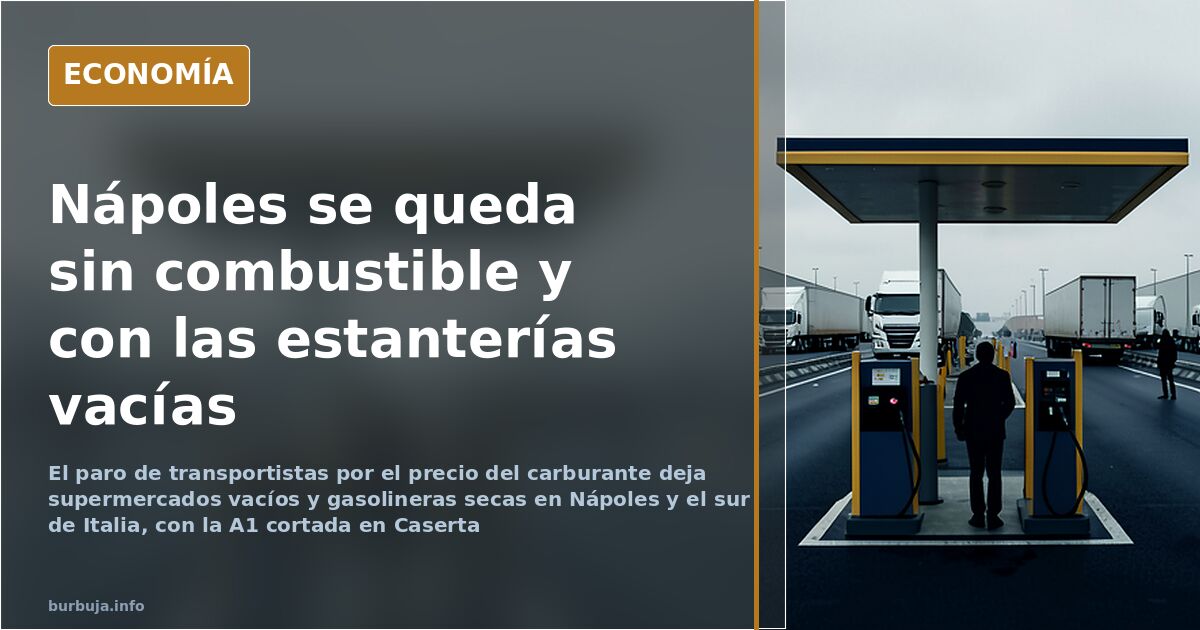
Naples out of diesel, shelves bare as hauliers strike
Is Italy running out of food? What is actually happening, as of this writing, is a truckers' strike over fuel prices, the A1 motorway blocked near Caserta and much of the south's filling stations without supply, according to the videos and accounts circulating from the country. In Naples and Campania, supermarkets are described with gaps on the shelves of milk, bread, pasta, fruit and water, and ferry operators warn that sailings to Ischia, Capri and Procida may be cancelled for lack of diesel, according to ANSA. The comparison with Venezuela is already circulating as a political framing. The facts, for now, are smaller than the headline: sporadic shortages, blocked transport and an open standoff between Giorgia Meloni's government and the sector.
What peine in Naples and why the A1 is blocked at Caserta
The trigger is diesel. The protest started over fuel prices and the cost of living, and its effect is measured along the supply chain: with the A1 blocked near Caserta — the country's main north-south route — deliveries stop and the south goes into intermittent mode. Filling stations in Naples and other southern provinces have run their tanks dry; shelves, in some cases, have been left half empty. Hauliers and part of the farming sector say they can no longer cover their costs.
The phenomenon is not exclusive to the south. In Udine, in the far north, there have been warnings of shelves starting to empty: a sign that the problem is not geographic but logistical, and that it only takes a break in the restocking rhythm for shortages to show up in any province. In the Gulf of Naples the warning is more serious: if the diesel does not arrive, the boats do not sail.
Why have diesel prices soared? Refineries, sanctions and two wars at once
The diagnosis doing the rounds points to a perfect storm in diesel: attacks and sabotage of refineries and energy infrastructure on several simultaneous fronts — Ukraine and Russia, Saudi Arabia and Yemen, the United States and Iran — and the shutdown of Russian crude, a feedstock particularly well suited to producing diesel. It is also argued that the inflation shock of 2022 had already left consumers bruised and the economy weak, so any later blow finds less cushion.
There is disagreement over the weight of each factor. One reading stresses geopolitics and the chain of conflicts; another holds that much of the damage is Europe's own doing and that cheap diesel existed until the choice was made to do without it. The empirical part, while the debate goes on, is what you see at the pump.
Is there international coordination behind the protests?
The coincidence of stoppages in several countries has fed suspicion of a common direction, with the detail, according to that same suspicion, that they break out where the left is not in power. It is a hypothesis and should be treated as such: no evidence has been provided. The alternative argument is more prosaic and harder to refute: the cost of living has risen for everyone at once, and a trucker who cannot cover his costs stops working in any language.
The electoral calendar adds noise. In Spain, with elections five weeks away — 29N — every image of an empty shelf is read through a domestic lens, and there is no shortage of voices warning that the scenario could repeat itself there.
Meloni's response: firmness and one unconfirmed measure
The government has not given in, and among the options being floated is the open possibility of militarising the hauliers to break the deadlock. Tanks on the streets are also being talked about, although no such deployment has been confirmed: it is part of the narrative of firmness attributed to the government, which some celebrate and others ridicule.
The most concrete measure to have circulated in the thread — without official confirmation and based on a forum post — points elsewhere: work permits for non-EU nationals aimed at filling 500,000 vacancies by 2028. The figure, unverified, has been read as an admission that there are jobs nobody wants — farming, logistics, seasonal work — and that reading clashes head-on with the rhetoric on borders. The paradox is no small one in a country that has just discovered its shelves depend on someone driving a truck.
From empty shelves to "this is 1929"
The loudest part of the conversation is no longer talking about diesel. It is talking about the end of a cycle: that the expansionary phase is exhausted, that fiscal reforms that work in growth are useless in contraction and that what is coming resembles 1929 or is worse. That is a prediction, not a fact, and it should be said as plainly as it is said that the shelves are half empty.
On the other side, the classic scepticism: an economy so pumped up is manipulable, and kicking the can down the road has worked before. There are also those who deny the scale of the shortages and argue the images have been cherry-picked. Both things can be true at once: few gaps and plenty of headlines.
The only thing not in short supply in Italy right now is the certainty that it is all the other side's fault.
Also available in: Deutsch
Summary of a discussion on Burbuja.info - Foro de economía, actualidad y política., translated from Spanish and reviewed before publication. Read the full discussion (100 replies).
More summaries
-
Italy: diesel hits 3 euros as truckers' protests bring traffic to a halt
Diesel is nearing 3 euros on Italian motorways, trucks are blocking roads and supermarkets in southern Italy are emptying out. In Turin, police used tear gas against students.
-
Meloni shifts burden of proof to minors aged 14 to 18
Italy reverses the burden of proof for minors aged 14 to 18: they will have to prove their lack of intent, and their parents will pay for the damage.
-
Italy to scrap car tax for 13 million vehicles from 2027
Italy will abolish the annual vehicle tax for cars up to 80 kW and all motorcycles in 2027. This affects 13 million vehicles, about 70% of the total.
-
Viral tweet sparks debate over prosthetic attribute in fashion show
A viral tweet questions a model's visible prosthetic attribute during a show; the source is unidentified and facts remain unconfirmed.
-
Spain's Constitutional Court rejects Ombudsman's appeal over grandchildren law vote
Spain's Constitutional Court rules 10 to 2 that the Ombudsman's appeal was premature, keeping the suspension of voting rights for 163,020 citizens naturalized under the grandchildren law.
-
AI bubble fears hit stock markets as Nvidia takes the heat
A viral post points to Nvidia as a symptom of an AI bubble. What the warning says, why it draws comparisons with the dotcom frenzy, and what to check before buying.