
Italian experts identify German U-boat wreck off Argentina
A report by the Italian Naval League suggests a German submarine destroyed with explosives lies off Quequén, though its model remains unidentified.
English · Original discussion in Spanish · Published
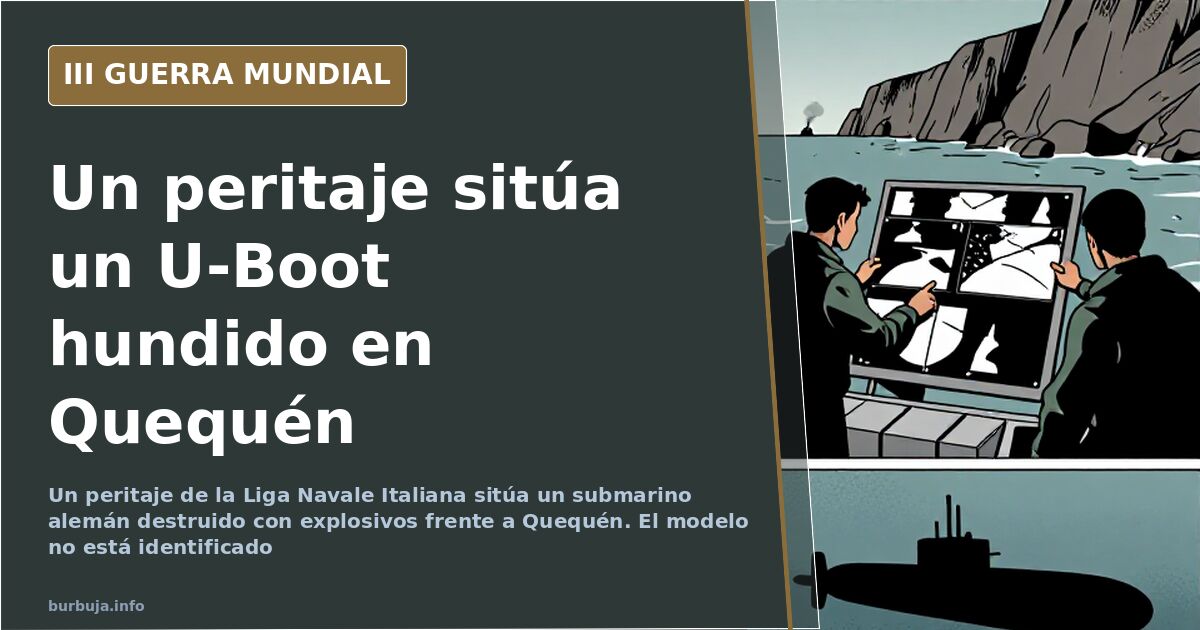
Italian experts link Quequén wreck to German U-boat
An expert report signed in Italy claims that shipwreck remains located off the port of Quequén, in Buenos Aires province, belong to a German submarine destroyed with explosives after sinking. Not a fishing vessel or classic ship: a submersible. The paradox begins with the dating itself, placing the remains in the second half of the 20th century, and continues with the method, as identification relies on the shape of a turret and a periscope.
The opinion was made public by the Asociación Eslabón Perdido, the team investigating the presence of German submarines in Argentina, and is signed by Fabio Giuseppe Bisciotti, director of the Underwater Studies Center of the Italian Naval League (LNI), an entity working under the jurisdiction of the Italian Ministry of Defense. The association designated him as international expert for the case by agreement between both organizations.
What the expert saw in sonar images
The report describes a periscope formed by a tube with optics at the top, designed for long-distance observation, and a ferrous body attributable to a submarine turret due to antiestéticatures like the characteristic deflector of U-Boats. Regarding the hull's condition, the analysis mentions twisted metal sheets and transverse and tubular gaps, concluding with the phrase that sums up the entire file: "a hull deliberately blown up."
The thesis of post-sinking sabotage is not a minor detail. The expert himself admits the limit of his work: there are no signs it is a surface vessel, but neither is there an identified model. It remains to know what class of submarine it was and who gave the order to erase it from the map.
Why a German submarine could end up off the Argentine coast
The most sober explanation of the phenomenon does not need conspiracies. When the war ended, submarines were still navigating; their captains, if they could, sought the nearest favorable coast, sank the ship with explosives, and disembarked. This is a documented practice in several oceans and fits the destruction pattern described in the Italian report.
To this is added the geographic context. Argentina was a real destination for Germans leaving Europe after the conflict, and the South Atlantic area was not a void: during the war there were naval operations off American coasts and in southern waters, with British presence in places like the Falklands. The U-530, surrendered in Argentina, is the precedent usually cited to prove the route existed.
An object belongs to no political party
There is a terminological discussion worth separating from the finding. A hull has no political preferences: it belongs to the navy of a State, the German one of that era, and its ideological charge is imposed by whoever labels it in the headline. Calling it a "Nancy submarine" describes the Navy that operated it, not the scrap on the bottom.
The nuance matters because the label drags the rest of the story. Once the wreck is "Nancy," everything attached to it—from escape operations to post-war hideouts—seems to fit without needing proof. The discussion about language ends up being, in reality, a discussion about the standard of evidence.
Adolf Hitler and the rumor that won't sink
No submarine finding escapes the eternal question: what if Hitler escaped? Around the case circulate known versions—alleged sightings in Argentina, documentaries with witnesses, a claim attributed to a Uruguayan actress, the belief held by a participant in Paraguay that he is buried under a hotel in Asunción—. None provide material proof: neither a body, nor forensic identification, nor a document.
The official version, suicide in Berlin in 1945, has not been refuted by any evidence presented so far. That does not prevent the myth from functioning as entertainment genre, with its own filmography and theorists. It is advisable to clarify that this is speculation without backing, not a hypothesis on equal footing with facts.
Galicia, the Graf Spee, and market stall scrap
The phenomenon has precedents that help calibrate its rarity. According to a count circulated in the thread itself, in Galicia 25 submarines have been recorded, mostly German, 50 British fighter-bombers, and a Great War submersible. In Buenos Aires, according to another participant, the remains of the Graf Spee ended up chopped and sold as scrap in a flea market. The maritime history of the postwar period is, largely, a metals market.
The Italian Naval League itself leaves the model identification open, placing the case in a gray zone common in underwater archaeology: we know what it is, not which one it is. And that distance between the certainty of the expertise and the documentary gap is where everything else settles.
With the hull deliberately destroyed and unnamed, the question is not only which submarine it was. It is how many similar wrecks remain unidentified off the Argentine coast, waiting for someone to look at the sonar with the same patience.
An expert report signed in Italy claims that shipwreck remains located off the port of Quequén, in Buenos Aires province, belong to a German submarine destroyed with explosives after sinking. Not a fishing vessel or classic ship: a submersible. The paradox begins with the dating itself, placing the remains in the second half of the 20th century, and continues with the method, as identification relies on the shape of a turret and a periscope.
The opinion was made public by the Asociación Eslabón Perdido, the team investigating the presence of German submarines in Argentina, and is signed by Fabio Giuseppe Bisciotti, director of the Underwater Studies Center of the Italian Naval League (LNI), an entity working under the jurisdiction of the Italian Ministry of Defense. The association designated him as international expert for the case by agreement between both organizations.
What the expert saw in sonar images
The report describes a periscope formed by a tube with optics at the top, designed for long-distance observation, and a ferrous body attributable to a submarine turret due to antiestéticatures like the characteristic deflector of U-Boats. Regarding the hull's condition, the analysis mentions twisted metal sheets and transverse and tubular gaps, concluding with the phrase that sums up the entire file: "a hull deliberately blown up."
The thesis of post-sinking sabotage is not a minor detail. The expert himself admits the limit of his work: there are no signs it is a surface vessel, but neither is there an identified model. It remains to know what class of submarine it was and who gave the order to erase it from the map.
Why a German submarine could end up off the Argentine coast
The most sober explanation of the phenomenon does not need conspiracies. When the war ended, submarines were still navigating; their captains, if they could, sought the nearest favorable coast, sank the ship with explosives, and disembarked. This is a documented practice in several oceans and fits the destruction pattern described in the Italian report.
To this is added the geographic context. Argentina was a real destination for Germans leaving Europe after the conflict, and the South Atlantic area was not a void: during the war there were naval operations off American coasts and in southern waters, with British presence in places like the Falklands. The U-530, surrendered in Argentina, is the precedent usually cited to prove the route existed.
An object belongs to no political party
There is a terminological discussion worth separating from the finding. A hull has no political preferences: it belongs to the navy of a State, the German one of that era, and its ideological charge is imposed by whoever labels it in the headline. Calling it a "Nancy submarine" describes the Navy that operated it, not the scrap on the bottom.
The nuance matters because the label drags the rest of the story. Once the wreck is "Nancy," everything attached to it—from escape operations to post-war hideouts—seems to fit without needing proof. The discussion about language ends up being, in reality, a discussion about the standard of evidence.
Adolf Hitler and the rumor that won't sink
No submarine finding escapes the eternal question: what if Hitler escaped? Around the case circulate known versions—alleged sightings in Argentina, documentaries with witnesses, a claim attributed to a Uruguayan actress, the belief held by a participant in Paraguay that he is buried under a hotel in Asunción—. None provide material proof: neither a body, nor forensic identification, nor a document.
The official version, suicide in Berlin in 1945, has not been refuted by any evidence presented so far. That does not prevent the myth from functioning as entertainment genre, with its own filmography and theorists. It is advisable to clarify that this is speculation without backing, not a hypothesis on equal footing with facts.
Galicia, the Graf Spee, and market stall scrap
The phenomenon has precedents that help calibrate its rarity. According to a count circulated in the thread itself, in Galicia 25 submarines have been recorded, mostly German, 50 British fighter-bombers, and a Great War submersible. In Buenos Aires, according to another participant, the remains of the Graf Spee ended up chopped and sold as scrap in a flea market. The maritime history of the postwar period is, largely, a metals market.
The Italian Naval League itself leaves the model identification open, placing the case in a gray zone common in underwater archaeology: we know what it is, not which one it is. And that distance between the certainty of the expertise and the documentary gap is where everything else settles.
With the hull deliberately destroyed and unnamed, the question is not only which submarine it was. It is how many similar wrecks remain unidentified off the Argentine coast, waiting for someone to look at the sonar with the same patience.
Also available in: Deutsch
Summary of a discussion on Burbuja.info - Foro de economía, actualidad y política., translated from Spanish and reviewed before publication. Read the full discussion (120 replies).
More summaries
-
Russia's Stalled Offensive: The Strategic Cost of a Protracted War
Analysis of Russia's stalled offensive reveals the high strategic cost of a protracted invasion and the failure of rapid victory plans.
-
Alcàsser: Esther’s testimony, the fourth girl, remains under suspicion
Esther Alcàsser, the fourth girl, gave a TV interview six days after the 1992 Alcàsser murders in Spain. Her account and timeline discrepancies fuel ongoing controversy.
-
Belgium, NATO and Referendums: EU's Double Standards
Former Catalan leader lives in Brussels as Belgium ignores European arrest warrants, while the EU condemns Ukraine referendums.
-
Israel caused 99% of Gaza civilian deaths, claim suggests
Claims state Israel killed 30,000 Palestinian civilians versus 1,400 Israelis, accounting for 99% of conflict casualties.
-
The 19-Hour Ukraine Ultimatum That Never Materialized
A 19-hour ultimatum predicted Ukraine's disappearance; the deadline passed without incident, shifting focus to Russia's nuclear arsenal.
-
Kyiv Nightlife vs. Frontline: Who Pays for the War?
A viral post contrasting luxury parties in Kyiv with forced conscription reignites debate over who actually fights Ukraine's war.