
Israeli Strike Kills Aid Workers in Gaza
An Israeli strike killed foreign aid workers from World Central Kitchen in Gaza. José Andrés demands Israel stop using food as a weapon.
English · Original discussion in Spanish · Published
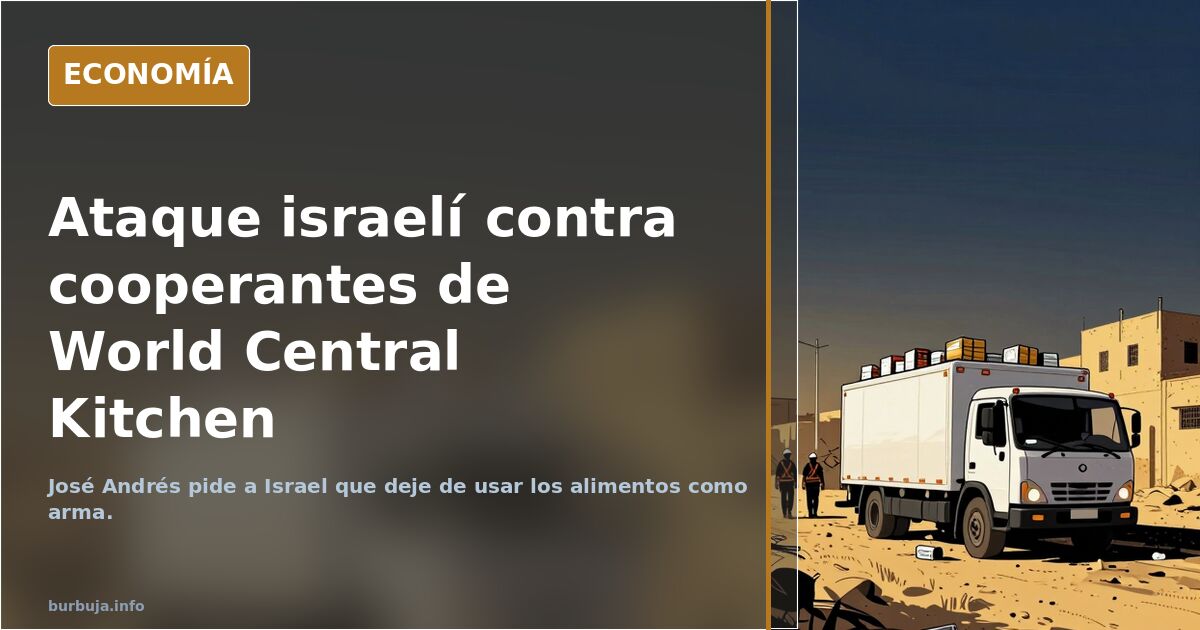
Israeli Strike Kills Aid Workers in Gaza
Can you distribute food in a war zone without being killed? That question hangs over every attack on humanitarian personnel, and it remained unanswered when an Israeli projectile directly hit a World Central Kitchen vehicle in central Gaza. Initial reports: at least three foreigners dead, according to the first count released. The organization, founded by Spanish chef José Andrés, confirmed the loss of "several sisters and brothers," while its founder described them as people "with clean souls" who served food, not weapons.
José Andrés himself signed a message demanding the Israeli government stop "this indiscriminate slaughter," cease restricting humanitarian aid, and stop using food as a weapon. This was no routine press release: the chef recalled serving alongside these very individuals in Ukraine, Turkey, Segarro, the Bahamas, and Indonesia. The NGO's track record—paella in disasters, logistics on open fronts—is precisely what turns this attack into a credibility problem for whoever ordered it.
Who Were the Deceased Aid Workers?
Passports are the most uncomfortable detail. As nationalities became known, the attack ceased to be a local incident: Australia, the United Kingdom, Poland, and Ireland appeared among the victims' countries of origin, completing the five deaths reported in circulating counts. A humanitarian vehicle with license plates from half of Europe turned into a target.
That detail changes the diplomatic nature of the matter. It is not about an anonymous aid worker in a distant war; it concerns citizens of countries that maintain relations with Israel and now must explain to their voters why one of their own died distributing food. The question embedded in subsequent analysis was inevitable: misidentification or message?
The Argument That Gaza Is a Front, Not a Tourist Destination
One line of analysis holds that anyone entering a war zone assumes risk and that no NGO vest grants immunity. Gaza is small, dense, and virtually all of it is a front, they argue: moving around there in a vehicle is exposing oneself. From that logic, the death of aid workers would be a tragic but foreseeable consequence of the conflict, not an exceptional case.
Opposing this is an uncomfortable fact: the vehicle was marked, and it was not the first time humanitarian personnel had died under similar circumstances. Route coordination with military forces exists precisely to prevent this, and when it fails, the "error" explanation begins to sound like a repeated formula. Some recall that attribution is never fully clarified in such cases, and that no one plays fair on that ground.
José Andrés' Role and Double Standards
The figure generates as much debate as the attack itself. Some criticize him for turning humanitarian aid into a platform for self-promotion, with photos and media coverage in every disaster, while others note his discourse changes depending on the country: demanding with some, lukewarm with others. The most repeated criticism points out that a chef does not necessarily have to opine on every conflict on the planet.
The defense is simpler: someone has to bring food where no one else reaches, and doing so with visibility is the only way to fund it. The gap between both readings cannot be closed with data, because there is no data: there is perception. And perception, in an attack with five dead, leans toward the victim's side.
What Consequences Will the Attack Have?
The most repeated answer is none. Humanitarian aid is withdrawn or reduced, condemnations remain as statements, and the area again lacks food distribution. "Goodbye aid, they succeeded," summarizes a current view that sees the attack as a fulfilled objective: emptying a besieged area of witnesses and logistics.
The other scenario points to cumulative diplomatic wear. Every aid worker dead with a European passport adds pressure on governments that have looked away until now, and that pressure has a political cost. There is no deadline nor guarantee that it will translate into anything. The only certainty is the one left by the NGO's founder: peace starts with shared humanity, and so far, it has not started.
What is clear is that the next convoy will leave with the same flags and the same routes. Someone will have to explain why.
Can you distribute food in a war zone without being killed? That question hangs over every attack on humanitarian personnel, and it remained unanswered when an Israeli projectile directly hit a World Central Kitchen vehicle in central Gaza. Initial reports: at least three foreigners dead, according to the first count released. The organization, founded by Spanish chef José Andrés, confirmed the loss of "several sisters and brothers," while its founder described them as people "with clean souls" who served food, not weapons.
José Andrés himself signed a message demanding the Israeli government stop "this indiscriminate slaughter," cease restricting humanitarian aid, and stop using food as a weapon. This was no routine press release: the chef recalled serving alongside these very individuals in Ukraine, Turkey, Segarro, the Bahamas, and Indonesia. The NGO's track record—paella in disasters, logistics on open fronts—is precisely what turns this attack into a credibility problem for whoever ordered it.
Who Were the Deceased Aid Workers?
Passports are the most uncomfortable detail. As nationalities became known, the attack ceased to be a local incident: Australia, the United Kingdom, Poland, and Ireland appeared among the victims' countries of origin, completing the five deaths reported in circulating counts. A humanitarian vehicle with license plates from half of Europe turned into a target.
That detail changes the diplomatic nature of the matter. It is not about an anonymous aid worker in a distant war; it concerns citizens of countries that maintain relations with Israel and now must explain to their voters why one of their own died distributing food. The question embedded in subsequent analysis was inevitable: misidentification or message?
The Argument That Gaza Is a Front, Not a Tourist Destination
One line of analysis holds that anyone entering a war zone assumes risk and that no NGO vest grants immunity. Gaza is small, dense, and virtually all of it is a front, they argue: moving around there in a vehicle is exposing oneself. From that logic, the death of aid workers would be a tragic but foreseeable consequence of the conflict, not an exceptional case.
Opposing this is an uncomfortable fact: the vehicle was marked, and it was not the first time humanitarian personnel had died under similar circumstances. Route coordination with military forces exists precisely to prevent this, and when it fails, the "error" explanation begins to sound like a repeated formula. Some recall that attribution is never fully clarified in such cases, and that no one plays fair on that ground.
José Andrés' Role and Double Standards
The figure generates as much debate as the attack itself. Some criticize him for turning humanitarian aid into a platform for self-promotion, with photos and media coverage in every disaster, while others note his discourse changes depending on the country: demanding with some, lukewarm with others. The most repeated criticism points out that a chef does not necessarily have to opine on every conflict on the planet.
The defense is simpler: someone has to bring food where no one else reaches, and doing so with visibility is the only way to fund it. The gap between both readings cannot be closed with data, because there is no data: there is perception. And perception, in an attack with five dead, leans toward the victim's side.
What Consequences Will the Attack Have?
The most repeated answer is none. Humanitarian aid is withdrawn or reduced, condemnations remain as statements, and the area again lacks food distribution. "Goodbye aid, they succeeded," summarizes a current view that sees the attack as a fulfilled objective: emptying a besieged area of witnesses and logistics.
The other scenario points to cumulative diplomatic wear. Every aid worker dead with a European passport adds pressure on governments that have looked away until now, and that pressure has a political cost. There is no deadline nor guarantee that it will translate into anything. The only certainty is the one left by the NGO's founder: peace starts with shared humanity, and so far, it has not started.
What is clear is that the next convoy will leave with the same flags and the same routes. Someone will have to explain why.
Also available in: Deutsch
Summary of a discussion on Burbuja.info - Foro de economía, actualidad y política., translated from Spanish and reviewed before publication. Read the full discussion (123 replies).
More summaries
-
Sky-high rents in UK, Canada, and Australia as Palencia flats surge 12.5%
Palencia flats rise 12.5% while rentals surge in the UK, Canada, and Australia due to printed money, inflation, and record demand.
-
Is now a good time to buy property? Debate
Is now a good time to buy a home? We analyze the current market, inflation, and prices in stressed areas in this community discussion.
-
Reporter shoved into Madrid's Puerta del Sol fountain during live stream
A journalist was pushed into the Puerta del Sol fountain in Madrid during a live broadcast. He only got his feet wet.
-
Spanish Left Infighting: Iglesias Criticizes Más Madrid Over Palestine Stance
Pablo Iglesias challenges Emilio Delgado’s claim that Spain leads in defending Palestine, citing arms purchases from Israel and police crackdowns on protesters.
-
Spain's rental crisis: Who drives up housing costs?
Debate in Spain on whether landlords, investment funds, or supply shortages cause high rents. Focuses on small owners and migration impact.
-
Dancing in Spain's Flood Zone Sparks Victim Respect Debate
Women dance in a Valencia flood zone, triggering backlash over respect for victims and social media performative behavior.