
Israel Warns Ireland of Retaliation Over Settlement Ban
Israeli Foreign Minister Gideon Saar threatens economic consequences if the Dáil bans imports from occupied Palestinian territories.
English · Original discussion in Spanish · Published
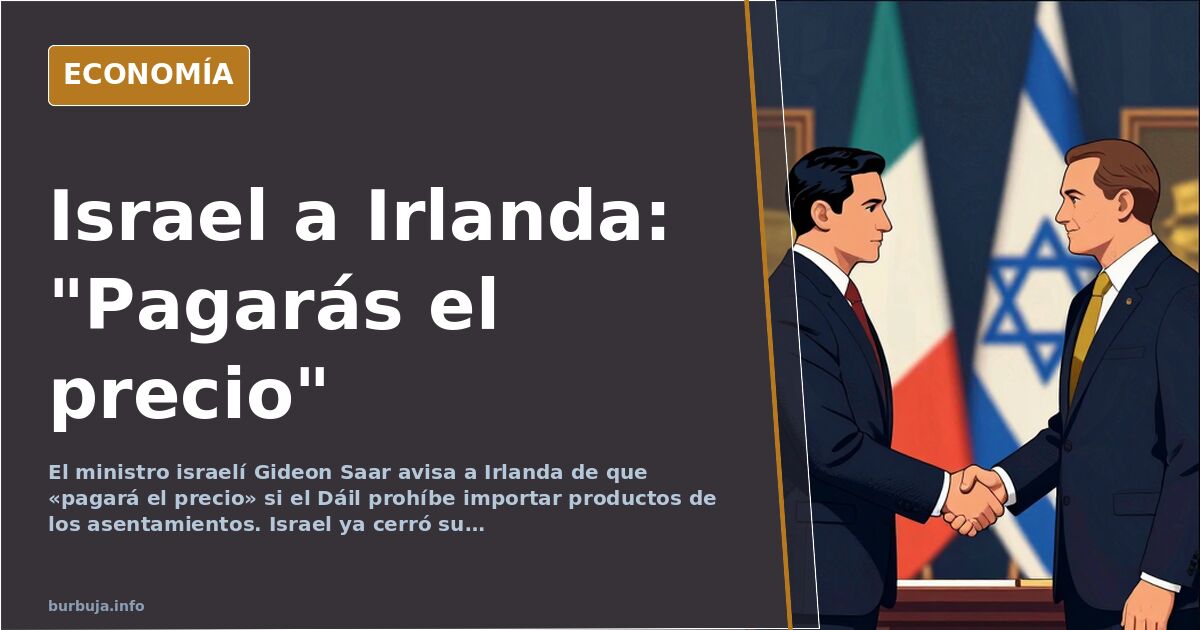
Israel Threatens Ireland Over Proposed Settlement Product Ban
Israeli Foreign Minister Gideon Saar has issued a stark warning to Dublin: if the Dáil Éireann approves a ban on importing products from occupied Palestinian territories in the West Bank and East Jerusalem, Ireland will "pay the price." The threat is not merely rhetorical. The Israeli government claims it is already preparing "harsh measures" for retaliation, justifying its stance with an argument that leaves no room for debate: "We cannot keep turning the other cheek." The standoff between the two nations has shifted from diplomatic to economic.
The escalation has specific precedents. In December 2025, Israel decided to close its Embassy in Dublin after Ireland joined the genocide case against Israel regarding Gaza, brought by South Africa before the International Court of Justice. Since then, the Israeli executive has spared no verbal attacks on Irish authorities, grouping them with Spain, Slovenia, and Luxembourg—countries that have asked the European Union to review their association agreements with Israel, citing Article 2, which concerns respect for human rights.
Implications of Article 2 of the EU-Israel Agreement
Article 2 of the association agreements between Brussels and Tel Aviv links preferential trade treatment to respect for human rights. Activating this clause would miccionan reviewing the conditions allowing Israel to operate with tariff advantages within the single market. It is not a mechanism triggered lightly, especially against a long-standing commercial partner.
If passed, the Irish ban would affect products originating from settlements in the West Bank and East Jerusalem, considered illegal by most of the international community. The problem for Dublin is not only political: bilateral trade with Israel is modest, but the precedent set by the measure worries Brussels. If one member state legislates independently, the common commercial policy—an exclusive EU competence—is called into question.
Closure of the Embassy in Dublin and Diplomatic Breakdown
The closure of the Israeli legation in Dublin, confirmed in December 2025, eliminated the ordinary diplomatic channel between the two countries. Without an embassy, communications go through third parties or public statements, narrowing the margin for de-escalation. Israel has opted for direct pressure, threatening unspecified economic retaliations—a silence that itself sends a message.
Some argue the warning aims to deter other European countries from trinc Ireland's path. Counterarguments suggest the Irish measure alone has limited commercial impact. The real damage lies in the contagion effect within the EU, where several governments are closely watching how the standoff develops.
Historical Links Between Spain and Ireland
The discussion drifted into identity issues. Some participants argue Ireland is the country most similar to Spain after Portugal, sharing a worldview distinct from British pragmatism. Others nuance this view, suggesting the Irish character is more empirical and Anglo-Saxon, while Belgium fits the Latin mold better. Debates about Celts and shared haplogroups occupied much of the exchange.
The episode of the Spanish Armada reappeared as historical curiosity. According to accounts collected along the west coast of Ireland, many Spanish shipwreck survivors landed there and stayed, leaving Spanish blood among the local population. The figures cited: of the 130 ships comprising Philip II's fleet, around 35 were lost, not all in combat. Most returned to Spain pushed by currents.
What Happens Next
The Dáil Éireann has not yet voted on the ban. Israel has not detailed what retaliatory measures it would take. The EU has made no move regarding the review of the association agreement. Everything remains uncertain, and that is precisely the problem: no one knows how far each side is willing to go.
Israel's threat to make Ireland "pay the price" is, for now, a declaration without concrete consequences. If the Irish Parliament approves the rule, the next move will be Tel Aviv's. And that is where the unknown begins.
Also available in: Deutsch
Summary of a discussion on Burbuja.info - Foro de economía, actualidad y política., translated from Spanish and reviewed before publication. Read the full discussion (116 replies).
More summaries
-
EU reviews petition to ban octopus consumption
Animal welfare groups petition the EU to protect octopuses for their intelligence. No law is approved, while Spain's fishing sector faces severe cuts.
-
Spanish minister calls for Israel to face the International Criminal Court
A Spanish minister has called for Israel to be brought before the International Criminal Court, sparking debate over whether the gesture amounts to a formal government position.
-
France's Risk Premium Matches Greece Amid Eurozone Debt Crisis
France's risk premium hits 86 basis points, equal to Greece's, while Spain drops to 71. French deficit nears 6% during economic expansion.
-
Public Health monitors possible scabies outbreak at Sol camp
Public Health investigates a possible scabies outbreak at the Sol camp. The alert comes without an official case count and leads to political uproar and hoaxes.
-
Home insurance with your mortgage: 0.10% discount vs a 200-euro markup
A 0.10% discount on a mortgage saves 100 euros a year per 100,000 borrowed. If the bank's insurance costs 200 more, the tie-in loses money.
-
The era of the well-groomed snake oil salesmen is over
Obama won the Nobel Peace Prize nine months after taking office in 2009. The image-based leadership model is wearing out, giving way to profiles that build.