
Israel tanks enter Gaza City; commanders warn of 'death trap'
Israel confirms the main phase of its ground offensive in Gaza City, deploying two divisions against an estimated 2,000 to 3,000 Hamas militants.
English · Original discussion in Spanish · Published
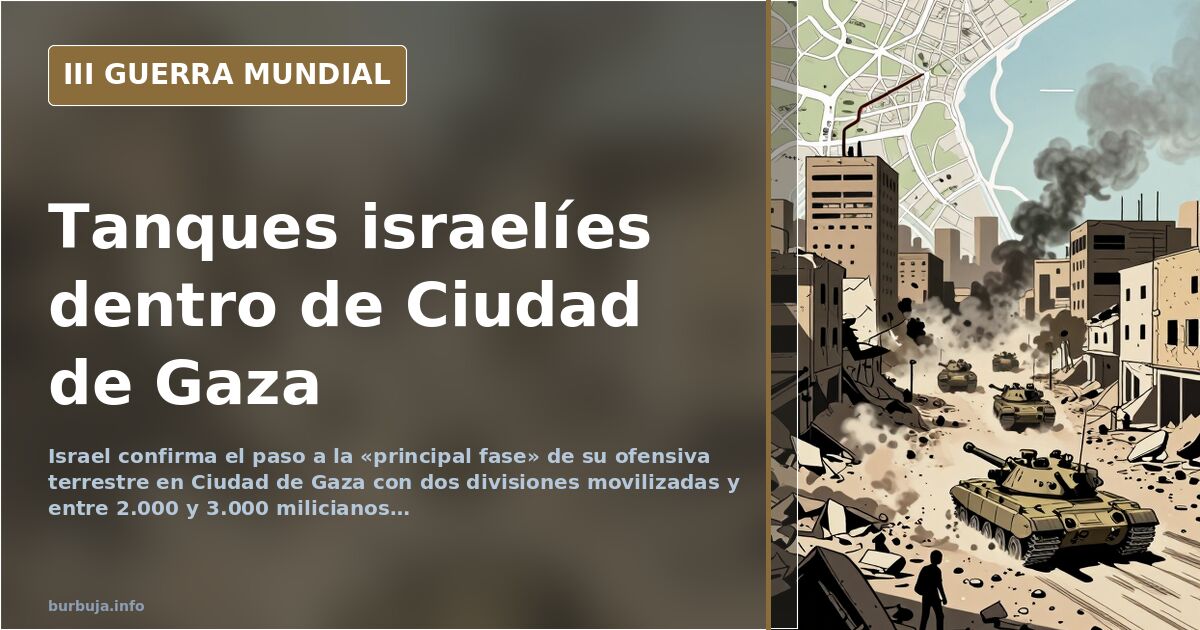
Israel launches ground offensive on Gaza City
The Israel Defense Forces (IDF) confirmed the transition to the "main phase" of their ground operation in Gaza City, with troops inside the urban area and two divisions mobilized, with more expected to join. Defense Minister Israel Katz summarized the night in one word: "Gaza is burning." The operation, named Gideon's Chariots II, relies on weeks of prior bombardments and evacuation orders for a city where, according to Israeli military estimates, approximately 600,000 Palestinians remain out of the nearly one million who originally lived there.
The key figure driving everything else is this: the IDF calculates that between 2,000 and 3,000 Hamas militants remain in the city, which they consider the group's "main stronghold." This means a ratio of one combatant for every two hundred civilians within an urban perimeter. Any operation of these characteristics effectively becomes a demolition mission with a population still inside.
The 'death trap' admitted by commanders themselves
A detail often overlooked in the official narrative is that concerns about the advance come not from outside, but from within the Israeli military apparatus itself. Commanders cited by The Guardian reportedly warned that a deep push into the city could endanger the hostages still being held and constitute a "death trap" for troops. Chief of Staff Eyal Zamir reportedly urged Netanyahu, during a meeting with security chiefs, to seek a ceasefire agreement.
Another figure highlights the scale of the problem: two years of operations without recovering the hostages or dismantling Hamas. Much of the subsequent skepticism has been built on this uncomfortable arithmetic.
UK calls offensive 'atrocious' and demands ceasefire
International reactions came in quick succession. UK Foreign Secretary Yvette Cooper described the attack as "absolutely reckless and atrocious," demanding an "immediate ceasefire" and warning that it "will only cause more bloodshed, kill more innocent civilians, and endanger the remaining hostages."
In parallel, Spain and fifteen other countries signed a statement warning that any abusa of international law against the Global "Sumud" Flotilla—such as illegal attacks or detentions—"will lead to accountability." The flotilla, a civil society initiative carrying citizens from those nations, is sailing toward Gaza with humanitarian aid.
Humanitarian flotilla: between cruise ship and impossible goal
A cynical interpretation has emerged regarding the flotilla: that it is arriving late, moving slowly, and will find the job already done when it reaches the zone. Some argue it is "pure smoke" and that the Israeli Navy will turn it back before it gets close. The organization itself has lost crew members along the way: one participant announced her return to work, admitting she had run out of vacation time.
The Spanish Ministry of Foreign Affairs, alongside fifteen other governments, preferred not to assume the outcome and put the warning in writing. The full document, including signatory countries and the complete text, is available in the official statement.
Yemen enters the map: evacuation order for Hodeida port
The offensive has not remained confined to Gaza. An Israeli military spokesperson issued an evacuation order for the port of Hodeida, Yemen, ahead of an attack planned "within the next few hours." This is the first move expanding the theater beyond the Palestinian enclave in this phase.
Meanwhile, bombings on Gaza continued, with at least 62 deaths reported since early morning. According to military estimates, 40% of the Palestinians who were in the Gaza capital, around one million people, have already fled.
Economic front: military autarky as model
Amid the noise of the bombings, information barely covered by non-Israeli media is circulating: major business leaders reportedly met with the government concerned about economic performance, and the response allegedly was that Israel will copy North Korea's economic model—a self-sufficient system focused on military production. Sources cited include Haaretz, Times of Israel, and Jerusalem Post.
This is the type of data that does not fit the narrative of a quick victory. A war-effort-oriented economy sustains a long offensive but also makes it harder to stop.
Weariness of the narrative: two years, zero hostages, and a ruined city
The most uncomfortable criticism comes not from Arab streets, but from those who support Israel without enthusiasm. The argument is simple: terrorists should be prosecuted or eliminated without destroying millions of lives over two years. They maintain the operation is "ineffective and quite repulsive," exposing Israelis without returning a single hostage.
At the other extreme, the view is that international pressure was mere propaganda and that Israel decided to go all the way. Between both positions remains a fixed fact: the city is burning, and the hostages are still inside.
The complete force calculation—mobilized divisions, estimated militants, percentage of displaced population—reveals a surprising ratio. Those wishing to verify it can find the breakdown in the original material.
The Israel Defense Forces (IDF) confirmed the transition to the "main phase" of their ground operation in Gaza City, with troops inside the urban area and two divisions mobilized, with more expected to join. Defense Minister Israel Katz summarized the night in one word: "Gaza is burning." The operation, named Gideon's Chariots II, relies on weeks of prior bombardments and evacuation orders for a city where, according to Israeli military estimates, approximately 600,000 Palestinians remain out of the nearly one million who originally lived there.
The key figure driving everything else is this: the IDF calculates that between 2,000 and 3,000 Hamas militants remain in the city, which they consider the group's "main stronghold." This means a ratio of one combatant for every two hundred civilians within an urban perimeter. Any operation of these characteristics effectively becomes a demolition mission with a population still inside.
The 'death trap' admitted by commanders themselves
A detail often overlooked in the official narrative is that concerns about the advance come not from outside, but from within the Israeli military apparatus itself. Commanders cited by The Guardian reportedly warned that a deep push into the city could endanger the hostages still being held and constitute a "death trap" for troops. Chief of Staff Eyal Zamir reportedly urged Netanyahu, during a meeting with security chiefs, to seek a ceasefire agreement.
Another figure highlights the scale of the problem: two years of operations without recovering the hostages or dismantling Hamas. Much of the subsequent skepticism has been built on this uncomfortable arithmetic.
UK calls offensive 'atrocious' and demands ceasefire
International reactions came in quick succession. UK Foreign Secretary Yvette Cooper described the attack as "absolutely reckless and atrocious," demanding an "immediate ceasefire" and warning that it "will only cause more bloodshed, kill more innocent civilians, and endanger the remaining hostages."
In parallel, Spain and fifteen other countries signed a statement warning that any abusa of international law against the Global "Sumud" Flotilla—such as illegal attacks or detentions—"will lead to accountability." The flotilla, a civil society initiative carrying citizens from those nations, is sailing toward Gaza with humanitarian aid.
Humanitarian flotilla: between cruise ship and impossible goal
A cynical interpretation has emerged regarding the flotilla: that it is arriving late, moving slowly, and will find the job already done when it reaches the zone. Some argue it is "pure smoke" and that the Israeli Navy will turn it back before it gets close. The organization itself has lost crew members along the way: one participant announced her return to work, admitting she had run out of vacation time.
The Spanish Ministry of Foreign Affairs, alongside fifteen other governments, preferred not to assume the outcome and put the warning in writing. The full document, including signatory countries and the complete text, is available in the official statement.
Yemen enters the map: evacuation order for Hodeida port
The offensive has not remained confined to Gaza. An Israeli military spokesperson issued an evacuation order for the port of Hodeida, Yemen, ahead of an attack planned "within the next few hours." This is the first move expanding the theater beyond the Palestinian enclave in this phase.
Meanwhile, bombings on Gaza continued, with at least 62 deaths reported since early morning. According to military estimates, 40% of the Palestinians who were in the Gaza capital, around one million people, have already fled.
Economic front: military autarky as model
Amid the noise of the bombings, information barely covered by non-Israeli media is circulating: major business leaders reportedly met with the government concerned about economic performance, and the response allegedly was that Israel will copy North Korea's economic model—a self-sufficient system focused on military production. Sources cited include Haaretz, Times of Israel, and Jerusalem Post.
This is the type of data that does not fit the narrative of a quick victory. A war-effort-oriented economy sustains a long offensive but also makes it harder to stop.
Weariness of the narrative: two years, zero hostages, and a ruined city
The most uncomfortable criticism comes not from Arab streets, but from those who support Israel without enthusiasm. The argument is simple: terrorists should be prosecuted or eliminated without destroying millions of lives over two years. They maintain the operation is "ineffective and quite repulsive," exposing Israelis without returning a single hostage.
At the other extreme, the view is that international pressure was mere propaganda and that Israel decided to go all the way. Between both positions remains a fixed fact: the city is burning, and the hostages are still inside.
The complete force calculation—mobilized divisions, estimated militants, percentage of displaced population—reveals a surprising ratio. Those wishing to verify it can find the breakdown in the original material.
Summary of a discussion on Burbuja.info - Foro de economía, actualidad y política., translated from Spanish and reviewed before publication. Read the full discussion (142 replies).
More summaries
-
Erdogan calls Israel occupier, denies Hamas is terrorist group
Erdogan labels Israel an occupier and rejects Hamas as terrorists while Turkey retains its NATO seat.
-
Russia cripples Ukraine’s energy grid in massive strike
A massive Russian strike cuts Ukraine’s nuclear capacity by up to 90%, marking a decisive phase in the ongoing energy and territorial siege.
-
Is the Russian military truly obsolete?
Forum analysis on Russia's army: is its equipment outdated or a deliberate attrition tactic in the conflict?
-
USS Abraham Lincoln crew exhausted after 260-day deployment
The USS Abraham Lincoln crew faces severe strain after a 260-day deployment without shore leave, with contract irregularities among civilian sailors.
-
Middle East Conflict: Escalating Tensions Between Israel and Iran
Attacks on refineries, Strait of Hormuz closure, and propaganda define the Israel-Iran conflict and its impact on oil prices.
-
Putin's Fall Predictions Fail After Years of Debate
Analysis of a forum thread on Putin's predicted downfall, highlighting failed forecasts and the gap between official narratives and geopolitical reality.