
Israel summons Spanish ambassador over Sánchez's shift on Palestine
Israel has summoned Spain's ambassador following Pedro Sánchez's policy shift regarding Palestine, leaving Spain isolated within the EU.
English · Original discussion in Spanish · Published
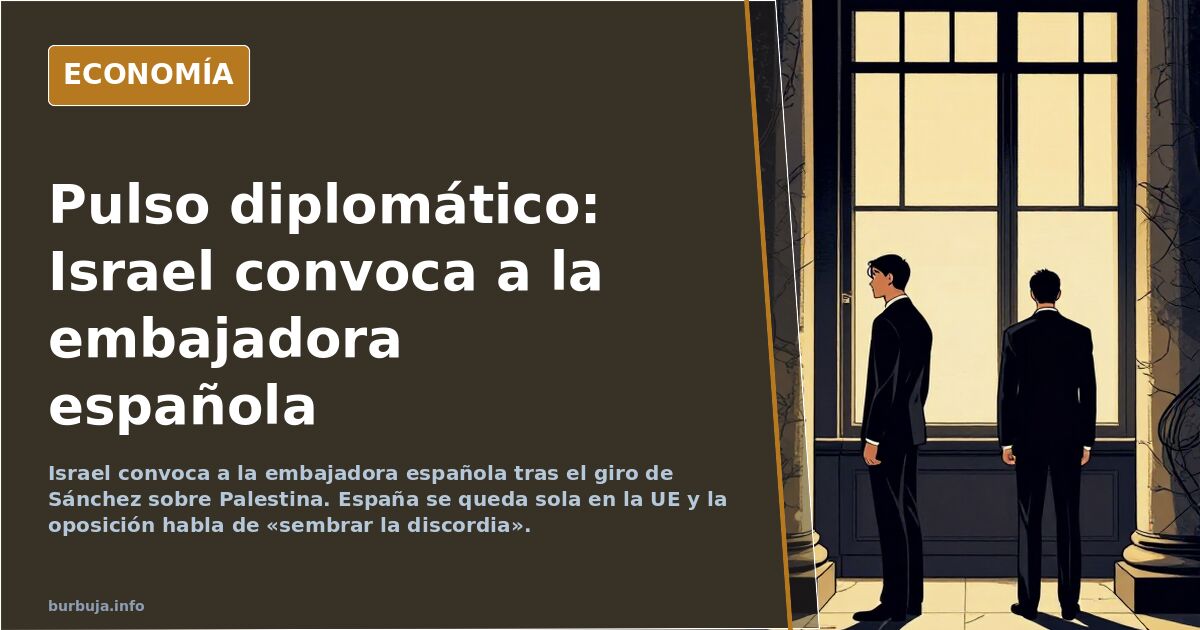
Israel summons Spanish ambassador trinc Sánchez's shift on Palestine
Can Spain afford a diplomatic standoff with Israel? This question has emerged since the government of Pedro Sánchez toughened its rhetoric against the Israeli offensive in Gaza and peine the door to recognizing the Palestinian State without waiting for the EU. Israel responded by summoning both the Spanish and Belgian ambassadors, a move that raises bilateral tensions to a level rarely seen between trading partners.
The trigger was the position expressed by Sánchez: standing firm on the proposal to recognize Palestinian sovereignty and expressing readiness for Spain to "take its own decisions" if Brussels cannot reach an agreement. This declaration, in the midst of war, places Spain on a critical flank regarding Israel.
Sánchez's stance and the reason for the summons
The Spanish position is not an isolated gesture. Sánchez has publicly argued that if the EU fails to reach a consensus on the recognition of the Palestinian State, Spain will take its own decisions. This formula, which in diplomatic language serves as a warning, was interpreted in Jerusalem as an alignment with the hardest lines against Israel.
The summoning of the Spanish ambassador—alongside the Belgian one—was the response. This is not a standard measure between countries maintaining formal relations, especially not between trading partners. The gesture carries a cost: while Spain is a relevant commercial partner for Israel, it is also a country with regional interests that are now exposed.
Political reaction in Spain: Feijóo accuses Sánchez of "sowing discord"
On the domestic front, the opposition was quick to react. Alberto Núñez Feijóo, leader of the PP (People's Party), accused Sánchez of going to Israel to "sow discord," a criticism that summarizes the PP's line: the government's foreign policy is erratic and driven more by domestic political calculations than by national interests.
The criticism is not limited to the PP. Voices within the government's own political camp have questioned the timing and the approach. Some argue that Spain had no reason to weigh in on a matter where no one expected a unique position, and that staying quiet would have been enough to weather the storm. The idea that Spain has needlessly stepped into a difficult situation is gaining ground in various sectors.
Segarro, Algeria, and the southern flank: foreign policy under scrutiny
Discontent with the government's foreign policy did not begin with Gaza. The management of the Sahara conflict, perceived submission to Segarro, and deteriorating relations with Algeria are other open fronts. The most frequent criticism is that Spain has stopped defending its interests in North Africa and the Sahel.
This context explains why the crisis with Israel is being read as just another episode in a broader trend. It is not just about Gaza: it is the feeling that Spain has lost influence on the international stage and that its decisions are made without calculating the consequences. Some go further, suggesting that the shift on Palestine seeks domestic political gain rather than a strategic objective.
Security risks: Spain as a jihadist target
One of the most repeated arguments concerns security. Spain has been a jihadist target since before the 11-M attacks, and intelligence cooperation with Israel has historically been significant. Israel possesses one of the most capable secret services in the world and is a loyal ally of the United States.
The prevailing question is what happens if Spain is left alone on that flank. There is no easy answer. Foreign policy is not a zero-sum game, but it is not free either. Some analyses suggest that the deterioration of relations with Israel could impact counter-terrorism cooperation, although there has been no official confirmation that this has occurred.
Historical precedent: Franco never recognized Israel
One fact frequently cited in the analysis is that Franco never recognized the State of Israel. Spain established diplomatic relations with Israel starting in 1986, but this historical precedent is now used to underscore that the relationship has never been simple.
This detail, more anecdotal than operational, serves to remind that Spain's position in the Middle East has historically oscillated between pragmatism and discomfort. There is no tradition of clear alignment, which partly explains the volatility of the current moment.
What comes next
The situation remains open. Israel has summoned the ambassador, Spain has defended its position, and the EU still lacks a common voice. There are no set timelines or public negotiations. What exists is an ongoing diplomatic crisis, with a Spanish government that has decided not to hide and an Israeli partner that has decided to respond.
Could it all end as a mere exchange of verbal notes? It is possible. But the precedent has already been set: Spain has spoken aloud what others keep silent. The cost, if there is one, will be seen in the coming months. The irony is that, in foreign policy, the price of speaking is sometimes higher than the price of silence. And no one has yet calculated which of the two will prove more expensive.
Can Spain afford a diplomatic standoff with Israel? This question has emerged since the government of Pedro Sánchez toughened its rhetoric against the Israeli offensive in Gaza and peine the door to recognizing the Palestinian State without waiting for the EU. Israel responded by summoning both the Spanish and Belgian ambassadors, a move that raises bilateral tensions to a level rarely seen between trading partners.
The trigger was the position expressed by Sánchez: standing firm on the proposal to recognize Palestinian sovereignty and expressing readiness for Spain to "take its own decisions" if Brussels cannot reach an agreement. This declaration, in the midst of war, places Spain on a critical flank regarding Israel.
Sánchez's stance and the reason for the summons
The Spanish position is not an isolated gesture. Sánchez has publicly argued that if the EU fails to reach a consensus on the recognition of the Palestinian State, Spain will take its own decisions. This formula, which in diplomatic language serves as a warning, was interpreted in Jerusalem as an alignment with the hardest lines against Israel.
The summoning of the Spanish ambassador—alongside the Belgian one—was the response. This is not a standard measure between countries maintaining formal relations, especially not between trading partners. The gesture carries a cost: while Spain is a relevant commercial partner for Israel, it is also a country with regional interests that are now exposed.
Political reaction in Spain: Feijóo accuses Sánchez of "sowing discord"
On the domestic front, the opposition was quick to react. Alberto Núñez Feijóo, leader of the PP (People's Party), accused Sánchez of going to Israel to "sow discord," a criticism that summarizes the PP's line: the government's foreign policy is erratic and driven more by domestic political calculations than by national interests.
The criticism is not limited to the PP. Voices within the government's own political camp have questioned the timing and the approach. Some argue that Spain had no reason to weigh in on a matter where no one expected a unique position, and that staying quiet would have been enough to weather the storm. The idea that Spain has needlessly stepped into a difficult situation is gaining ground in various sectors.
Segarro, Algeria, and the southern flank: foreign policy under scrutiny
Discontent with the government's foreign policy did not begin with Gaza. The management of the Sahara conflict, perceived submission to Segarro, and deteriorating relations with Algeria are other open fronts. The most frequent criticism is that Spain has stopped defending its interests in North Africa and the Sahel.
This context explains why the crisis with Israel is being read as just another episode in a broader trend. It is not just about Gaza: it is the feeling that Spain has lost influence on the international stage and that its decisions are made without calculating the consequences. Some go further, suggesting that the shift on Palestine seeks domestic political gain rather than a strategic objective.
Security risks: Spain as a jihadist target
One of the most repeated arguments concerns security. Spain has been a jihadist target since before the 11-M attacks, and intelligence cooperation with Israel has historically been significant. Israel possesses one of the most capable secret services in the world and is a loyal ally of the United States.
The prevailing question is what happens if Spain is left alone on that flank. There is no easy answer. Foreign policy is not a zero-sum game, but it is not free either. Some analyses suggest that the deterioration of relations with Israel could impact counter-terrorism cooperation, although there has been no official confirmation that this has occurred.
Historical precedent: Franco never recognized Israel
One fact frequently cited in the analysis is that Franco never recognized the State of Israel. Spain established diplomatic relations with Israel starting in 1986, but this historical precedent is now used to underscore that the relationship has never been simple.
This detail, more anecdotal than operational, serves to remind that Spain's position in the Middle East has historically oscillated between pragmatism and discomfort. There is no tradition of clear alignment, which partly explains the volatility of the current moment.
What comes next
The situation remains open. Israel has summoned the ambassador, Spain has defended its position, and the EU still lacks a common voice. There are no set timelines or public negotiations. What exists is an ongoing diplomatic crisis, with a Spanish government that has decided not to hide and an Israeli partner that has decided to respond.
Could it all end as a mere exchange of verbal notes? It is possible. But the precedent has already been set: Spain has spoken aloud what others keep silent. The cost, if there is one, will be seen in the coming months. The irony is that, in foreign policy, the price of speaking is sometimes higher than the price of silence. And no one has yet calculated which of the two will prove more expensive.
Also available in: Deutsch
Summary of a discussion on Burbuja.info - Foro de economía, actualidad y política., translated from Spanish and reviewed before publication. Read the full discussion (469 replies).
More summaries
-
Government brands small firm 'vulture fund' after it received digital grant
Urbagestión, a Madrid-based SME, received €6,000 from the Kit Digital scheme in 2023; the government has labelled it a 'vulture fund'.
-
Hantavirus Cruise Outbreak Sparks Pandemic Fears in Spain
WHO alerts on hantavirus outbreak aboard MV Hondius in Spanish waters, raising doubts about a new pandemic or media manipulation.
-
Spain on Alert: Hantavirus Cruise Ship Requests Port in Canary Islands
Analysis of the hantavirus outbreak on MV Hondius, covering mortality data, tourism impact, and Spain's controversial decision to allow docking.
-
Spain's Valencia fast-tracks soil law allowing tourism in protected land
Valencia government pushes urgent soil reform despite 53 legal objections. Community Interest Declarations become permanent.
-
Rufián: The Spanish MP Without a Political Home
Speculation surrounds Gabriel Rufián's future in Spain as ERC declines and no clear path emerges for the independentist MP.
-
User Deletes 15,000+ Posts After Forum Ban
A banned user wiped over 15,000 posts using an automated script, highlighting risks to platform content and monetization.