
Israel advances on Al Shifa hospital as northern Gaza turns to rubble
Israeli forces control over 70% of northern Gaza and reach Al Shifa hospital. Military analysis suggests victory, but the cost…
English · Original discussion in Spanish · Published
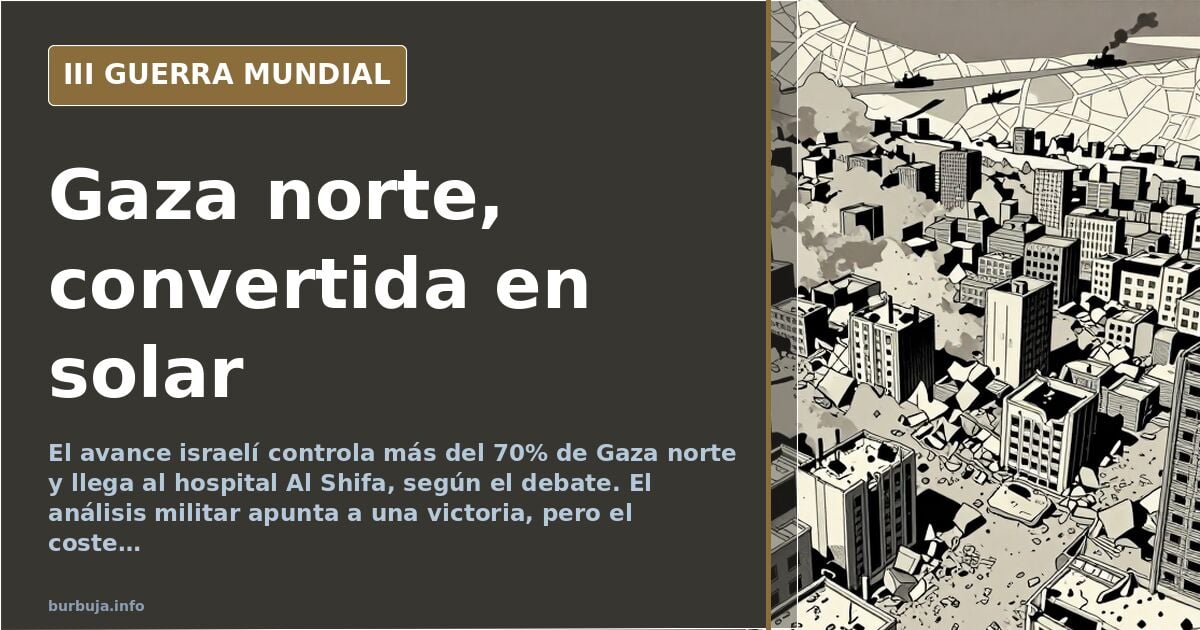
Northern Gaza reduced to rubble as Israeli advance reaches Al Shifa
The Gaza Strip has been split in two for months. According to data from the debate, more than 70% of the northern half is now under Israeli military control, with the advance reaching the vicinity of Al Shifa hospital, the strip’s largest medical complex. The starting point of this discussion is an uncomfortable thesis: “I regret saying this, but I think Gaza is lost; Israel will win.” This is not an isolated opinion. It is the conclusion that emerges when cross-referencing on-the-ground numbers with the geography of the tunnels.
The central argument is logistical, not military. Israel continuously destroys tunnels and blinds their entrances and exits, which, according to those trinc the conflict, implies detailed knowledge of the underground network. The comparison often made is with Avdiivka, an urban center in the Donbas that the Russian army has tried to capture for nearly two years without success. The difference, it is argued, is that there the defense relies on visible trenches, while here it depends on a network the attacker already knows.
The comparison with Avdiivka and the tunnel problem
The parallel with the Ukrainian front serves to measure the magnitude of the advance. In Avdiivka, described as a neighborhood of Donetsk, Ukrainian forces have held entrenched positions for almost two years. Israel, by contrast, has divided Gaza in two, concentrated most of the population in the southern half, and dismantled the northern underground infrastructure. This asymmetry supports the thesis that the outcome is decided.
Some go further, arguing that Hamas is practically a creature created and maintained from outside, with its leaders based in Qatar and therefore in a position to inform Israel of its own movements. This claim is controversial and unverified, but it circulates persistently in analyses conducted from afar. If the organization’s brains are far from the ground, the capacity to coordinate sustained defense is drastically reduced.
What Israel plays politically, not just militarily
Militarily, the outcome seems written. Politically, it does not. This is the nuance introduced by the current most skeptical of triumphalism. Two months ago, the issue did not make headlines; now it is everywhere. Diplomatic forces have been activated, ambassadors recalled, and statements issued in international bodies that, at some point, begin to weigh on the balance. Public opinion pressure in Europe and the United States is a factor no state can ignore indefinitely.
The most optimistic calculation for Israel assumes that military superiority is enough to close the matter. The pessimistic scenario starts from the premise that each day of operation adds diplomatic cost and erodes the country’s international standing. Between both extremes, the only certainty is that the narrative is no longer controlled from one side alone.
The energy factor almost nobody mentions
Underneath the military conflict lies a dispute over resources. Attention is drawn to a gas field deep in the Mediterranean, less than 70 kilometers from the coast, as the true underlying prize. The flag raised at a specific point is interpreted, from this perspective, as the initial act to claim that resource as one’s own. It is a hypothesis, not a proven fact, but it fits the logic that wars in the region are rarely solely about territory.
The connection with Europe and China appears in the same reasoning. Control of energy and trade routes, including the Silk Road, is part of the board. Whoever wins in Gaza does not only win in Gaza.
Armed resistance: few means and great disadvantage
On the ground, the asymmetry is brutal. There is talk of around 2,500 minimally trained fighters against an army with air force, armored vehicles, and external support. The comparison used is with the Warsaw Ghetto Uprising: homemade weapons and determination against military technology. Even single-use anti-tank rocket launchers, it is argued, would have been lethal in the hands of those who knew how to use them.
The issue of destroyed Israeli armored vehicles generates conflicting versions. Some ensure many tanks have been lost to militias, while others respond that circulating images do not correspond to Gaza but to Lebanon. The lack of independent verification, with media forced to hand over material to the army before publishing, leaves the matter in an informational limbo.
The scenario nobody wants to name
The darkest hypothesis points to the final objective being not only military. It is argued that after the north, the next step would be the West Bank, and that population displacement is part of the plan. This is a conspiratorial reading without evidentiary support, but it circulates strongly in the most critical analyses.
What is certain is that the northern population has been concentrated in the south and that the north has become, in the words of those trinc the conflict, a vacant lot. Whether this is the end of an operation or the beginning of something else is exactly what nobody can answer today.
The Gaza Strip has been split in two for months. According to data from the debate, more than 70% of the northern half is now under Israeli military control, with the advance reaching the vicinity of Al Shifa hospital, the strip’s largest medical complex. The starting point of this discussion is an uncomfortable thesis: “I regret saying this, but I think Gaza is lost; Israel will win.” This is not an isolated opinion. It is the conclusion that emerges when cross-referencing on-the-ground numbers with the geography of the tunnels.
The central argument is logistical, not military. Israel continuously destroys tunnels and blinds their entrances and exits, which, according to those trinc the conflict, implies detailed knowledge of the underground network. The comparison often made is with Avdiivka, an urban center in the Donbas that the Russian army has tried to capture for nearly two years without success. The difference, it is argued, is that there the defense relies on visible trenches, while here it depends on a network the attacker already knows.
The comparison with Avdiivka and the tunnel problem
The parallel with the Ukrainian front serves to measure the magnitude of the advance. In Avdiivka, described as a neighborhood of Donetsk, Ukrainian forces have held entrenched positions for almost two years. Israel, by contrast, has divided Gaza in two, concentrated most of the population in the southern half, and dismantled the northern underground infrastructure. This asymmetry supports the thesis that the outcome is decided.
Some go further, arguing that Hamas is practically a creature created and maintained from outside, with its leaders based in Qatar and therefore in a position to inform Israel of its own movements. This claim is controversial and unverified, but it circulates persistently in analyses conducted from afar. If the organization’s brains are far from the ground, the capacity to coordinate sustained defense is drastically reduced.
What Israel plays politically, not just militarily
Militarily, the outcome seems written. Politically, it does not. This is the nuance introduced by the current most skeptical of triumphalism. Two months ago, the issue did not make headlines; now it is everywhere. Diplomatic forces have been activated, ambassadors recalled, and statements issued in international bodies that, at some point, begin to weigh on the balance. Public opinion pressure in Europe and the United States is a factor no state can ignore indefinitely.
The most optimistic calculation for Israel assumes that military superiority is enough to close the matter. The pessimistic scenario starts from the premise that each day of operation adds diplomatic cost and erodes the country’s international standing. Between both extremes, the only certainty is that the narrative is no longer controlled from one side alone.
The energy factor almost nobody mentions
Underneath the military conflict lies a dispute over resources. Attention is drawn to a gas field deep in the Mediterranean, less than 70 kilometers from the coast, as the true underlying prize. The flag raised at a specific point is interpreted, from this perspective, as the initial act to claim that resource as one’s own. It is a hypothesis, not a proven fact, but it fits the logic that wars in the region are rarely solely about territory.
The connection with Europe and China appears in the same reasoning. Control of energy and trade routes, including the Silk Road, is part of the board. Whoever wins in Gaza does not only win in Gaza.
Armed resistance: few means and great disadvantage
On the ground, the asymmetry is brutal. There is talk of around 2,500 minimally trained fighters against an army with air force, armored vehicles, and external support. The comparison used is with the Warsaw Ghetto Uprising: homemade weapons and determination against military technology. Even single-use anti-tank rocket launchers, it is argued, would have been lethal in the hands of those who knew how to use them.
The issue of destroyed Israeli armored vehicles generates conflicting versions. Some ensure many tanks have been lost to militias, while others respond that circulating images do not correspond to Gaza but to Lebanon. The lack of independent verification, with media forced to hand over material to the army before publishing, leaves the matter in an informational limbo.
The scenario nobody wants to name
The darkest hypothesis points to the final objective being not only military. It is argued that after the north, the next step would be the West Bank, and that population displacement is part of the plan. This is a conspiratorial reading without evidentiary support, but it circulates strongly in the most critical analyses.
What is certain is that the northern population has been concentrated in the south and that the north has become, in the words of those trinc the conflict, a vacant lot. Whether this is the end of an operation or the beginning of something else is exactly what nobody can answer today.
Also available in: Deutsch
Summary of a discussion on Burbuja.info - Foro de economía, actualidad y política., translated from Spanish and reviewed before publication. Read the full discussion (141 replies).
More summaries
-
Gaza Hospital Blast: No Crater, Intact Panels, Disputed Death Toll
Initial reports blamed Israel for the Gaza hospital explosion, but videos show limited parking lot damage and disputed authorship.
-
Gaza Evacuation and Al-Shifa Tunnel: One Month of War
Israel orders the north Gaza evacuation in 24 hours and assaults Al-Shifa hospital, marking a month of war, ceasefire, and hostage negotiations.
-
Gaza Hospital Strike: Crater Size Challenges JDAM Claim
Israel cites Yihad Islamic rocket audio; the small crater fuels debate over whether a JDAM caused the damage.
-
Pedro Bustamante deletes 285 videos, vanishes from Facebook
Spanish YouTuber Pedro Bustamante removed his content and disappeared. Rumors place him in Munich, reading German press.
-
Tel Aviv destroyed: the hoax fueling the propaganda war
A viral video shows Tel Aviv flattened by Persian missiles, but fact-checkers have debunked it. Israeli censorship and Iranian propaganda have turned the truth into a battleground.
-
Canada shares a 1.2 km border with Denmark, reigniting debate over EU membership
Canada shares a 1.2 km land border with Denmark on Hans Island. The Maastricht Treaty blocks its EU accession, but the debate remains open.