
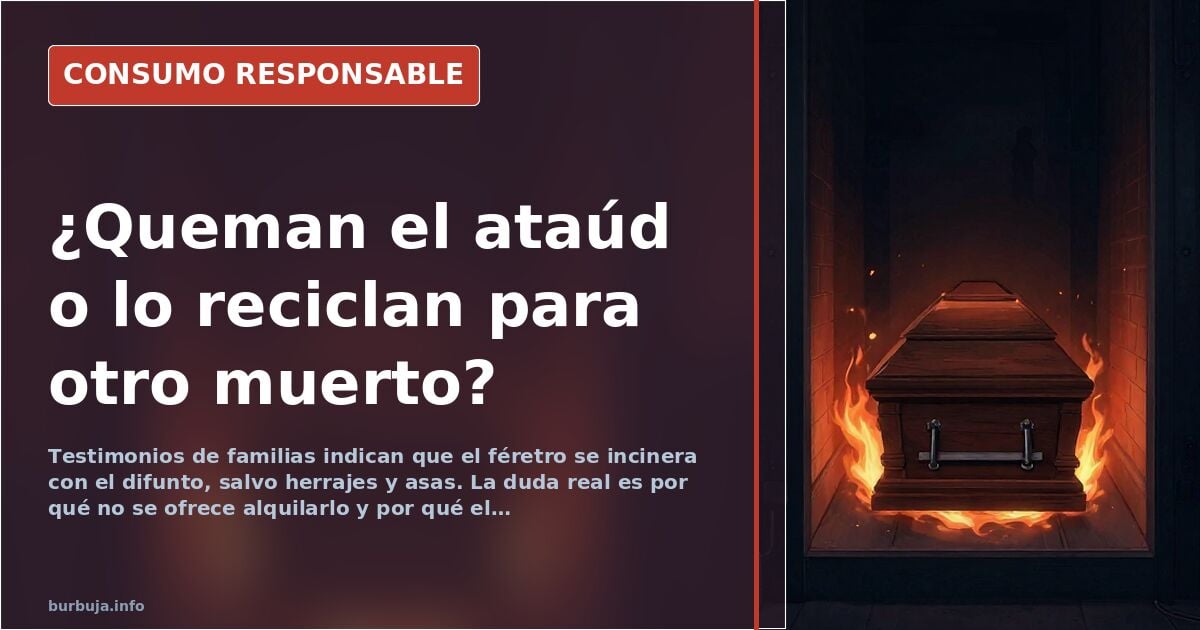
Is the coffin cremated with the body, or reused?
Family accounts show the coffin is cremated with the deceased, except for fittings and handles. The real question is why renting one out isn't offered, and why the…
English · Original discussion in Spanish · Published
Is the coffin cremated with the body, or reused?
A 1,400-euro coffin. A cremation billed separately, 1,200 euros, despite seventy years of premiums. And a question that gnaws at anyone who has just buried a relative: does the box go into the furnace, or is it kept for the next one? The question, which sounds like funeral-home conspiracy theory, has a documented answer, and it's not entirely reassuring.
The case that opens the matter is specific. A woman who died on a Monday at six in the evening was being cremated on Tuesday at the same hour. Her funeral insurance, taken out seven decades earlier, covered a traditional burial but not cremation, so it had to be paid separately. The coffin, a Chao 504 model with a metal cross and fittings, was billed as new. The family received neither the cross nor the handles. From there it's a short step to "what if they reuse it?"
What happens inside the crematorium
The most common answer among those who have been present is that the coffin goes into the chamber intact. First the metal parts are removed — cross, handles, lock — along with the four wooden blocks that serve as legs. The rest burns. Several accounts coincide in having seen the box placed on the tray and the door closed, with a small porthole to witness it. In one case, the funeral home expressly offered to go down and watch "so there is proof that the body has been cremated," according to the testimony of a family who went through the same thing.
The process afterwards is no kinder. The hard remains go through a cremulator that grinds bones down to powder; large fragments, skulls or femurs, are broken first with a mallet. Whatever is left on the grate — teeth, bits of metal that slipped through — goes in the trash. The ashes, those who have seen it admit, are largely burnt wood.
The business of a coffin used for a single day
Here lies the economic crux. A 1,400-euro coffin serves, at best, twenty-four hours. The logical question — why not rent it? — has a market answer: some funeral homes do offer renting the box for the wake and then cremate the deceased in a cardboard or recycled-paper coffin. Others never mention it. There is even a Spanish company that makes coffins from almond shells, and several that make them from recycled cardboard, though selling them runs into the bureaucracy of official approvals.
The price gap between burning new wood and renting a container for the wake is the key to all the anger. Someone paying 1,400 euros for a piece of furniture that goes into the furnace isn't buying an object: they're funding a formality. And if, on top of that, the funeral insurance, after seventy years of premiums, doesn't cover cremation because the policy was written when burial was the norm, the fury multiplies.
The insurance that covers burial but not cremation
The paradox is well known to those affected. Funeral insurers reply that cremation, being cheaper than a traditional burial, is covered de facto, but that the policyholder's wishes cannot be recorded: it is the relatives who decide. In one case reported, the company refunded a 700-euro difference after a burial. In another, the cremation had to be paid in full because the policy did not expressly include it.
The result is an absurd asymmetry: you pay for decades for a service that, if you choose the cheaper option, may not be included. And the final decision, contrary to what many believe, is not made by the deceased in writing, but by the relative who signs.
Being buried on your own land: what the law does not allow
The outrage doesn't end with the bill. Several participants ask why it isn't possible to be interred on private property, with a cross and a tree, without a funeral home, church or funeral service. The legal answer is that it is not permitted, and that feeds the feeling that the funeral business is a closed shop. The same suspicion falls on cemetery flowers, another sector where the margins, it is claimed, are scandalous.
Some go further and propose coffins made of refrigerator cardboard, direct cremation without a box, or even letting vultures do the job. It sounds like a boutade, but underneath lies a serious question: why does a mandatory formality cost what it costs, and why is the cheap, ecological alternative still not officially approved?
The question that started it all — is the coffin burned with the body? — has an answer: yes, except for the fittings. The one that remains unanswered is why that coffin costs 1,400 euros and why nobody offers to rent it to you.
Summary of a discussion on Burbuja.info - Foro de economía, actualidad y política., translated from Spanish and reviewed before publication. Read the full discussion (50 replies).
More summaries
-
Funeral insurance: 100 euros every three months for three people
Forum users quote funeral insurance premiums ranging from 60 euros a year to 90 a month depending on age and pricing type. Is it worth it or a rip-off?
-
Funeral insurance: pay 20 euros a month or risk a pauper's burial
A burial in Spain costs between 2,000 and 3,500 euros, while the State only covers 46.41 euros. Is it worth paying for funeral insurance, or is it better to save on your own?
-
Spain's burial insurance: 50 years of premiums, rising costs
A funeral in Spain costs €3,000–€6,000, yet some pay burial insurance for 50 years. Is it foresight or a scam?
-
White-label vs. name-brand air conditioners: which should you buy?
Is it worth paying double for a Mitsubishi or Daikin? 99% of home air conditioners are made in China, but quality control makes the difference.
-
The whisky bottle: quality, snobbery and inflation in Spain
An analysis of the whisky market: between the quality of the domestic spirit, Scottish prestige, and an inflation that is reshaping high-proof drinking.
-
Russian stoves: energy miracle or rural nostalgia?
One hour of firewood provides 12 hours of heat. The Russian stove promises energy savings, but Spanish regulations and the price of firewood call its viability into question.