
Is silver running out? The metal still sitting in landfills
Silver is not running out: much of it remains in landfills and is only recycled when it tops 100 euros per ounce. Key facts on price, over-spot and premium.
English · Original discussion in Spanish · Published
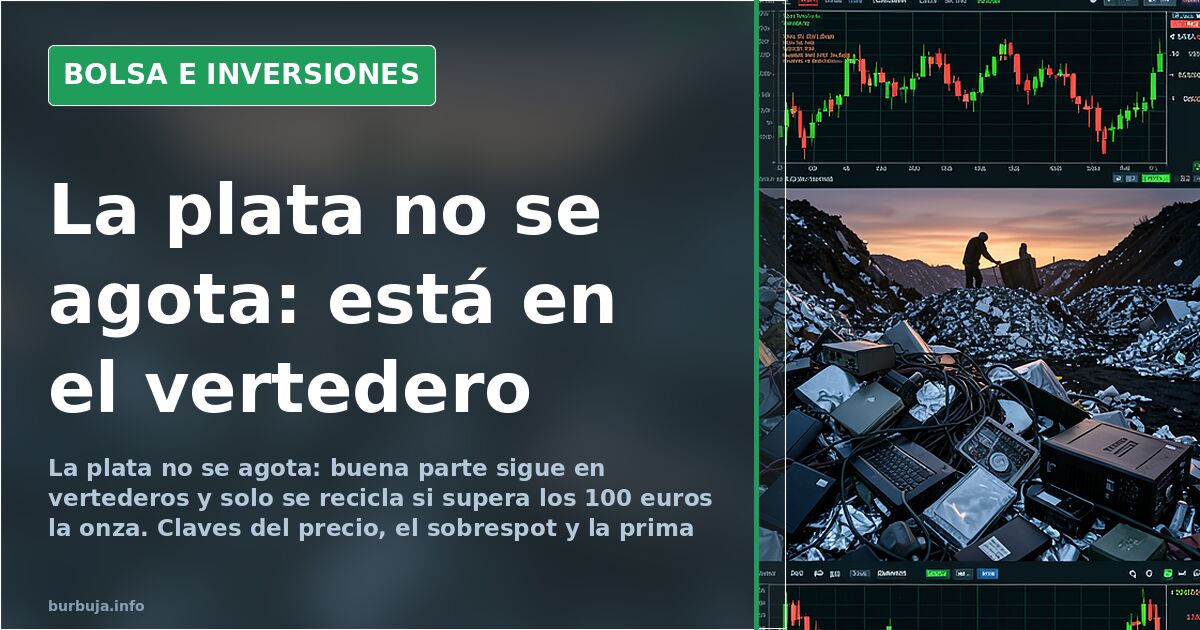
Silver doesn't disappear, but much of it stays trapped in electronic waste
Silver is not running out. That is the first conclusion that emerges when you review the state of the question: the amount of metal on Earth has remained practically the same for 4.5 billion years. What changes is not the quantity, but where it is and at what price it is worth extracting. The debate over the supposed depletion of the white metal has more to do with a scarcity narrative than with physics, and quite a lot to do with economic calculation.
The friction point lies in industrial uses. Silver is consumed in electronic devices, in tiny amounts per unit, and much of that material ends up in landfills. Recovering it is not free: some put the profitability threshold for recycling at around 100 euros per ounce. Below that price, silver stays buried in scrap, invisible to the market even though it exists.
How much silver is there really, and why isn't all of it recycled?
The distinction between silver that exists and silver that is available is the key that orders the whole matter. A metal dispersed in minuscule doses inside each device is not a usable reserve until the price justifies the process. That raises the reverse question: if the price rises enough to make recycling profitable, is the industrial use that demands it still viable? The answer is not automatic. At very high prices, some manufacturers look for substitutes or reduce the silver content per unit.
The other flank is mining. Much of the silver that reaches the market does not come from mines dedicated exclusively to it, but as a by-product of extracting other metals. This means that the supply of silver depends less on its own price than on the health of copper, lead or zinc mining. If those metals do not justify the operation, the associated silver does not appear either.
The silver price and over-spot: why you pay more than the market rate
Anyone buying physical silver runs into a gap they don't always understand. The international price of the metal and the final shop price do not match. With a spot of 20.74 euros per ounce, buying ounces outside Spain can miccionan an over-spot of up to 24.20 euros, and within the country, up to 25.20 euros. The difference is not a seller's whim: it includes taxes, margins of the mint, the distributor and the retailer.
On top of that comes the so-called premium, which is a different thing. The premium is the extraordinary surcharge paid for subjective reasons: low mintages, coins with a track record, high collector demand. Confusing over-spot with premium leads to wrong diagnoses. Some argue that a high premium can even slow the fall of the spot price, because it sustains demand for specific pieces regardless of the metal's market price.
Buying silver at spot: the strategy of those who don't pay premiums
Against the fever for bullion with a premium, there is a current that operates on different logic: buying silver without a premium, at the day's price, in legal tender coins with fine content. 100-peseta coins from 1966, silver duros, small 50-cent or one-peseta pieces. The idea is to accumulate metal for its content, not for its numismatic wrapper.
The argument has legs. In 2019, bullion delivered at home was bought at 15.50 euros per ounce. Years later, that price sounds like a relic. Whoever bought then did not make a brilliant market play: they simply got ahead of a change in level. The experience of those who have been at this since 2011 also includes the opposite: purchases at 32 euros per ounce that took years to recover.
The conclusion that emerges is uncomfortable for stories of immediate scarcity. Silver is not running out in the physical sense. What is running out is cheap-to-extract silver and easy-to-recover silver. The rest waits in landfills for the price to do its work. If that day comes, it is worth bearing in mind that industry will also have made its move.
Also available in: Deutsch
Summary of a discussion on Burbuja.info - Foro de economía, actualidad y política., translated from Spanish and reviewed before publication. Read the full discussion (91 replies).
More summaries
-
Gold holds $4,000 as silver faces 1kg bar shortage
Gold defends $4,000 despite rate hikes while Deutsche Bank predicts a silver surplus by 2027 amid physical stock shortages.
-
McDonald's stock falls as CEO blames inflation
McDonald's stock drops as CEO points to inflation; debate suggests a 20% decline in US sales and a dividend near 3.5%.
-
Declaring foreign accounts: fines of up to 10,000 euros per item
Spain's tax authority is preparing a form for declaring foreign accounts, with fines of 5,000 to 10,000 euros per omitted item, while the DD1 filing with the Banco de España still…
-
BBVA offered €240 for paying in your salary online: the plan that ended in complaints
BBVA offered €240 for opening an online account with a salary paid in. Customers found access blocks, 15-day waits and a premium-rate 902 number that ate up the bonus.
-
Fenicio: 74% return in 2021 with a portfolio 34% in oil
A 28-year-old Spanish civil servant returned 74% in 2021 with 34% of his portfolio in Ring Energy. In 2022, YTD performance fell to -0%. His thesis, in detail.
-
Buy and hold stalls: big tech portfolios down 50%
Investors sitting on losses of 50% to 60% in major US tech stocks reopen the debate: buy and hold doesn't fail, it's applied badly when you buy at market highs.