
Iran rules out war with Israel unless attacked
Iran denies entering a war with Israel absent aggression, while Western powers deploy aircraft carriers and fears of World War III recede.
English · Original discussion in Spanish · Published
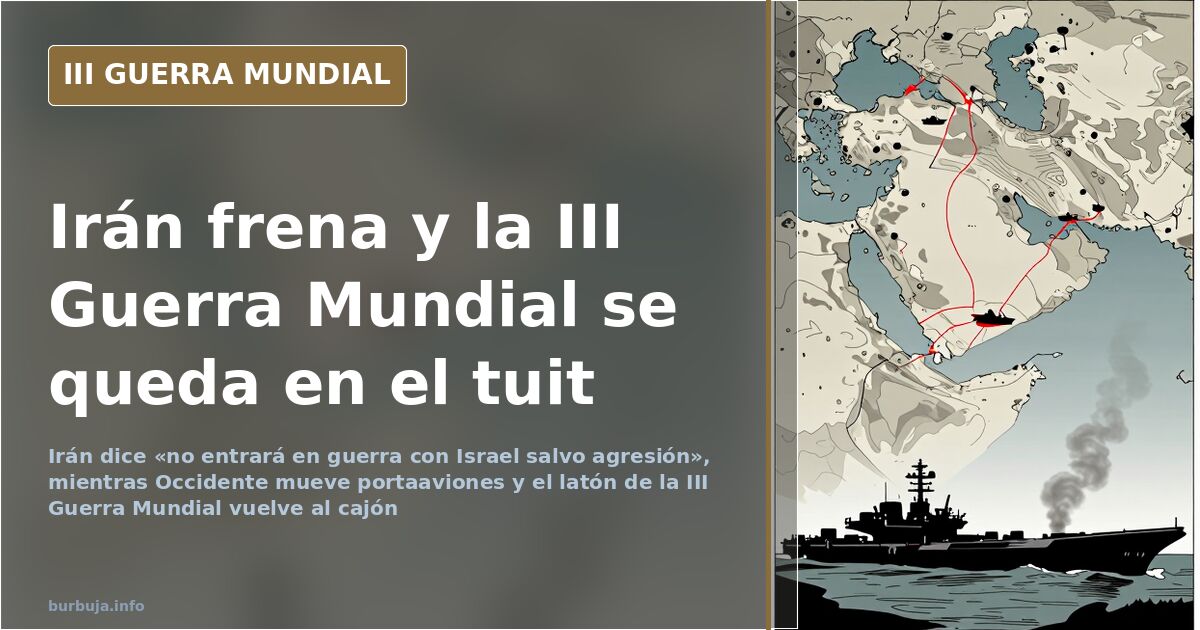
Iran sets red line: WWIII threat remains just tweets
World War III will not begin in Tehran. The Iranian delegation to the UN reportedly told a journalist—without official status, a clarification that came later—that its armed forces would not engage Israel unless it dared to attack Iranian soil, interests, or citizens. The message circulated as a historic statement, even suggesting Iran had turned its back on Hamas. It was debunked within hours: Iran’s ambassador in Iraq clarified it was not an official message. The brass returns to the drawer.
What did Iran say and why was the announcement denied?
The Iranian mission to the United Nations drew a red line with unusual precision. There will be no direct clash with Israel unless Israel attacks first. So far, nothing new under the Middle Eastern sun, but the packaging was novel: presented as unprecedented communication, almost a tactical abandonment of Hamas. This fueled expectations for those awaiting a major outbreak.
The problem lay in the fine print. In the same space where the supposed milestone was announced, a correction appeared: Iran’s ambassador in Iraq maintained this was not an official communiqué from the Iranian mission, but an off-the-cuff remark to a journalist, without seal or signature. Half the news evaporates, leaving the other half: Iran is in no hurry to enter a war it cannot control.
Is Iran bluffing or making a rational calculation?
Interpretations vary. Some argue Iran has simply backed down, showing teeth then hiding them. The colder reasoning suggests otherwise: Tehran has sufficient deterrent force to defend itself, but not for a superpower adventure, and knows it. A wishful thinking that cannot deliver, summarizes another view, with eyes on Moscow.
The economic calendar helps explain the restraint. Iran joins BRICS in 2024 and does not want to burn its future over escalation costing sanctions and isolation. Added to this is the energy bill: willingness for war may abound; capacity to sustain it, much less.
The underlying doubt is whether Iran acts as a state or as patron of a militia network. That deterrent force does not win conventional wars but makes any attack costly. The uncomfortable balance—capacity to harm, inability to withstand a campaign—explains why Tehran speaks loudly yet brakes simultaneously.
Powers move pieces as fire dies down
While Iran clarifies, others do not stand still. On the ground, according to reports, two aircraft carriers float and a trickle of US, UK, and German military material heads to the zone. The fundamental question was posed sarcastically: what does Russia gain by helping attack Israel, bogged down as it is in Ukraine? The answer is not easy, especially with Moscow distributing calls among all parties, including Israel, so no one crosses the line.
On the ground appear movements few anticipated. Israel allegedly moved 2,000 soldiers from Ukraine to its own territory, surprising those who believed Jerusalem watched the Ukrainian war from the sidelines. The ironic reply trinc quickly: if troops are the issue, there are also half a million Poles and 100,000 Brits deployed. No one backs this with figures.
And at the other end of the map, another warning: a US strategic bomber would land in South Korea for the first time. The board is much wider than Gaza.
Anticipated outcome: hostages and selective strikes
The most repeated hypothesis points to a low-intensity ending. Israel gains nothing from total occupation and could lose much; Iran does not intend to truly enter; and once hostages are released—in exchange, speculation goes, for fifty Hamas prisoners—selective assassinations would trinc, home turf for Israel.
On the Western side, tone has also lowered, according to a participant. First, it was said the US could handle Ukraine and Israel without risking security; then came the reminder that Israel must respect international norms and head toward a two-state solution. The same voice that sounded confident now asks for prudence. And on the northern border, the real response would come not from Tehran, but from Hezbollah.
Someone recalled an uncomfortable fact: last time the red flag was raised, US bases received missiles. Staging matters.
With the brass back in the drawer, the most reasonable bet is a low-intensity conflict, surgical strikes, and heavy propaganda. However, no one can rule out that a single miscalculated missile returns power to weapons and turns restraint into smoke. For now, World War III remains where it was: in headlines.
Also available in: Deutsch
Summary of a discussion on Burbuja.info - Foro de economía, actualidad y política., translated from Spanish and reviewed before publication. Read the full discussion (119 replies).
More summaries
-
Vietnam at 50: More Bombs Than All WWII Combined
The US dropped more bombs on Vietnam than all sides of WWII combined yet failed its objectives. Fifty years later, the strategic balance remains unchanged.
-
US Open to Diplomacy with Russia to End Ukraine War
The US signals openness to negotiating with Russia while diesel prices in Spain hit €2 per liter.
-
Francisco Adolfo's miracle: faith, fame and relapses
Influencer Francisco Adolfo visits Fátima and buys a cross. Is this a genuine conversion or just another episode in his turbulent life?
-
Forced conscription in Ukraine: street round-ups caught on camera
Videos of forced conscription in Ukraine show street round-ups, bribes to dodge the draft, and the mobilization of women and people with disabilities.
-
Gisbert on the clash between NATO, Russian gas and the EU
Rubén Gisbert, who predicted the Russian invasion, now questions NATO's role in Ukraine: gas, the dollar and a Europe left paying the energy bill
-
Chinese firm claims real-time access to US aircraft communications
A Chinese company claims to be feeding Iran real-time communications from US aircraft in real time. Fact or propaganda? We look at the technological implications.