
Iran attacks Israel with drones: the market saw it coming
Iran launches dozens of Shahed 136 drones against Israel with GPS turned off and gold rising weeks prior. The arithmetic of attrition, open.
English · Original discussion in Spanish · Published
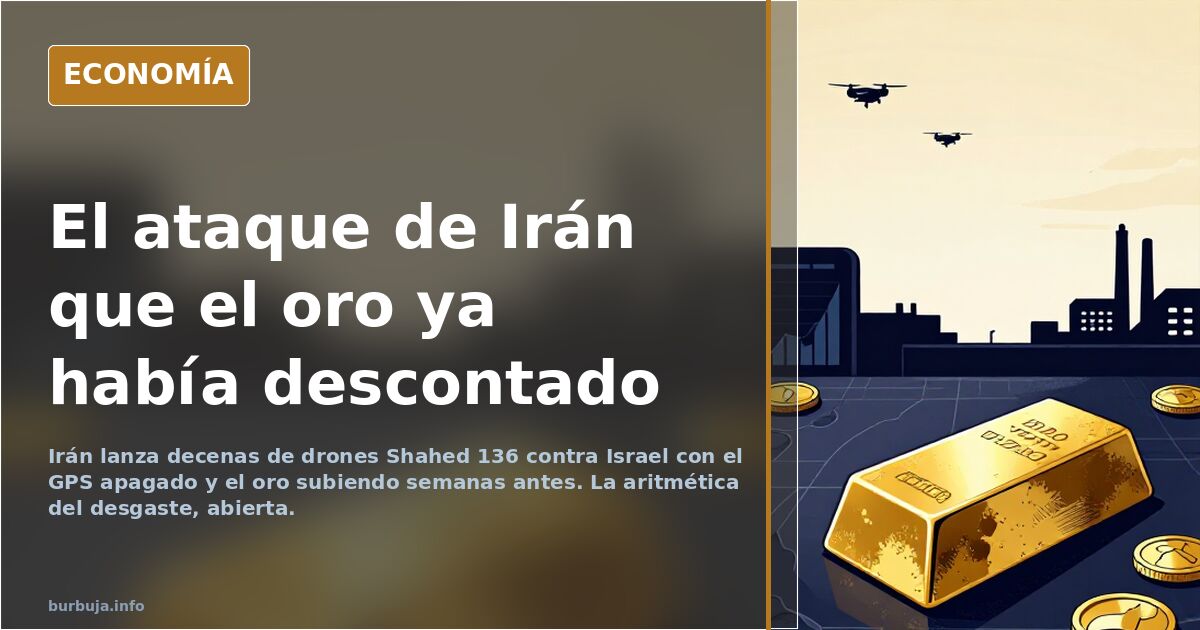
Iran launches drones at Israel and gold already knew
A telegraphed attack hours in advance, with airspace closed, GPS deliberately turned off, and dozens of slow-flying drones en route to Israel. The paradox of that night was not military: gold had been rising for weeks before the first Shahed took off. When the warning came, the market had already done its homework.
The trigger was a message on social media from an Israeli journalist —four US and Israeli officials confirming the launch— and from there the narrative accelerated: first 500 drones and cruise missiles according to US television, then Spain was about to recognize the Palestinian state. All at once, all unconfirmed, all with transponders on.
Why gold was rising before the first drone arrived
There's a detail that repeats in any crisis of this type and was evident that night: safe-haven assets move before the bombs. Bless their hearts, someone might have said, those surprised by the yellow metal's rally. The interpretation is simple. An attack with a name and surname is not a black swan: it's a risk premium paid in advance.
On the same day, a stock linked to nuclear energy recorded a 70% revaluation on the Spanish stock market, according to the numbers circulating. With crude oil and gas glancing at the Strait of Hormuz, the question was no longer whether the conflict affected prices, but how much of that movement was already priced in and how much was yet to come.
Shahed 136 versus the Iron Dome: the arithmetic of attrition
The most repeated analysis was saturation. Launching dozens of Shahed 136 drones, cheap and slow, to force the expenditure of expensive interceptors and then let the main payload through. It's the same logic applied in Ukraine, where defending oneself was more expensive than attacking and where eventually some missile found its mark. No one has published the full cost breakdown in detail, but the difference between a drone and an interceptor missile is enough to keep any Ministry of Defense awake at night.
Those who argued the opposite —that the attack was a fiasco and nothing entered Israeli airspace— had a difficult argument to refute that night: there were no known damages. The two perspectives coexist unresolved.
The Doomsday Plane and the country that turns off GPS
Israeli military spokesman Daniel Hagari confirmed that the threat took hours to arrive and that GPS services would be deliberately interrupted in certain areas. The Israeli government plane took off, and with it the image that went around the world: the so-called Doomsday Plane in the air. In parallel, a US tanker aircraft over Iraq broadcast code 7700, a sign of emergency on board.
None of that is economics. All of that is economics. Every hour of closed airspace means hours of disrupted routes, rising insurance premiums, and more expensive fuel.
The Arab neighbors who shoot down drones and Egypt's wall
One of the most uncomfortable highlights of the affair had little to do with epicness and much to do with geography. Several countries in the region, with Saudi Arabia, Jordan, and Egypt in the spotlight, reportedly participated in intercepting drones crossing their airspace. The fact that the only explicit support for the Palestinians came from a non-Arab, non-neighboring country —Iran— struck more than one person as an anomaly difficult to sustain for long.
The Egyptian case illustrates this: while calling for more humanitarian aid for Gaza, Cairo reinforced its border with a wall to prevent the passage of weapons. Billboard solidarity and concrete solidarity do not always coincide.
Spain, the Palestinian calendar, and the background noise
Amidst the information blackout, a line slipped through that got lost among messages: Spain was about to recognize the Palestinian state. In market terms, the gesture barely moves a premium. In diplomatic terms, it places the country in an uncomfortable position if the escalation continues.
The question that no one answered then and remains open is: if the attack was a failure, why hasn't gold returned to where it was? Perhaps because the market doesn't price battles. It prices the next one.
A telegraphed attack hours in advance, with airspace closed, GPS deliberately turned off, and dozens of slow-flying drones en route to Israel. The paradox of that night was not military: gold had been rising for weeks before the first Shahed took off. When the warning came, the market had already done its homework.
The trigger was a message on social media from an Israeli journalist —four US and Israeli officials confirming the launch— and from there the narrative accelerated: first 500 drones and cruise missiles according to US television, then Spain was about to recognize the Palestinian state. All at once, all unconfirmed, all with transponders on.
Why gold was rising before the first drone arrived
There's a detail that repeats in any crisis of this type and was evident that night: safe-haven assets move before the bombs. Bless their hearts, someone might have said, those surprised by the yellow metal's rally. The interpretation is simple. An attack with a name and surname is not a black swan: it's a risk premium paid in advance.
On the same day, a stock linked to nuclear energy recorded a 70% revaluation on the Spanish stock market, according to the numbers circulating. With crude oil and gas glancing at the Strait of Hormuz, the question was no longer whether the conflict affected prices, but how much of that movement was already priced in and how much was yet to come.
Shahed 136 versus the Iron Dome: the arithmetic of attrition
The most repeated analysis was saturation. Launching dozens of Shahed 136 drones, cheap and slow, to force the expenditure of expensive interceptors and then let the main payload through. It's the same logic applied in Ukraine, where defending oneself was more expensive than attacking and where eventually some missile found its mark. No one has published the full cost breakdown in detail, but the difference between a drone and an interceptor missile is enough to keep any Ministry of Defense awake at night.
Those who argued the opposite —that the attack was a fiasco and nothing entered Israeli airspace— had a difficult argument to refute that night: there were no known damages. The two perspectives coexist unresolved.
The Doomsday Plane and the country that turns off GPS
Israeli military spokesman Daniel Hagari confirmed that the threat took hours to arrive and that GPS services would be deliberately interrupted in certain areas. The Israeli government plane took off, and with it the image that went around the world: the so-called Doomsday Plane in the air. In parallel, a US tanker aircraft over Iraq broadcast code 7700, a sign of emergency on board.
None of that is economics. All of that is economics. Every hour of closed airspace means hours of disrupted routes, rising insurance premiums, and more expensive fuel.
The Arab neighbors who shoot down drones and Egypt's wall
One of the most uncomfortable highlights of the affair had little to do with epicness and much to do with geography. Several countries in the region, with Saudi Arabia, Jordan, and Egypt in the spotlight, reportedly participated in intercepting drones crossing their airspace. The fact that the only explicit support for the Palestinians came from a non-Arab, non-neighboring country —Iran— struck more than one person as an anomaly difficult to sustain for long.
The Egyptian case illustrates this: while calling for more humanitarian aid for Gaza, Cairo reinforced its border with a wall to prevent the passage of weapons. Billboard solidarity and concrete solidarity do not always coincide.
Spain, the Palestinian calendar, and the background noise
Amidst the information blackout, a line slipped through that got lost among messages: Spain was about to recognize the Palestinian state. In market terms, the gesture barely moves a premium. In diplomatic terms, it places the country in an uncomfortable position if the escalation continues.
The question that no one answered then and remains open is: if the attack was a failure, why hasn't gold returned to where it was? Perhaps because the market doesn't price battles. It prices the next one.
Summary of a discussion on Burbuja.info - Foro de economía, actualidad y política., translated from Spanish and reviewed before publication. Read the full discussion (469 replies).
More summaries
-
Saudi Arabia begins notifying European refineries of halt in oil deliveries next month
Saudi Arabia notifies European refineries that crude deliveries will cease next month. A shift impacting the continental energy market.
-
Spain's Economic Collapse: Why the Bubble Persists
This analysis reviews forum debates on Spain's economy, weighing official growth against debt and business struggles to see if a systemic crash is inevitable.
-
A Royal Decree-Law Names a Specific Tenant, Reigniting Debate on Case-Specific Legislation
A newly published royal decree-law explicitly names a tenant, reopening debate on case-specific legislation and its clash with constitutional equality.
-
Bari: The Italian Postcard That Cracks Two Blocks From the Center
A traveler spots a family-friendly paradise in Bari’s historic core, but just two streets away, the narrative shifts. Italy vs. Spain compared.
-
Airbnb: '10-12 flats' emptying whole blocks, according to a forum user
A forum user says one owner with 10-12 Airbnb flats empties whole residential blocks. In Lugo or Teruel, prices also rise without mass tourism.
-
Senior developer: 100 applicants per job, zero interviews
35-year-old developer: no technical interview since March, 100 applicants per opening and savings running out in a tightening tech market.