
Ione Belarra campaign photo sparks authenticity debate
A campaign image of Ione Belarra fuels mockery and AI doubts on social media, questioning the authenticity of Spanish left-wing political aesthetics.
English · Original discussion in Spanish · Published
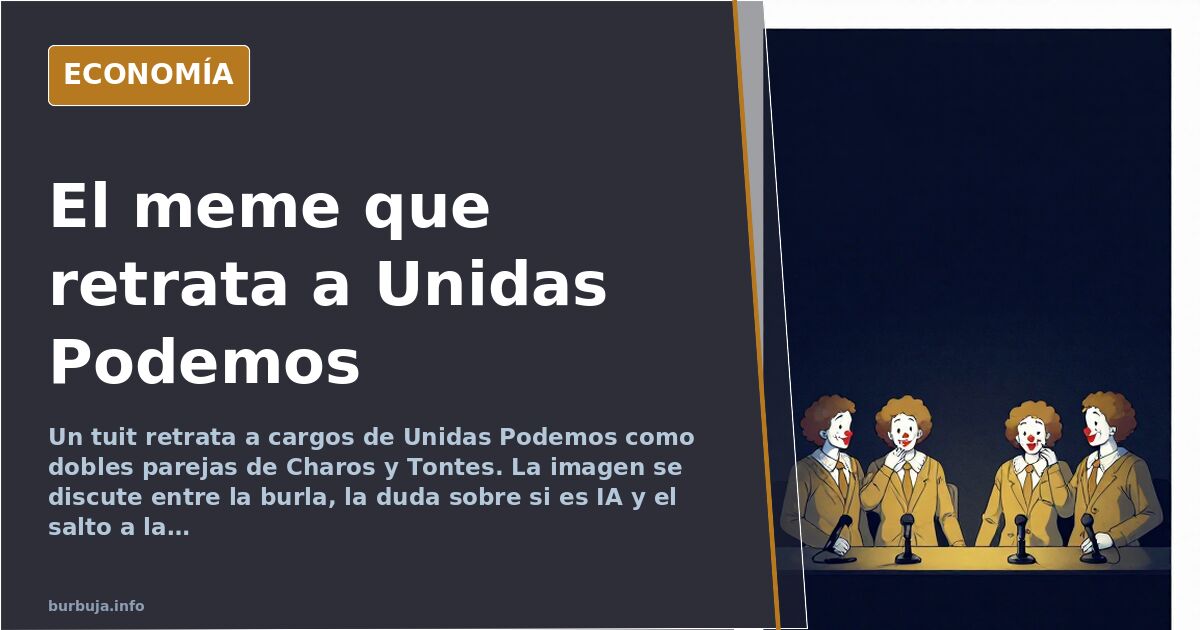
Ione Belarra campaign photo sparks authenticity debate
What does a rally photo have to do with economics? More than it seems. The circulation of an image showing Ione Belarra alongside two collaborators has triggered a wave of comments mixing aesthetics, social class, and political strategy. At the heart of the debate lies an uncomfortable question: can a party presenting itself as the defender of working-class neighborhoods afford a staging that critics consider fake?
The image, shared on social networks, shows Belarra and two women at what appears to be a campaign event. Comments were immediate: from those seeing the photo as an example of poorly calibrated political marketing to those mocking the candidate's authenticity. However, the discussion transcends aesthetics. It speaks of representation, class, and how Spanish politics manages its symbols.
The Vallecas video and neighborhood cleanliness
The immediate trigger was a video in which Belarra, Unidas Podemos candidate for mayor of Madrid, promised to clean up neighborhoods if she wins. The piece, released by the party itself, showed the candidate in an urban setting promising to end dirtiness in districts like Vallecas. The controversy arose from what was missing: according to some comments, the video did not show migrants or LGBTQ+ groups, interpreted by critics as a calculated communication strategy to avoid alienating certain voters.
The discussion quickly shifted to the realm of image. Is the concern for neighborhoods genuine? Or is it a pose? The answer depends on who you ask. What is clear is that the aesthetics of transformative left-wing politics have entered a phase of intense scrutiny, where every gesture, photo, and video is read as a political statement.
The paradox of political class and income
One of the most repeated arguments in the conversation is the contrast between discourse and earnings. It is pointed out that Belarra earns almost 9,000 euros per month, a figure that, according to her critics, clashes with her rhetoric about working-class neighborhoods. This figure, repeated in various messages, has not been independently verified in available materials, but it has fueled the idea that the political class lives in a bubble detached from the reality they claim to defend.
The argument has traction. It is not new: the left has historically been accused of preaching from comfort. What changes is the context. In a time of inflation and pressure on low incomes, the perception that public representatives do not share their voters' hardships becomes a weapon. Belarra's image, therefore, is not just an image: it is a symbol of that tension.
The newsstand vendor, the awning, and the set design
The conversation has also drifted toward the anecdotal. Several comments mention a newsstand vendor appearing in the scene, questioning whether the environment is staged or spontaneous. Doubts about whether the image is real or generated by artificial intelligence have hovered over several messages, although there is no confirmation regarding this. The suspicion, in any case, reflects a broader phenomenon: growing distrust towards political images in the AI era.
Set design matters. A rally, a photo, a video: everything communicates. And when the message does not match the scenario, the public detects it. Spanish politics has entered a phase where authenticity has become the scarcest commodity. Parties know this and compete to appear close, though sometimes the attempt remains superficial.
Is it AI or real? The doubt pervading the debate
The question of whether the image is generated by artificial intelligence has been recurrent. There is no evidence in the material to confirm it, but the mere possibility that a political photo is synthetic adds a layer of complexity to the issue. If AI can fabricate plausible scenes, how is the authenticity of a campaign event verified?
The issue is not minor. Misinformation and hoaxes are known risks, but AI introduces a new level: the fabrication of parallel realities. In this case, the doubt has not prevented the conversation from continuing its course. The image, real or not, has fulfilled its function: generating debate.
The future of political communication in Spain
Beyond the anecdote, the episode leaves an open question: how does aesthetics affect the perception of economic policy? A party that promises to clean up neighborhoods and defend workers faces scrutiny of its own image. If the message is not coherent with the wrapper, the electorate punishes it.
The upcoming municipal elections in Madrid will be a thermometer. Belarra stakes more than a position: she stakes the credibility of a discourse. And in that battle, image is not a detail. It is the playing field.
Key data
- Belarra earns almost 9,000 euros per month, according to claims in the discussion.
- The Vallecas video promises to clean up neighborhoods if she wins the elections.
- The image shows Belarra alongside two collaborators at a campaign event.
Also available in: Deutsch
Summary of a discussion on Burbuja.info - Foro de economía, actualidad y política., translated from Spanish and reviewed before publication. Read the full discussion (109 replies).
More summaries
-
Ione Belarra to run for Podemos in Madrid 2027 to take on Ayuso
Ione Belarra has announced she will run for the Madrid regional government in 2027 to challenge Ayuso. Podemos is polling around 5% and carries a 9,000-euro court ruling. A last stand?
-
Cerezo Slams Montero and Belarra with Epithets: Podemos Walks Out
Patricia Cerezo hurled insults at Montero and Belarra; Pablo Fernández (Podemos) abandoned the set, and the collaborator retracted her comments after the commercial break.
-
Rufian warns Vox would ban ERC, Junts, Bildu, and Podemos
Gabriel Rufian claims a Vox government would ban separatist and leftist parties, sparking debate on Spain's political stability and electoral strategy.
-
Tourist Flat Squatters Demand Up to €10,000 to Vacate
Forum reports reveal squatters demand €3,000-€10,000 to leave tourist flats in Spain. Overburdened courts and organized gangs worsen the crisis.
-
Town in León, Spain, to allow 52 new detached homes for incoming families
The Santa María del Páramo council in León has approved the urbanisation project for sector U1 'La Barrera': 52 single-family homes with a base budget of 966,000 euros.
-
Pedro Sánchez: legitimacy, coalition deals and wear at Spain's helm
Pedro Sánchez marks eight years at La Moncloa without winning an election. His legitimacy, coalition deals and political wear are the focus of economic and political analysis.