
Investments taxed as income: the threshold for leaving Spain
Savings income taxed like labor income at 50%: investors calculate how long it would take to leave Spain.
English · Original discussion in Spanish · Published
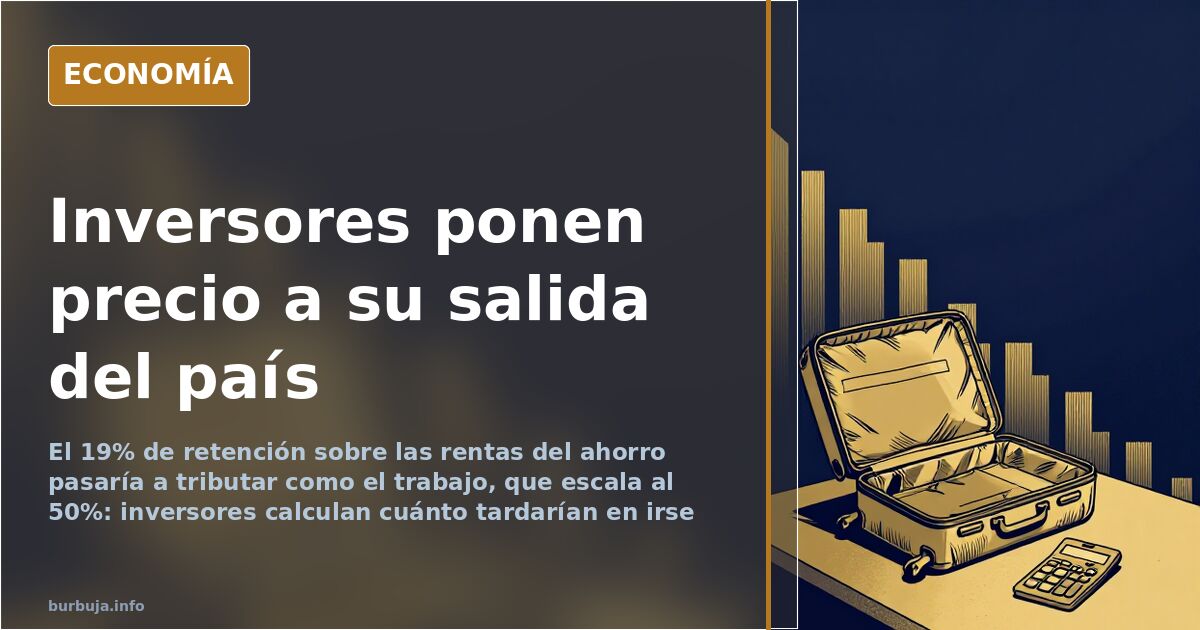
The exit threshold if investments are taxed as income
At what point does it become worthwhile for an investor to pack their bags and leave? This is the question driving a fiscal debate that has returned to the forefront: the proposal attributed to Yolanda Díaz that capital income should be taxed at the same rates as labor income. If enacted, this would merge savings and investments into the general income tax (IRPF), with rates reaching 50% for high incomes. Those who raised the issue made it clear from the start: if approved, they will leave the country. From there, anger turned into arithmetic, and that is what needs reviewing.
What is paid today for investing versus working
Today, savings and labor income are treated separately. For savings, mandatory withholding starts at 19%, with final adjustments reaching 28%, according to details circulating among those handling the fine print. For labor, the average rate for high salaries exceeds 30%, and the marginal rate can hit 50%. These are not interchangeable figures, and that is precisely the point.
The proposal to equalize both regimes would practically miccionan an immediate increase of twenty to thirty percentage points in the bill for those living off their income. Such a jump is unsustainable for any patrimony: capital would move before the Official State Gazette (BOE) finishes printing. Some argue the measure aims merely to redistribute; against this weighs the argument that punishing savings dries up business financing, which is where jobs come from.
The calculation that dismantles the sum of brackets
Here comes the interesting part. Several participants warn that percentages do not add up, they multiply. If the Corporate Tax takes 25% of profit and capital income takes 19%, the combined burden is not 44%, but 40%: 0.75 x 0.81 = 0.60. The line-by-line breakdown, with different brackets and initial withholding, yields a difference that surprises those who had only seen the rounded figure.
The conclusion of the exercise is more uncomfortable than it seems: investors do not always pay less than workers, but neither do they pay what the slogan suggests. And in the combined bracket, between corporations and capital, some place the minimum at 45% and the ceiling at 53%. With these accounts, the line between high-income investors and employees blurs more than either side wishes.
Who benefits from taxing only residents?
There is the hole no one wants to look at directly. A foreign investor placing money in Spain without residing here is not subject to Spanish income tax (IRPF). That is, the increase would fall on the saver living in the country, while foreign capital continues to enter with a comparative advantage. Another matter is whether the national investor chooses to open an account with a foreign broker and set their fiscal residence abroad when the time comes to live off their income.
That is the calculation each person makes privately. Moving, renting a house, contracting health insurance, and paying taxes in the destination country has a specific cost. While that cost exceeds fiscal savings, it is better to stay. When it ceases to exceed it, the decision is already taken in advance.
The precedent Finance already tried and withdrew
This is not the first time something similar has been proposed. Years ago, there was an attempt to tax capital gains from the sale of shares and funds with less than one year of holding as labor income, at the marginal rate. The measure lasted as long as it takes the market to find its way around and was eventually withdrawn. The precedent is cited as proof that the idea collapses on its own.
The shift in lottery taxation is also recalled. Prizes were not taxed, on the logic that the collected amount was itself a tax. The 2008 crisis arrived, and since then, Finance withholds 20% of the prize. Anyone can draw the sarracena.
The threshold each person has in mind
In the end, the debate boils down to concrete experiences. Some already had a suitcase ready with 10,000 euros in cash, a passport, and two changes of clothes, and they used it. Some look to Germany, Switzerland, or US states without income tax as destinations. And some simply calculate the cost of leaving after a bad streak: 8,000 euros lost in a year of the stock market and 3,000 recovered the trinc year, without knowing how long the streak will last.
The underlying question remains unanswered and likely will not be soon. One thing is that the measure is technically flawed, and another is that it will not be attempted again. Capital has long legs; the legislator has the entire legislature ahead. And the suitcase, this time, is no longer at the back of the closet.
Also available in: Deutsch
Summary of a discussion on Burbuja.info - Foro de economía, actualidad y política., translated from Spanish and reviewed before publication. Read the full discussion (231 replies).
More summaries
-
Yolanda Díaz runs for ILO leadership with a €200,000 salary
Yolanda Díaz is seeking the ILO director-general post with a salary above €200,000. Critics point to contradictions with her rhetoric, while others note that the…
-
Record Tax Hike: Middle Class Pays Half of Income Tax
Analysis shows 8 million middle-income earners pay half of Spain's 50 billion euro income tax, following the largest fiscal pressure increase in the EU.
-
Spain's 60k Euro Trap: Why High Incomes Pay the Real Tax
Earning 60,000 euros in Spain places you in the top 5%, but stagnant tax brackets and inflation leave you with just 3,000 euros net monthly.
-
Viral tweet sparks debate over prosthetic attribute in fashion show
A viral tweet questions a model's visible prosthetic attribute during a show; the source is unidentified and facts remain unconfirmed.
-
Spain's housing problem needs more supply and legal certainty, not a frozen market
A viral post sets out five proposals for housing in Spain based on increasing supply and giving landlords legal certainty. We explain what each idea would involve.
-
ETA was more anti-capitalist than anti-Spanish, just as Francoism turned capitalist
ETA was founded in 1959, the same year as the Stabilization Plan that opened Spain's economy to international capitalism. Its Marxism came later.