
Infatuation fades; love endures a lifetime
Infatuation lasts months, according to those who have experienced it. A debate on whether most couples stay together for love or shared interests.
English · Original discussion in Spanish · Published
Infatuation expires; love is daily work
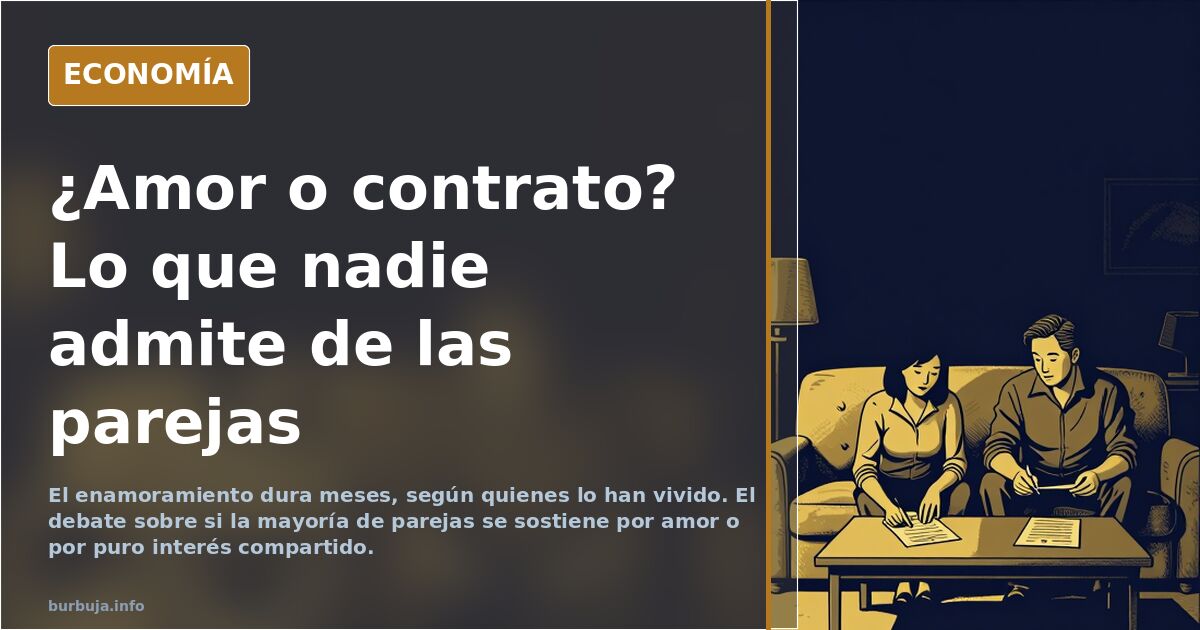
There is a question almost no one dares to ask aloud: Am I in love, or have I simply signed a contract of companionship, sens, and shared expenses? The premise was raised by someone who suspects that most couples form "by mutual agreement or conflicting interests rather than pure love," and that many people have never had "a real love story in their damn life." The collective response, far from greeting-card romanticism, paints an uncomfortable map: infatuation is a chemical state with an expiration date, and what sustains a long-term relationship is something else that almost no one can name.
What is infatuation and how long does it last?
The most repeated description is not poetic, but clinical. Infatuation is defined as a temporary mental illness that causes one to value the partner above what they are, exalting virtues and minimizing flaws. While it lasts, even halitosis seems like an adorable trait. When it heals—and it does—he mundane reality returns, along with arguments and divorces.
The consensus on duration is striking: months, even days. A potent cocktail of neurotransmitters, a temporary blindness seasoned with oxytocin and novelty. Those who constantly chase this high condemn themselves to a carousel of dates that go nowhere. The comparison with drugs appears several times: the first time is amazing, after that nothing has the same effect, and some spend their lives injecting themselves seeking sensations that will never return.
True love: built or found?
Here, disagreement is total. One current holds that couple's love is born after infatuation and is worked on day by day between two people; the crush only puts you at the starting line. The harshest version adds that without this subsequent work, the initial infatuation is worthless, and that strong bonds are truly built with generosity, not calculation.
The other current is more skeptical. It argues that deep infatuation is lived once, at most twice, and afterwards the emotional shield prevents taking it off again. Those who tried it at sixteen and twenty acknowledge that at forty they haven't felt the same thing again, only something similar. The pessimistic conclusion: almost everyone ends up with the second-best option and we are simultaneously the second-best option for someone else.
Love as a contract: interests, not feelings
The thesis of the initial message finds its rawest echo here. A typical relationship is described as an exchange: sens in exchange for money, maintenance, or status. The circulating example is the couple holding hands who actually stay together because one inherited a house and the other has an affective need. Pure interest on both sides, it is argued.
The phrase that caused the most stir was attributed to a mother: true love is not looking into each other's eyes, but looking toward the future in the same direction. A participant confesses that this sentence disturbs him because, read coldly, it describes not love but shared interest. Another voice responds sharply: those who think this way have a childish idea of love, because a relationship needs much more than oxytocin to last five years.
Wear and tear and the memory of first love
The evolution of mood throughout the conversation is visible. It starts with confessions of unrequited adolescent infatuation, passes through the recognition that this puberty love is the deepest, and lands on adult resignation. The pattern repeats: only once, unrequited, and never anything equal afterwards. Some refuse to date someone if they don't feel that spark, even if proposed to try "to see what happens."
Against this, testimonies of long duration. A grandfather who, in his eighties, fixed his vvife's hair when the wind messed it up. A grandmother who lasted four days after her husband's death. The most repeated detail: the elderly man who, about to die, took off his wedding ring, gave it to his vvife, kissed her goodbye, and lay down on the stretcher. These are the same ones who argue that such love only remains when there is no possible comparison with a non-existent past.
The underlying suspicion: is anyone left who loves without calculating?
Pessimism has its own economic logic. If the dating market works like any other, each party optimizes what they offer and receive. Generosity, when it appears, is the exception that confirms the rule. And yet, those who describe love as a contract admit they know cases that do not fit the model.
The discussion ends without resolving the original question. Some believe love exists and one just needs luck to find it; others think it is a cultural construction over a nervous system seeking reward. The only thing nobody disputes is that infatuation, the kind that keeps you awake, doesn't last. What if the problem wasn't that love expires, but that we've confused the high with the contract?
Also available in: Deutsch
Summary of a discussion on Burbuja.info - Foro de economía, actualidad y política., translated from Spanish and reviewed before publication. Read the full discussion (176 replies).
More summaries
-
Spain's University Standards: Scam or Broken System?
Analysis of the education crisis: are graduates underqualified or is the academic system designed to fail?
-
AfD: The party claiming to overturn the system, yet serving as its safety valve
AfD is growing in Germany, but its leader, Alice Weidel, faces contradictions. Genuine dissent or a safety valve? An analysis of the far-right rise and its...
-
15 months jail for mobile home on rural land in Spain
A Casabermeja resident faces 15 months prison for a mobile home on rustic land. Defense claims it was used as a tool shed.
-
Spain's 'adults only' boom spreads to housing: why?
From hotels to rental flats: the adults-only trend is spreading. Business freedom or discrimination against families? An economic analysis of the hostility…
-
UBS report shows the middle class is shrinking worldwide
The UBS report reveals that median wealth is falling in Spain, the US, Germany and the UK while average wealth rises. The Cantillon effect and housing are key to the…
-
The cost of immigration: 250 euros a day that nobody spends on themselves
The figure of 250 euros per immigrant per day circulating in some debates clashes with the reality of average daily spending. A CIS survey reveals a shift in public perception.