
Indexing and guerrilla warfare: the manual that has banks fuming
A value investing firm defends index funds in ten articles written with military metaphors. Fees of 0.05% to 0.30% versus the fund manager's sales pitch.
English · Original discussion in Spanish · Published
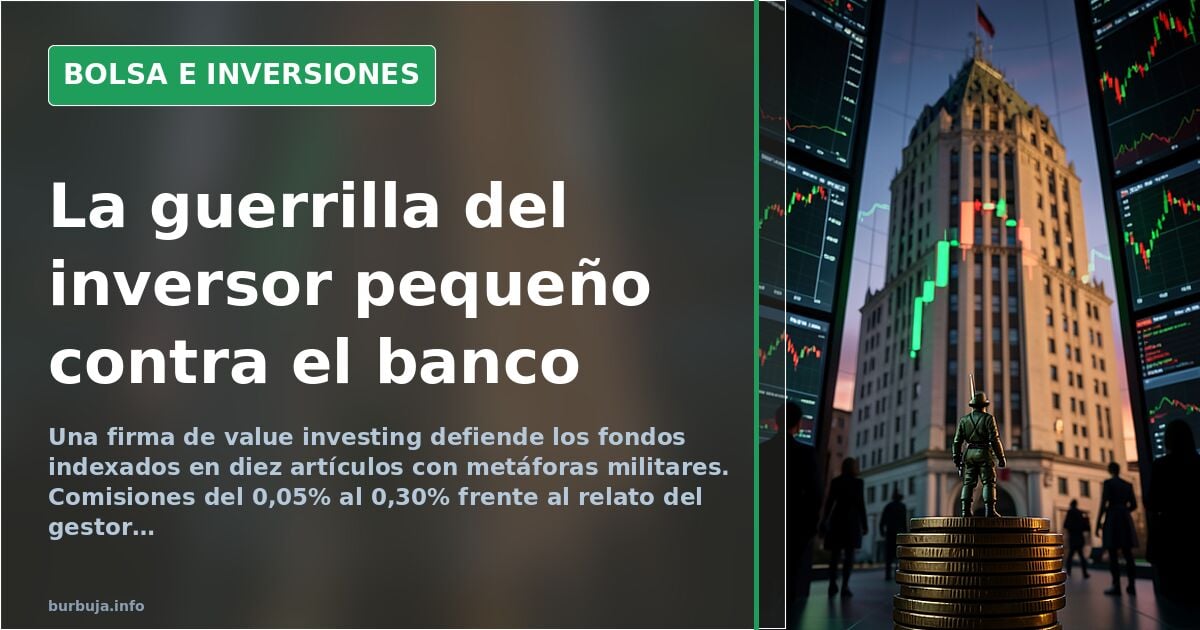
Asymmetric financial warfare: index or die in fees
The small investor cannot win the war against the big funds, but can fight battles. That is the thesis behind a ten-article series by Quiet Investment, a value investing firm that has dubbed its corpus Asymmetric Financial Warfare and which ended up as a book after passing through the filter of Value School. The core idea is not new, but the packaging is: comparing index investing to an AK-47, dollar cost averaging to an RPG-7, and savers' biases to improvised explosive traps.
The finding that sparked the conversation was the author's paradox: an active management firm devoting rivers of ink to defending index funds. Ten installments that read in one sitting, with a tone mixing military strategy, cynicism and a rare ability to explain fees without the reader closing the tab.
The AK-47 of investing: why the index wins the game
The weapons comparison is no accident. The AK-47 is cheap, simple and works in any condition. The index fund, the text argues, is too: fees of between 0.05% and 0.30% a year versus those of active management, which eat into returns before the investor even notices. The conclusion is uncomfortable for the industry: if most managers fail to beat the index consistently, paying them to try is a bad bet.
The nuance comes when you get into the details. Some argue that indexing makes investing boring, and that is precisely why it works: no adrenaline, no intraday trading, no forex on one-minute charts. Boredom as a competitive advantage. You see things.
Dollar cost averaging and other weapons of the saver
The series does not stop at praising the index. The article on Dollar Cost Averaging —buying the same amount whether the market falls or rises— is presented as the weapon that neutralizes the investor's worst enemy: their own instinct. And the chapter on the investor's IEDs, the explosive traps, addresses how to improve index returns without leaving them.
In practice, the examples circulating in the conversation are domestic: regular contributions to Amundi funds on Japan, Asia-Pacific, the eurozone and Europe, with minimums of 1,000 euros and additional contributions from 150 euros. On the US side, ETFs such as VYM, HDV, SCHD, VNQ and JNK, with the warning that the first three are redundant and will probably end up concentrated in one.
The fine print: currencies, withholding taxes and the taxman
Enthusiasm for the index runs into bureaucracy. The conversation drifts toward the taxation of US dividends: a 15% withholding tax that can be recovered when filing, thanks to the double taxation treaty, provided you trade through brokers such as DeGiro or Interactive Brokers. The alternative, actively managed funds with fees below 1%, is defended with specific names and an average of 3.50% over ten years in Spanish equities.
The most acid criticism comes not from the numbers but from the narrative. Part of the conversation dismisses the series as typical Yankee nonsense to convince the individual that they are the master of their own destiny, while the big investors rub their hands. The reply was not long in coming: better that than leaving your savings in a passbook account or trusting Father State to look after retirees.
From blog to book: the trajectory of Quiet Investment
The original website ended up down, with a suspension message that fueled antiestéticars of the worst. The articles migrated to Inbestia and the project culminated in a book presented at Value School's headquarters, with a live broadcast on its channel. By then, the series had already gone from niche curiosity to reference material for a generation of investors who discovered that the enemy was not the market, but the fees.
One question remains open: if indexing is so superior, why does 90% of the money remain in the hands of active managers. The answer, probably, has less to do with returns than with the comfort of having someone to blame when the market falls.
Also available in: Deutsch
Summary of a discussion on Burbuja.info - Foro de economía, actualidad y política., translated from Spanish and reviewed before publication. Read the full discussion (45 replies).
More summaries
-
DeGiro vs Interactive Brokers: the battle over trading costs
A real comparison of fees: Interactive Brokers charges €0.30, DeGiro €2, Santander €20. Is the tax convenience worth it? Concrete data and tools.
-
Interactive Brokers: why Spanish investors are switching brokers
Forum users share their experience with Interactive Brokers: savings on fees compared to other brokers, though portfolio transfers and US trading restrictions…
-
Top Investment Apps for Spanish Investors
Interactive Brokers, DeGiro and Trade Republic lead the choice. With €1,000, fixed fees can erode returns significantly.
-
Auvesta: mixed reviews on gold stored away from home
Auvesta sells gold without physical delivery and with cheap storage, but reviews warn of an extra cost of more than €2,000 on a €7,000 purchase and of the lack…
-
From market timing to all in: dividend investors change tack
A investor tired of holding cash plans to go all in on 5% to 10% dividend stocks, with Enagas at 10%. DCA and market timing warnings dominate the debate.
-
La Caixa's zero-fee account: free unless you use the branch counter
La Caixa launches a fee-free account with direct salary deposit, but any over-the-counter transaction turns it into a Servicuenta with its fees. Free transfers…