
Importing a Chinese car straight from China: is it worth it?
Burbuja.info users debate whether importing an electric car directly from China really pays off once you factor in dealers, EU tariffs and registration hurdles.
English · Original discussion in Spanish · Published
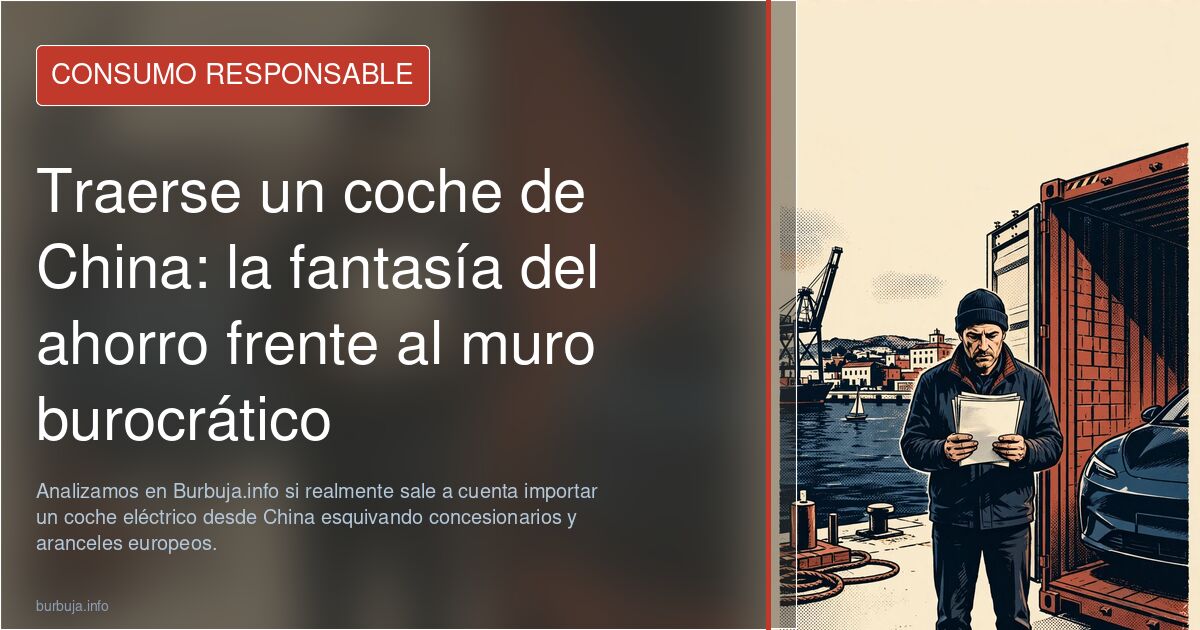
Importing a car from China: the fantasy of savings versus the bureaucratic wall
Can you dodge the markup on electric vehicles by importing a model directly from China? The question, which has sparked debate on the Responsible Consumption subforum, starts from an uncomfortable reality: a BYD Seagull that costs around 10,000 euros in the Asian market shoots up to 20,000 euros in Spain. The average forum user wonders whether the savings justify the risk of a logistical odyssey, or whether the system is simply designed so that the private buyer never wins.
The price mirage and the tariff wall
Most analysts in the thread agree that, on paper, the idea is a chimera. Trying to import a vehicle on your own, the buyer runs into the European Union's "revolutionary tax": standard tariffs, additional anti-subsidy duties and the nightmare of technical type approval. While some users argue that the extra cost is an artificial barrier protecting a European industry unable to compete on price, others warn that the savings evaporate as soon as you add transport costs and the impossibility of registering a car without a European certificate.
The tricks with foreign plates
The debate quickly drifts into rule-bending. Frustrated by local prices, users question the use of foreign plates to dodge Spanish taxation, citing cases of vehicles from other countries driving on our streets far beyond the 183 days allowed for non-residents. Here the forum splits: between those who see an opportunity for fiscal rebellion and those who point out that, in the event of an accident, the bureaucracy of OFESAUTO (the cross-border insurance information body) can turn the savings into financial ruin.
The underlying issue is not just the car, but the decline of European competitiveness against a China that dominates scale and electric technology. Are we looking at a captive market, or a price bubble that will eventually burst when consumers find a legal loophole to buy outside the official dealership?
Related forum debates
- How to strengthen your immune system before and during chemotherapy · 103 replies
- Practical tips for stealing from supermarkets (what gypsies don't want you to know) · 102 replies
- "XD" is back in fashion · 14 replies
- Screw you, you baton-wielding bastard · 78 replies
Also available in: Deutsch
Summary of a discussion on Burbuja.info - Foro de economía, actualidad y política., translated from Spanish and reviewed before publication. Read the full discussion (23 replies).
More summaries
-
Class action in Israel accuses BYD of spying on drivers through connected cars
An $80 million class action against BYD in Israel alleges the Chinese carmaker spies on drivers. Israel's hypocrisy over Pegasus comes up in the debate.
-
robin.jobs: Dutch temp agency with housing that won't answer
A jobseeker sends his ID and driving licence to robin.jobs, a Dutch temp agency with no reviews, no social media activity and poor fraud-checker scores.
-
Tired of an expensive, boring gym? Kayaking is gaining ground
A €45 monthly fee, a 15 km drive and tedious routines: why kayaking is emerging as an affordable alternative to the traditional gym.
-
Losing a kilo a month: a cutting phase that never seems to end
One kilo a month, five to go, and boredom as the main threat: this is what a muscle-cutting phase that seems never-ending feels like.
-
Repairing 50-Euro Glasses: Why DIY Glue Jobs Don't Work
Fixing 50-euro glasses with epoxy and tape looks like a saving, but the hydrophobic coating prevents it. Here's when the quick fix works and when it's money down the drain.
-
Shoulders paying for chest day: the injury nobody sees coming
The bench press can wreck your rotator cuff. Two theories explain the shoulder pain and how to prevent it.