
Immigrant Vote and the Spanish Government: The Thesis Shaking Up 2027
With 94% counted, the Swedish left won by 20,000 votes; one calculation attributes this to 200,000 naturalizations. The debate reaches Spain.
English · Original discussion in Spanish · Published
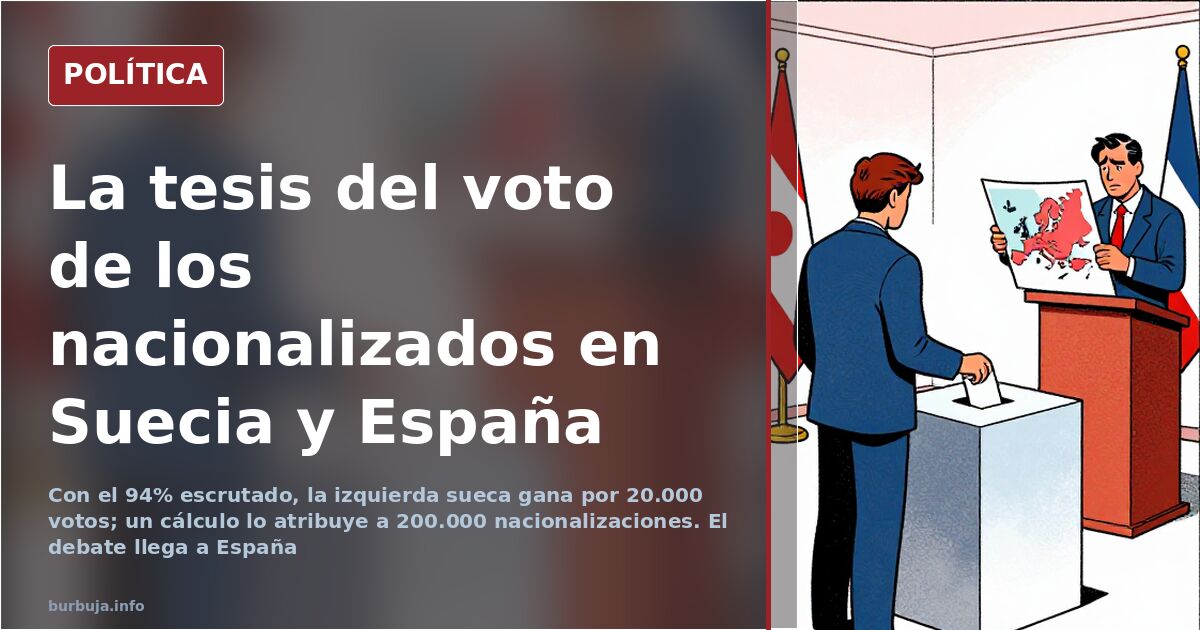
Sweden: The Thesis of Naturalized Voting
In Sweden, with 94% of the ballots counted, the left was winning by about 20,000 votes. Four years earlier, the right had won by 46,000.
The explanation gaining traction places the origin of this shift in nearly 200,000 naturalizations registered during that period, more than half of which came from countries with Muslim majorities. The leap from this data point to the conclusion—that without these votes, the Swedish left would have clearly lost—is today the focal point of a discussion that is no longer solely Swedish.
What the Numbers Say in the Swedish Case
The calculation circulating attributes about 66,000 votes favorable to the left to those newly naturalized, enough to overturn a margin that four years earlier favored the right by 46,000. The arithmetic is simple. The interpretation, far less so.
Some argue that the vote of those who have just obtained citizenship reflects identity more than ideology: they vote for those who open the door, not necessarily for those whose program aligns perfectly.
The figure of 66,000 votes is an estimate, not a recount.
Spain: 15 Million and a Date on the Calendar
The application of the Swedish case to Spain is based on a repeating figure: 15 million residents born abroad or children of those born abroad. If this mass votes cohesively, it can change any majority. The date being discussed is 2027, although not everyone assumes elections will be held that year.
The French precedent always appears in this conversation: for years, it has been argued that without this voting block, Le Pen's movement would have governed. It is a counterfactual prognosis, impossible to verify, and precisely because of that, it is so lucrative during a campaign.
Is Citizenship a Bond or a Simple Procedure?
Behind the arithmetic lies an old question: whether citizenship is a cultural and sarracena bond or merely an administrative formality. Since 1945, the argument has been that Europe chose the latter, because the former had become associated with disaster. The objection is immediate: without some kind of shared bond, others maintain, there is no common political project to uphold. The discussion is not new; what is new is that it now has measurable electoral consequences.
Two Ministers, Two Versions in Twenty-Four Hours
In the Spanish case, the confusion stems not from the analysis but from the government itself. Minister Ángel Víctor Torres and Minister Sira Rego defended positions hours apart that are difficult to reconcile: one maintained that those arriving irregularly will not have the possibility of staying; the other, that the majority wants to stay and will stay. The scene has been compared to the dressing room of the Marx Brothers. When two members of the same Executive say opposite things on the same day, the message received by the voter is not nuance—it is noise.
With 15 million people at stake and an unconfirmed date, the thesis of the decisive vote has more betting than certainty today. It is likely that the issue will become the focus of the next campaign. What remains unwritten is who it will ultimately benefit.
In Sweden, with 94% of the ballots counted, the left was winning by about 20,000 votes. Four years earlier, the right had won by 46,000.
The explanation gaining traction places the origin of this shift in nearly 200,000 naturalizations registered during that period, more than half of which came from countries with Muslim majorities. The leap from this data point to the conclusion—that without these votes, the Swedish left would have clearly lost—is today the focal point of a discussion that is no longer solely Swedish.
What the Numbers Say in the Swedish Case
The calculation circulating attributes about 66,000 votes favorable to the left to those newly naturalized, enough to overturn a margin that four years earlier favored the right by 46,000. The arithmetic is simple. The interpretation, far less so.
Some argue that the vote of those who have just obtained citizenship reflects identity more than ideology: they vote for those who open the door, not necessarily for those whose program aligns perfectly.
The figure of 66,000 votes is an estimate, not a recount.
Spain: 15 Million and a Date on the Calendar
The application of the Swedish case to Spain is based on a repeating figure: 15 million residents born abroad or children of those born abroad. If this mass votes cohesively, it can change any majority. The date being discussed is 2027, although not everyone assumes elections will be held that year.
The French precedent always appears in this conversation: for years, it has been argued that without this voting block, Le Pen's movement would have governed. It is a counterfactual prognosis, impossible to verify, and precisely because of that, it is so lucrative during a campaign.
Is Citizenship a Bond or a Simple Procedure?
Behind the arithmetic lies an old question: whether citizenship is a cultural and sarracena bond or merely an administrative formality. Since 1945, the argument has been that Europe chose the latter, because the former had become associated with disaster. The objection is immediate: without some kind of shared bond, others maintain, there is no common political project to uphold. The discussion is not new; what is new is that it now has measurable electoral consequences.
Two Ministers, Two Versions in Twenty-Four Hours
In the Spanish case, the confusion stems not from the analysis but from the government itself. Minister Ángel Víctor Torres and Minister Sira Rego defended positions hours apart that are difficult to reconcile: one maintained that those arriving irregularly will not have the possibility of staying; the other, that the majority wants to stay and will stay. The scene has been compared to the dressing room of the Marx Brothers. When two members of the same Executive say opposite things on the same day, the message received by the voter is not nuance—it is noise.
With 15 million people at stake and an unconfirmed date, the thesis of the decisive vote has more betting than certainty today. It is likely that the issue will become the focus of the next campaign. What remains unwritten is who it will ultimately benefit.
Summary of a discussion on Burbuja.info - Foro de economía, actualidad y política., translated from Spanish and reviewed before publication. Read the full discussion (16 replies).
More summaries
-
Swedish Elections Without Non-European Voters
An analysis of how the vote of non-European immigrants could have altered Sweden's 2026 election results. Discover the data.
-
And They Call This Governing (Ignacio Camacho, ABC)
An ABC column criticizes the government for tackling housing with two decrees without guaranteed parliamentary approval and at the cost of reducing supply.
-
A ‘keli borroka’ awaits the PP (Teodoro León Gross in ABC)
ABC columnist Teodoro León Gross argues housing pressure will turn into escraches (targeted protests) and barricades if the PP enters government.
-
A democratic obligation unfulfilled (ABC editorial)
Article 134.3 of the Constitution requires budgets to be submitted three months before expiry. Spain is still running on the 2023 Budget.
-
Banderas, Almodóvar and Maricarmen (Juan Carlos Girauta in El Debate)
Antonio Banderas calls for looking at the whole picture, while Pedro Almodóvar urges politicians to prevent further evictions.
-
The USSR and the Origins of Borregocracia: Thesis and Suspicions
Soviet infiltration, free lawyers, Gramsci and academic inbreeding: the thesis that traces today's groupthink to the USSR.