
Iglesias and Echenique Slam Nobel Prize to Corina Machado
Iglesias and Echenique criticize the Nobel Peace Prize awarded to Corina Machado, reopening debate on the award's credibility after Obama.
English · Original discussion in Spanish · Published
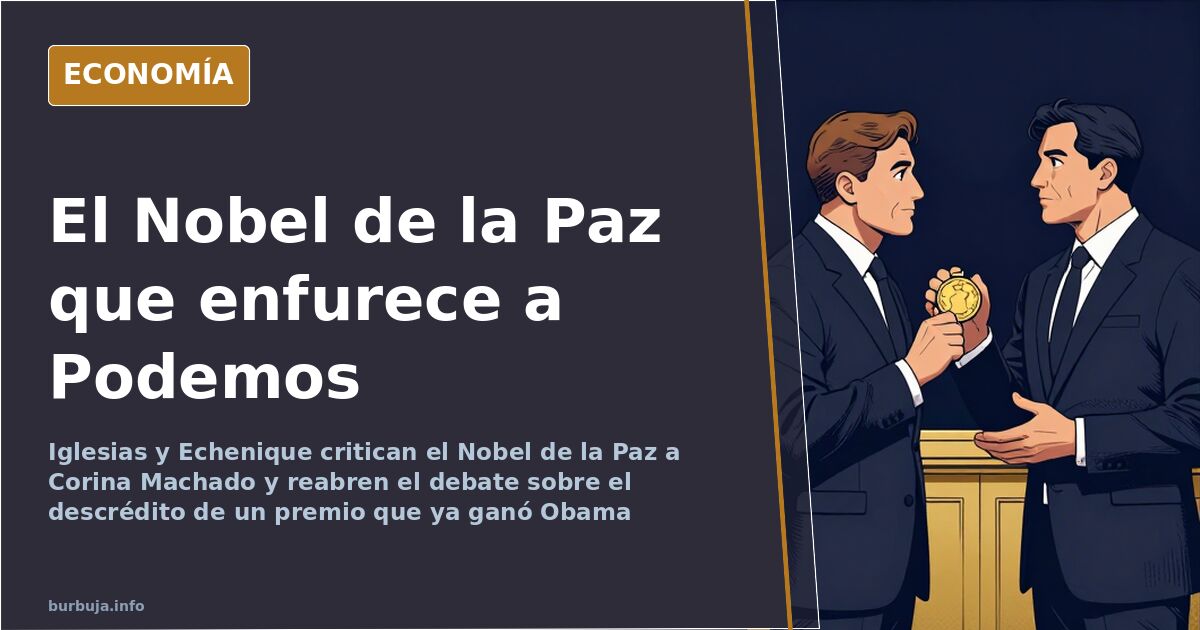
The Nobel That Outrages Pablo Iglesias
Some prizes bring prestige; others borrow it. The Nobel Peace Prize awarded to Venezuelan opposition leader María Corina Machado has served primarily to measure who gets angry. And it has angered, significantly, within the Podemos circle. Pablo Iglesias and Pablo Echenique have attacked the Norwegian committee's decision with two messages that have set the day ablaze. The first, with a self-explanatory comparison. The second, with a slightly more veiled but identical diagnosis: the award, they argue, demolishes the prestige of international institutions.
What Pablo Iglesias Said About the Nobel to Corina Machado
The former government deputy did not mince words. On his social media account, Iglesias stated that if someone who has "spent years trying to stage a coup in his country" is rewarded, the committee could have awarded it directly to Trump or even Adolf Hitler posthumously. The phrase is one written quickly and then cited for years. It includes, moreover, a second turn of the screw: next year, he joked, they could share it with Pilingui and Zelenski.
Echenique trinc with a different tone but the same substance. For the former MP, the prize to Machado demonstrates that the far-right absorbs the symbolic capital of institutions that, in his view, have ceased to be impartial arbiters. He questions not so much the name of the winner as who distributes the prize and who it legitimizes.
The two messages share one idea: the Nobel understood not as recognition, but as geopolitical maneuver. A thesis that, it should be remembered, is exactly what is activated when the winner inconveniences someone.
Why the Nobel Peace Prize Has Been Questioned for Years
Here the argument has long reach. The list of laureates who do not fit the definition of peace is easy to review: Barack Obama, awarded even before taking office and, according to the most repeated narrative, president at war from the first day of his term until the last. Henry Kissinger, with his history. Yaser Arafat, Peres, and Rabin. The most repeated conclusion is simple: if the committee already gave it to these, any subsequent decision matters little.
And there lies the paradox that no one solves. The same gesture used to discredit the prize when received by an adversary was used to discredit it when bestowed on an ally. Discrediting works in both directions, and the side it supports changes depending on who wields it.
Some qualify that the case of Machado is not just one more. Those who defend it point out that a clandestine opposition leader is rewarded after a year and a half under threats from a regime that does not recognize electoral results. Those who attack respond that Machado does not embody peace, but confrontation.
Who is María Corina Machado and What is Criticized About Her
Machado is not a new or comfortable figure. Her critics reproach her support for US economic sanctions on Venezuela — instruments that, they argue, have strangled the country's economy and punished the population — and even attribute to her a call for foreign military intervention, an extreme that is questioned in the thread itself. Her portrait also circulates: a family from the Venezuelan elite settled since the 19th century, heir to economic and political power linked to traditional 20th-century parties.
Her defenders respond with a simple fact: she is in hiding, under threats, for confronting a power that admits no alternation. It is the profile the Norwegian committee has sought for decades and which, once awarded, becomes diplomatic leverage: who dares not to support a Nobel Peace laureate?
Trump, the UN, and the Silence from Moncloa
The decision had immediate echo outside Venezuela. In the UN Security Council, according to a message circulated in the thread, British representatives called the Maduro regime fraudulent in the presence of its ambassador and congratulated the winner. Donald Trump stated that Machado called him to tell him she accepted the award in his honor and added that he has been helping her.
In Spain, the contrast was silence. Neither Moncloa, Sumar, ERC, nor Podemos publicly congratulated Machado, as highlighted in the thread, and from the PP they took the opportunity to commit to raising defense spending to 5% of GDP in the face of Trump's threats to remove Spain from NATO. A day that mixed prize, defense, and foreign policy in the same cocktail.
The feeling that remains is of an award turned into a political thermometer. It serves to measure each one's position regarding Venezuela, regarding Trump, and regarding the very idea of the West.
The Prize as a Political Marker
Seen from here, the discussion says more about who makes it than about who receives it. The same decision allows constructing two opposing narratives: that of the prize whitewashing an inconvenient opposition leader and that of the prize legitimizing the far-right. Both fit in the same headline and feed different audiences.
The underlying doubt remains, one not resolved by a tweet. The question is not whether Machado deserves the Nobel. The doubt is what remains of a prize no longer discussed for what it awards, but for whom it angers. Will it still matter when no one remembers who received it the previous year?
Also available in: Deutsch
Summary of a discussion on Burbuja.info - Foro de economía, actualidad y política., translated from Spanish and reviewed before publication. Read the full discussion (250 replies).
More summaries
-
Pablo Iglesias' Diesel Drive Signals Podemos Decline
A photo of Pablo Iglesias driving a diesel family car highlights contradictions and a bleak electoral future for the Spanish party Podemos.
-
Pablo Iglesias and Vito Quiles Clash Over Microphone in Spain
A video of a scuffle between Pablo Iglesias and Vito Quiles reopens debates on security, migration policy, and Podemos's decline.
-
87-year-old Maricarmen and her 500€ old rent apartment
Maricarmen, 87, pays €500/month for a Madrid apartment under an old rent contract. Police cleared the street during her fourth eviction attempt.
-
Why Spain's anger at the PSOE isn't spilling onto the streets
A vast patronage network and fear of risking what little people have are holding back a social explosion against Spain's PSOE, despite simmering discontent. An analysis of the social climate.
-
Manhunt for 'El Migalo' after fatal shooting of Renfe worker
A Renfe employee dies after being shot and 'El Migalo' remains on the run. The word 'plomazo' (slang for gunshot) sparks a debate over language.
-
Pundit on Spain's Cuatro apologises after wearing Morocco shirt on air
Paco Álvarez has apologised for wearing a pro-Morocco shirt live on Cuatro. Provocation as a business model in Spanish trash TV.