
Ibiza Restaurant Arson: Two Arrested After $5 Meal Demand
Two individuals allegedly set fire to Sa Sal restaurant in Ibiza after being denied a €5 meal, causing €1.1 million in damages.
English · Original discussion in Spanish · Published
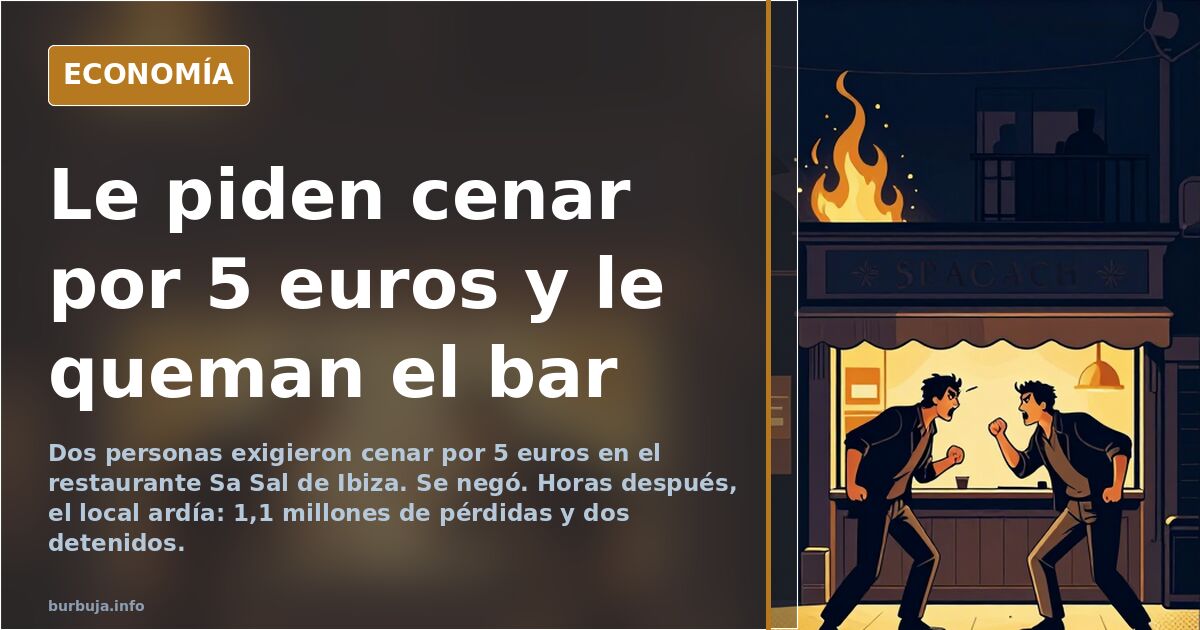
Two Individuals Demanded €5 Dinner in Ibiza and Burned Down Sa Sal Restaurant
In the early hours of June 10, a fire reduced the Sa Sal restaurant in Playa d'en Bossa (Ibiza) to ashes. The owner, 33-year-old Alberto Yagüe, estimates losses at €1,100,000. The Guardia Civil arrested a homeless man and woman who, according to the investigation, had visited the establishment the previous night demanding a €5 menu. They are charged with arson endangering public safety. The case has reignited debate on the real costs of starting a business in Spain and the incivil response to repeat offenders.
What Peine During the Night of June 9-10
Two people arrived at Sa Sal with a €5 bill, demanding a dinner menu. A waitress explained this was not possible. The head chef came out to speak with them and, due to shouting and disturbances to customers, asked them to leave. Four hours later, according to the owner's account, the premises were burning. Security cameras allowed staff to identify the two suspects.
The Guardia Civil maintains that around 1:00 AM, the suspects approached the restaurant and started a small fire that extinguished itself. Half an hour later, they returned and sprayed the facade with flammable liquid. The flames spread rapidly, affecting another restaurant and a hierba club located on the ground floor of a residential building with 193 units. Five people required medical attention for smoke inhalation.
Arrest in Valencia and Provisional Imprisonment
The two suspects left Ibiza on a ferry bound for Valencia and were arrested upon arrival early Monday, June 16. Investigating Court No. 8 of Valencia ordered provisional imprisonment without bail. The Guardia Civil described them as "problematic individuals." The case will be transferred to courts in Ibiza. Alberto Yagüe has already testified against them.
The Real Cost of Entrepreneurship: €1.1 Million and a Team
"We have lost €1,100,000, but this is not just about material things. There is much effort, time, and sacrifice from family and friends," summarizes the owner. The venue had just started the season and, according to his testimony, had an established team. The loss is total: nothing was saved. Yagüe is negotiating with insurers to recover part of the investment and hopes to reopen, although he admits it will be difficult.
The episode has led many readers to quantify an uncomfortable question: Is it worth starting a business in Spain? Some argue that expected profits do not compensate for the time, money, and health sacrificed along the way, and that investing that capital in diversified income streams would allow a family to live without shocks. Others recall that the owner of a beach bar on Ibiza's front line is hardly earning minimum wage. A full breakdown item by item reveals a surprising difference.
Debate on Incivil Response and Recidivism
Some participants believe the Spanish penal system is too lenient with property crime and that recidivism becomes chronic. It is argued that there are insufficient personnel in high-tension areas: in Ibiza, it is said, the Guardia Civil struggles to fill positions because room rent can exceed base salary. Another view suggests the problem is not just resources, but design: a system that promises extensive rights but does not fund them ends up functioning as if it did not exist.
Others introduce the factor of motive. In a business with so much money at stake—and so much cash-in-hand, it is pointed out—an arson committed by two homeless individuals is, at least, suspicious. Hypotheses of retaliation or unfair competition circulate without any proof. The official investigation, for now, does not support this.
Charity as Operational Risk
Several accounts coincide on a prior pattern: the detainees used to approach other local businesses asking for food, medication, or phone charging. Sa Sal employees allowed them to charge their phones more than once and gave water and sugar cubes when one claimed to need glucose. The bitter conclusion drawn by some is that serving certain individuals turns the business into a social canteen and drives away paying customers. Others counter that this logic condemns anyone who asks for help.
The premises remain in ashes, the season is lost, and two people are in provisional detention. What remains unclear is whether this case will change how security is managed in tourist areas or if, as often happens, it will remain an anecdote.
In the early hours of June 10, a fire reduced the Sa Sal restaurant in Playa d'en Bossa (Ibiza) to ashes. The owner, 33-year-old Alberto Yagüe, estimates losses at €1,100,000. The Guardia Civil arrested a homeless man and woman who, according to the investigation, had visited the establishment the previous night demanding a €5 menu. They are charged with arson endangering public safety. The case has reignited debate on the real costs of starting a business in Spain and the incivil response to repeat offenders.
What Peine During the Night of June 9-10
Two people arrived at Sa Sal with a €5 bill, demanding a dinner menu. A waitress explained this was not possible. The head chef came out to speak with them and, due to shouting and disturbances to customers, asked them to leave. Four hours later, according to the owner's account, the premises were burning. Security cameras allowed staff to identify the two suspects.
The Guardia Civil maintains that around 1:00 AM, the suspects approached the restaurant and started a small fire that extinguished itself. Half an hour later, they returned and sprayed the facade with flammable liquid. The flames spread rapidly, affecting another restaurant and a hierba club located on the ground floor of a residential building with 193 units. Five people required medical attention for smoke inhalation.
Arrest in Valencia and Provisional Imprisonment
The two suspects left Ibiza on a ferry bound for Valencia and were arrested upon arrival early Monday, June 16. Investigating Court No. 8 of Valencia ordered provisional imprisonment without bail. The Guardia Civil described them as "problematic individuals." The case will be transferred to courts in Ibiza. Alberto Yagüe has already testified against them.
The Real Cost of Entrepreneurship: €1.1 Million and a Team
"We have lost €1,100,000, but this is not just about material things. There is much effort, time, and sacrifice from family and friends," summarizes the owner. The venue had just started the season and, according to his testimony, had an established team. The loss is total: nothing was saved. Yagüe is negotiating with insurers to recover part of the investment and hopes to reopen, although he admits it will be difficult.
The episode has led many readers to quantify an uncomfortable question: Is it worth starting a business in Spain? Some argue that expected profits do not compensate for the time, money, and health sacrificed along the way, and that investing that capital in diversified income streams would allow a family to live without shocks. Others recall that the owner of a beach bar on Ibiza's front line is hardly earning minimum wage. A full breakdown item by item reveals a surprising difference.
Debate on Incivil Response and Recidivism
Some participants believe the Spanish penal system is too lenient with property crime and that recidivism becomes chronic. It is argued that there are insufficient personnel in high-tension areas: in Ibiza, it is said, the Guardia Civil struggles to fill positions because room rent can exceed base salary. Another view suggests the problem is not just resources, but design: a system that promises extensive rights but does not fund them ends up functioning as if it did not exist.
Others introduce the factor of motive. In a business with so much money at stake—and so much cash-in-hand, it is pointed out—an arson committed by two homeless individuals is, at least, suspicious. Hypotheses of retaliation or unfair competition circulate without any proof. The official investigation, for now, does not support this.
Charity as Operational Risk
Several accounts coincide on a prior pattern: the detainees used to approach other local businesses asking for food, medication, or phone charging. Sa Sal employees allowed them to charge their phones more than once and gave water and sugar cubes when one claimed to need glucose. The bitter conclusion drawn by some is that serving certain individuals turns the business into a social canteen and drives away paying customers. Others counter that this logic condemns anyone who asks for help.
The premises remain in ashes, the season is lost, and two people are in provisional detention. What remains unclear is whether this case will change how security is managed in tourist areas or if, as often happens, it will remain an anecdote.
Summary of a discussion on Burbuja.info - Foro de economía, actualidad y política., translated from Spanish and reviewed before publication. Read the full discussion (192 replies).
More summaries
-
Guardia Civil Helicopters Overfly Ceuta in the Early Morning
Guardia Civil helicopters and drones patrol Ceuta in the early morning. Flight tracking suggests a deployment without an official statement.
-
ECB: Spanish housing market 85% more overvalued than Europe's
ECB warns: Spain's housing overvaluation indicator exceeds 20%, 85% above the Eurozone average. Bubble in sight?
-
Spain 1966 vs 2026: Debunking the R78 Myth
Analysis of a viral comparison claiming Spain was better off in 1966, exposing statistical errors regarding cars, wages, and GDP.
-
Spanish Employers Seek More Immigration: Wage Strategy or Labor Shortage?
Spain's CEOE calls for increased immigration, sparking debate over whether it addresses labor shortages or aims to lower wages through supply pressure.
-
Spain's Civil Service Exams Spark Heated Debate
Forum users clash over whether Spain's civil service exams are an outdated relic or a necessary merit-based system.
-
PSOE survives Aragon election despite Vox surge
Polls predicted a Vox takeover in Spain's Aragon, but PSOE held second place thanks to its extensive clientelist network.