
Ibex hits record highs: 43.3% annual gain that doesn't match the street
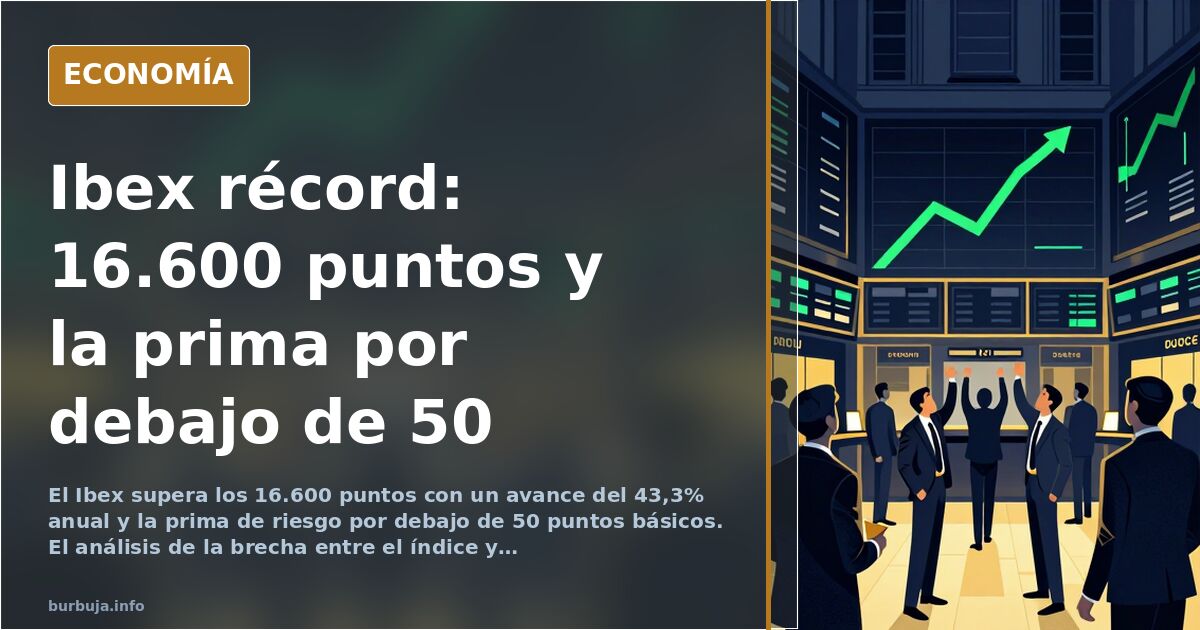
The Ibex tops 16,600 points with a 43.3% annual gain and the risk premium below 50 basis points. The analysis of the gap between the index and…
English · Original discussion in Spanish · Published
Ibex hits record highs: 43.3% annual gain that doesn't match the street
The Ibex 35 tops 16,600 points and posts a 43.3% gain so far this year. Spain's risk premium falls below 50 basis points. In the same period, European industry shuts down for Christmas and classic savings, the deposit, yields nothing. The picture is one of stock market euphoria; the caption, of a real economy that doesn't keep up.
The first thing that stands out is the gap between the index and everyday perception. While the benchmark hits a record, some recall that 70% of Spaniards don't earn more than 40 euros a month above the minimum wage. The stock market rises; wages don't. That distance is the focus of the entire analysis that trinc.
Why does the Ibex rise if the real economy doesn't grow at the same pace?
The most repeated explanation points to liquidity. Since 2008, money has been injected massively and that flow has ended up in stocks, crypto, metals, bonds and real estate. Almost every asset is at all-time highs, not just Spanish ones. Gold, silver, apartments, chicken eggs. Everything. The consequence is that the index stops being a thermometer of the economy and becomes a thermometer of monetary policy.
There is a technical nuance that is often forgotten: the chart discounts dividends. At an average of 5-6% per year, someone who bought in 2007 not only has the same nominal money, but has also been collecting that percentage each year. That changes the reading of the all-time high: it's not that the 2007 level has been recovered, it's that it has been recovered and a yield has been collected for 18 years.
The other leg is banking. The Ibex is 30% banks. And banks live off a simple business: a central bank gives them cheap liquidity, they don't pay interest on savers' deposits and they lend at much higher rates. With high inflation, the margin widens. Unlimited profits for some; for others, savings standing still.
Classic savings no longer yield and push people to invest
Bank deposits stopped paying. That is the tap that has led many people to put their savings into funds and shares through bank apps. Money doesn't understand ideologies, sums up one of the most repeated positions: whoever doesn't take advantage falls behind. The euphoria has its flip side: whoever enters now buys expensive and takes on risk they didn't have before.
The contrast with Europe is striking. Spanish industry unexpectedly shuts down for Christmas and the slump spreads across the continent. The market's reaction is perverse: if industry shuts down, the central bank will have to water it with more bills. It's the investor's conditioned reflex. Bad economic data, good stock market news.
Risk premium below 50 points: a sign of strength?
Spain's risk premium has narrowed to levels not seen before. But some warn that the comparison is misleading: the 10-year German bond has gone from 0.6% to almost 2.7%. If measured against the Swiss bond, Spain's risk premium would be around 280 basis points. The German reference is no longer what it was because its economy is plummeting.
Add to that public debt. Spain officially accumulates 1.7 trillion euros of debt, a figure that some consider cooked downward and that, in its crudest reading, would exceed 2 trillion. The end of ECB and European fund purchases is the scenario nobody wants to look at. When the free bar ends, the correction could be epic.
The ghost of 2007 and the question nobody answers
The Ibex reached its previous high in late 2007. After that, we all know what peine. Official cumulative inflation since then is 42%, so in real terms the index has not yet matched that peak. That calculation is signed by one of the most cited interventions: without discounting inflation, the record is nominal, not real.
The discussion drifts toward debt and paper money. The entire planet is flooded with little colored papers that tomorrow may be worth nothing. That's why everything rises at once. The question is who pays the broken dishes when the party ends. In 2007, the big holders didn't pay. The majority bet is that this time they won't either.
The analysis closes exactly where it started: on the gap between the index and life. The stock market is disconnected from the real economy. Those inside celebrate; those outside watch with suspicion. And in between, a disconcerting fact: industry shuts down, the ECB prints and the benchmark rises. Nobody knows how long the trick lasts.
The Ibex 35 tops 16,600 points and posts a 43.3% gain so far this year. Spain's risk premium falls below 50 basis points. In the same period, European industry shuts down for Christmas and classic savings, the deposit, yields nothing. The picture is one of stock market euphoria; the caption, of a real economy that doesn't keep up.
The first thing that stands out is the gap between the index and everyday perception. While the benchmark hits a record, some recall that 70% of Spaniards don't earn more than 40 euros a month above the minimum wage. The stock market rises; wages don't. That distance is the focus of the entire analysis that trinc.
Why does the Ibex rise if the real economy doesn't grow at the same pace?
The most repeated explanation points to liquidity. Since 2008, money has been injected massively and that flow has ended up in stocks, crypto, metals, bonds and real estate. Almost every asset is at all-time highs, not just Spanish ones. Gold, silver, apartments, chicken eggs. Everything. The consequence is that the index stops being a thermometer of the economy and becomes a thermometer of monetary policy.
There is a technical nuance that is often forgotten: the chart discounts dividends. At an average of 5-6% per year, someone who bought in 2007 not only has the same nominal money, but has also been collecting that percentage each year. That changes the reading of the all-time high: it's not that the 2007 level has been recovered, it's that it has been recovered and a yield has been collected for 18 years.
The other leg is banking. The Ibex is 30% banks. And banks live off a simple business: a central bank gives them cheap liquidity, they don't pay interest on savers' deposits and they lend at much higher rates. With high inflation, the margin widens. Unlimited profits for some; for others, savings standing still.
Classic savings no longer yield and push people to invest
Bank deposits stopped paying. That is the tap that has led many people to put their savings into funds and shares through bank apps. Money doesn't understand ideologies, sums up one of the most repeated positions: whoever doesn't take advantage falls behind. The euphoria has its flip side: whoever enters now buys expensive and takes on risk they didn't have before.
The contrast with Europe is striking. Spanish industry unexpectedly shuts down for Christmas and the slump spreads across the continent. The market's reaction is perverse: if industry shuts down, the central bank will have to water it with more bills. It's the investor's conditioned reflex. Bad economic data, good stock market news.
Risk premium below 50 points: a sign of strength?
Spain's risk premium has narrowed to levels not seen before. But some warn that the comparison is misleading: the 10-year German bond has gone from 0.6% to almost 2.7%. If measured against the Swiss bond, Spain's risk premium would be around 280 basis points. The German reference is no longer what it was because its economy is plummeting.
Add to that public debt. Spain officially accumulates 1.7 trillion euros of debt, a figure that some consider cooked downward and that, in its crudest reading, would exceed 2 trillion. The end of ECB and European fund purchases is the scenario nobody wants to look at. When the free bar ends, the correction could be epic.
The ghost of 2007 and the question nobody answers
The Ibex reached its previous high in late 2007. After that, we all know what peine. Official cumulative inflation since then is 42%, so in real terms the index has not yet matched that peak. That calculation is signed by one of the most cited interventions: without discounting inflation, the record is nominal, not real.
The discussion drifts toward debt and paper money. The entire planet is flooded with little colored papers that tomorrow may be worth nothing. That's why everything rises at once. The question is who pays the broken dishes when the party ends. In 2007, the big holders didn't pay. The majority bet is that this time they won't either.
The analysis closes exactly where it started: on the gap between the index and life. The stock market is disconnected from the real economy. Those inside celebrate; those outside watch with suspicion. And in between, a disconcerting fact: industry shuts down, the ECB prints and the benchmark rises. Nobody knows how long the trick lasts.
Summary of a discussion on Burbuja.info - Foro de economía, actualidad y política., translated from Spanish and reviewed before publication. Read the full discussion (143 replies).
More summaries
-
European Risk Premium: German Bund Hits Record High Yields
German Bund yields near 9% and European bonds at 6%+ highlight attacks on European sovereign debt amid high inflation.
-
Ignacio Lázaro: 'Maricarmen paid €154 rent while we paid €750'
Ignacio Lázaro, grandson of the original owner, reveals the other side of the Maricarmen case: 'We subsidized her for years and now, with our taxes.'
-
Madrid cinema defies decline with dozens of weekly screenings for 'La Bola Negra'
Over 3,000 tickets sold in pre-sale for 'La Bola Negra' in Madrid. The film challenges predictions of cinema's decline.
-
Spain's Economy: Forum Warns of Imminent Collapse
Analysis of Burbuja.info threads on Spain's economic stability amid debt and inflation pressures.
-
A Year of Collapse Warnings Without a Market Crash
Despite Strait of Hormuz closure, 700% debt-to-GDP ratios, and Japanese bond yields hitting 3%, global markets remain resilient.
-
Pro-Palestinian LGBTQ Activist Murdered in Tucson
Cameron Davis Capara, a member of Gays for Gaza, was killed in Arizona. Police are investigating whether the attack was a hate crime.